Busted!

I caught the bus today, and I got busted by the bus driver!

I’m not used to getting into trouble; in fact it’s a little odd just how rare it is for me to earn anyone’s displeasure. My crime was to hail the bus between stops; something which I now appreciate is verboten, but which in my innocence I had actually thought was quite, well … innocent! Apparently not.

The encounter made me think. It was a taste of life on the other side. As I say, I hardly ever hear a cross word from anyone (… anyone other than the six women in my immediate family, obviously). In part this is because I am male: I’m fairly convinced that the women of our world reserve their choicest invective for one another. Blokes don’t do that! And I suspect I am also protected from people’s worst manners simply by a quirk of height. At 6′ 7″ I seem to command a wholly unearned esteem from the general populace.

Had I been able bodied and upstanding, I doubt very much that I would have been busted by the bus driver. But seated in my wheel chair in the wrong spot I was evidently putting him out, and so he put me down. I realised again how substantial the divisions in our world are; but this time I was not merely a spectator to injustice: I was the victim – minor though this episode surely was.

The world pays respect to ability; we call it ‘respectability’. Our great athletes, our gifted musicians, our most eloquent speakers: all of them earn our respect and are rewarded for their skill. Movie stars and rock gods are fawned on by adoring multitudes. It’s natural enough, and to honor achievement is a grand thing. The problem is that we occasionally do the opposite, and disrespect disability.

There was, however, a darker dimension to my bus driver’s displeasure. He also treated me as just another passenger on his bus! Public busses are a new world to me, they are a window on a different way of life; and, dare I say it, on a different strata of life as well. The bus crowd is … unusual. Most folks on the bus are there because they don’t own a car. There are lots of single mums: young and harried, worn-out toddlers in hand, struggling with battered and overloaded prams. There are school leavers (I wonder why they left?) with angular haircuts and glazed, impersonal eyes. There are young men with piercings that make you wince, and girls with tattoos of things that shouldn’t exist. There are plenty of odd bods – like me – subsisting on one sort of pension or another. And the bus driver (can you believe this?) had the hide to lump me in with all of them! Imagine! He addressed me the same way he spoke to the rest of his truck load of captive humankind. Bemused, I watched him practice his technique on others who unwittingly earned his ire.

If it’s natural to respect ability, could it be unnatural to respect disability? The despots of history have certainly thought that way. Sometimes when hope flees in the dark of night I’m tempted to believe that ‘survival of the fittest’ really is the ultimate truth; that the race is always to the swift. “On the contrary, those parts of the body that seem to be weaker are indispensable, and the parts that we think are less honorable we treat with special honor (1 Corinthians 12:22-23). Thankfully our corner of the world is remarkable in the way it respects those less-able. The very fact that B3 and I can get on every bus in our city amazes me. The huge team of dedicated, inspiring people who share with us in the care of our nine year old daughter is testimony to the fact that men and women are capable of great distinction.

Maybe my bus driver friend was just having a bad day? I’ve painted him in a bad light, I know. And as much as I would like to protest, I can’t: because I am far from innocent. You have already seen my hypocrisy: for some reason I don’t feel I should be on the bus! I tell myself I don’t belong on board. In my mind’s eye I am as superior toward my bus peers as the bus driver was toward me, and my attitude betrays my pride.

I didn’t choose to be on the bus any more than my travelling companions did. But there we all are, none the less! Life is a strange and unpredictable journey that requires much patience and grace. A Man well acquainted with its ups and downs said simply, “Love one another”.

 
Rejoice!

_____________________________________________

A post script…

A good friend passed away suddenly this week. We were once neighbours, farming a couple of miles apart when our children were young, and through the years I have been privileged to share in many of their joys and some of their trials. I was touched deeply to learn that in recent months she had often read this page, and that somehow my thoughts had moved hers. What a profound privilege it is to share life, and to share life’s truths with one another.
Me Me, I Mine, My My

Six months and 28 blogs on, and I’m beginning to fret when it comes to penning my weekly monologue.   I feel like the Old Testament prophet Jonah, who managed to cram 18 repetitions of the personal pronoun and its derivatives into a mere 5 verses*. (That’s a strike rate of better than one me-me, I-mine or my-my in every 7 words!)  And this just moments before Jonah was famously swallowed by the whale. A pretty sure way to shut the whinger up; and very likely the point of that illustrative story.  

Here’s an example:  Last week I made a stellar discovery: something that has changed the topography of my world.  Having made a trip to town with B3, I was weighing up the alternatives of charging home again the same way, or ringing for a wheel chair taxi. Glancing up from my inspection of B3’s battery meter, which is at the core of this decision, I happened to see a public bus pull into the kerb a short distance away. As they stop, these modern buses exhale deeply and with a sigh the whole front of the bus lowers itself towards the kerb for the convenience of its passengers.  I rolled across for a closer inspection, and the driver happily demonstrated the ramp that hinges neatly up out of the floor and onto the curb.  So began a terrific new chapter in the annals of my mobility!  It’s brilliant!  It’s a sheer delight to be at large once more after weeks of relative confinement.  Every trip has strategic appeal:  there are timetables to consider, routes to peruse and alternatives to weigh.  Bussing has all the tactical challenge of sailing days in our youth, racing Manly Juniors on the hectic waters of Sydney Harbour – except that power doesn’t seem obliged to give way to battery.  I can get to our church office on a Tuesday for a tenth of the cost of the wheelchair taxi. I can go just about anywhere I want and into every shopping centre or leafy park in the city.  I feel like a teenager learning to drive (and don’t I sound like one?) And I feel convicted of that same legendary, narrow, adolescent self-absorption.  My life has the feel of a cyclone, a storm spinning madly inwards, forcing me into an eye (or an I!) of idle egocentricity.

This is the nub:  the further down the path of incapacity one travels, the more pre-occupied with self one becomes.  It is unremitting and cruel.  For example, my daily routine now consumes much of the capacity I once endeavoured to offer others.  A shower is an hour long campaign, carefully executed in successive stages of plan, attack and recover. I hate the domestic drama that is unfolding before my eyes:  as I take longer and longer to attend to my own requirements and contribute steadily less to my household, my Favourite Wife has to pick up ever more of the responsibility.  She has gone back to work to earn our living, she does all the driving, all the shopping, all the cooking, and virtually all of everything else.  Fortunately for us she happens to be extraordinary!  We have a gorgeous nine year old daughter with Down syndrome who has always happily consumed every scrap of available energy and attention from both her parents; but more and more often I simply watch the taxing dramas play out. The storm is so unfair, so distorting, and so relentless.

If infirmity were not introverted enough; blogging my experience seems just to accentuate the dilemma.  If I type one more me-meI-mine or my-my; I feel like I might implode! Or should I look for a whale?  If I keep writing, and I think I will, I hope that it will never become a cripple’s rant against an able bodied world.  I write because of the clarity it brings to my view; I write because of the urgent need to be honest with myself and with the world; and because it’s so darned hard to talk about it all.  I write because I thrive on the connection it brings with people near and far.  I also dare to hope that the stories we tell will build each other’s lives.

When I read a book I nod off during long diatribes and theories, but I am galvanised by a personal account. Let someone speak of their own struggle or triumph in life and I’m all ears. I can’t get enough of that!  And so I will hold my breath and blog away. Honesty, after all, sets us free: even from ourselves.

Rejoice!

*Jonah 2:2-6

Snow Flake

At 3.00am, at 4.30, 6.00, and then 7.00 we peaked through the blinds in our ‘studio chalet’ (which sounds just a little oxymoronic: isn’t it one or the other?) hoping against hope to see snow!

Would our third alpine escape prove as disappointingly snow-flake-free as the previous two?  The emotions involved in this simple state of affairs were, for me, cataclysmic. Surely a mature man and his Favourite Wife would have learned to adopt a philosophical stance towards life’s ups and downs after our many years of turbulent family life?  Not by a long shot!

It’s something that I have noticed happening lately: I agonize over all the wrong things.  I obsess over trivial details and invest myself in insignificance as though life itself were in the balance.  Sometimes I feel like a flake!  I needed to purchase a head band torch for the Gibson Desert trip I have just completed. I went to shop after shop, day after day, endlessly lugging Bugger in and out of the car boot and then waking up during the night: completely unable to make a decision!  A fortnight ago we spent a blissful weekend celebrating the engagement of one of our daughters. It was truly a glorious time, culminating with a seaside picnic where our nine year old girl characteristically absconded from her post in a perfect family photo. It was a very normal thing for her to do; and typical of the stubborn independence that we have come to associate with Down syndrome.  Yet this one moment of disappointment – a simple photo with a child missing – threatened my equilibrium for days!

A life-crisis magnifies the unimportant.  Normal proportion goes out the window to be replaced with an imposed sense of urgency, probably false, that says “now or never!”  An absurd drive for continued real-time perfection exaggerates every loss and tarnishes every pleasure.

I once read the moving account of a holocaust survivor who spoke of her parents being unable to protect her from serious harm during her childhood.  Having witnessed unimaginable evil they could no longer perceive ordinary danger.  Although it might seem trivial by comparison, I sometimes feel that my thoughts are so often occupied with ultimate issues that I don’t know any longer how to handle immediate ones.

So, we kept vigil in our chalet, but we were to be disappointed once more!  The snow was a no-show beyond the pane of our window; with much consequent pain in our hearts.

Driving home we detoured through Thredbo and noticed a ski lift running up the mountainside. Karen went to investigate, which was unexpected as her choice of seating leans decisively toward something soft and cosy near the fire, certainly not a chair lift, and she abhors heights.  She soon returned with a firm declaration, “No, no and no! It’s raining, it’s scary, it’s extremely cold and you won’t be able to move quick enough to get on the seat and what would happen with Bugger (the wheel chair) and what will you do at the top without it anyway? Definitely No!”  All of which sounded pretty exciting to me! 

Once more my flaky emotions saw an opportunity to flurry.  But we might never come here again. Next time we find a mountain I might not be well enough. We haven’t seen any snow. Now or never!

But just a few miles further on my wife spun the car around. It’s not for nothing I call her Favourite!  We headed back, hired the clothing, bought the tickets!

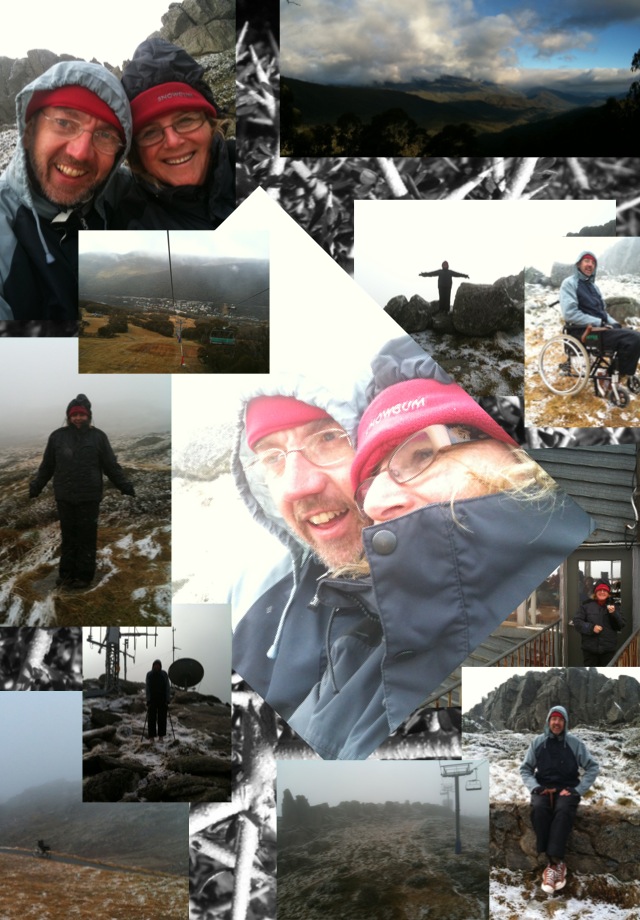
It was brilliant, dazzling!  And terrifying for one of us.  Towards the top of the 600 metre cable lift (with Bugger securely stowed on the seat beside us) the temperature dropped even lower, the wind blew and snow began to whip around our faces!  On the summit we drank hot tea in the highest restaurant in the country; and learned that we had arrived for the very first snow fall of the season!  Then we ventured out into the white. Rather hard to find words to describe the fun and exhilaration of our day in the snow.

Reason returned, balance was regained and our cares vanished for that day. I’d like to think that we learned, once more, that life is held in bigger hands than our own. I’m a little worried that I might soon embrace another flaky cause; but even if I do, I know beyond doubt that I won’t do it alone.

Rejoice!

Snow Flakes

Not by Sight

Holidaying for a couple of nights in the Snowy Mountains my Favourite Wife and I are surrounded by trees, wonderful Australian trees, whose leaves hang down. And on our third alpine pilgrimage for the year we are hoping, once again, that it will snow!

Downward-hanging leaves are superb. I relish the sight of towering snow gums with their striking, variegated trunks and verdant leaves – all hanging down. To me it’s deeply satisfying, but to the English colonists this was deeply unsettling; so alienating, in fact, that their earliest artists sometimes painted gum leaves growing upwards from stem and branch. I wonder if it was merely artistic licence; or was it, perhaps, a subconscious reaction to a strange and fearful world? Did they actually see our leaves at all? Sight can be a most unreliable sense! The world we see, or think we see, is not always the true world at all.

A week has now passed since the neurology appointment that indicated some form of motor neurone disease. (How I hate typing that phrase. I still find it difficult to get my fingers, my mouth, or my head around it). It’s exactly a year since exactly the same thing happened in exactly the same doctor’s rooms; and yet in spite of the months of uncertaincy life is richer than ever. I don’t think I am naive about the future, and I can see all too clearly the physical evidence of my predicament. For example B3 (our second power wheelchair and the third incarnation of good old Bugger) was delivered this week, and she’s surely something to feast your eyes on! But it is not what my eyes see that demands my attention; at least not those eyes. With some other ‘inner eye’ I have seen a clarity of being that I find irresistable.

Perhaps we see this world ‘through a glass dimly’ at best; and yet I have a sense that the glass is clearing a little. With so much that ought to anchor me in the visible world, I often glimpse something new beyond the bounds of normal sight: the sheer delight and pristine calmness of simple existence.

I remember another episode that also included a doctor and a diagnosis. Several years ago I went to a GP for some reason or other, and happened to mention that I had a painful knuckle. The doctor gave my right hand the briefest, cursory glance without even turning round in his chair and immediately pronounced it to be arthritis. I was incensed! At barely 40 how could I possibly have arthritis? I protested volubly, but the doctor said he could prove it was arthritis by a simple test: he would squeeze the knuckle in a certain way, and it would hurt like hell. Which he did, and which it also did. He was an Indian man and a Christian, and in a rather brusque way dismissed my self-pitying protestations. “Tell me, did you think you were going to live forever?” he chided with a stern, sideways shake of his head. Miraculously the ‘arthritis’ lasted just a year or two, but in the trifling annoyance I briefly tasted my own mortality and even saw the distant possibility of resurrection! Perhaps that sounds silly, but truly there was a strange joy in that mild pain.

There is, however, one time of day when blindness can obscure the path. The night watch is by far the hardest and ’round 3am I sometimes lose my way. My inner eyes that in the light of day see past the substance of things, in darkness focus instead on the insubstantial terrors of so-called reality.

For three weeks we have been looking at the alpine weather forecast every day, and right now (at 3am!) it still promises snow for tomorrow. We are holding our breath, barely able to contain our excitement about the future. Will it snow in the morning?

Rejoice!

Back from the Brink

The real D-Day, when it finally arrived, took me completely by surprise. With the spectre of inorganic causes still haunting me as it has for the past twenty days since leaving Melbourne hospital, I attended a six monthly Neurology appointment wondering how the local specialist would respond. I hadn’t considered that this might actually be Diagnosis-Day. Well, it was……..sort of.

Inorganic Causes. It’s a beguilingly simple phrase, and yet these innocuous words have felt like an aimed rifle, forcing me repeatedly down dark corridors in my imagination; attempting to explore the remote possibility that I might somehow be deeply, pathologically insane! Could I possibly hate myself (an insane though in itself as I’m actually reasonably fond of me) to the degree that I am destroying myself from the inside out? Could my familiar struggles with my own self-worth (and who doesn’t have those?) have delivered me to a place of giving up on life? Could this be some mad subconscious avoidance on a monstrous scale? I doubt it, I seriously doubt all of it. But every doubt creates its own tension. The words that others speak can have extraordinary power.

I once thumbed a ride from Alice Springs out to Ayers Rock; back in the days when hitch-hiking was still safeish. When my first lift turned off the Stuart Highway a long way from anywhere I discovered that people are understandably reluctant to pick up odd bods in the middle of nowhere. You know that thing that happens when you see someone wandering along miles from Woop Woop, and you automatically accelerate a little? The trip ended up taking two full days, and necessitated a camp in the bush that I was utterly unprepared for. All I had was a tin of baked beans, a pocket knife and a flattened teaspoon that I happened to find lying on the road. It was a cold night, and I had to light a fire to lie beside (so I must have had matches too!). The moment you kindle a flame amongst spinifex and mulga twigs a bright blaze springs up; and in that instant the dark night closes in around you like a draw string bag! There is no way to explain the tricks your mind begins to play. Every noise takes on a preposterous form, and every silence breathes with menacing intent! I was a naïve teen back then; but as a wise old man my mind seems just as susceptible to formless fears.

Having calmed down somewhat over the last fortnight and become fairly sure I wasn’t going mad, I nonetheless needed to run the inorganic causes outcome past every second person in my world. Friends, family, therapists. In a way I am still doing it right now: I have to write about this, I have to tell you also (whoever you are, friend or stranger), to purge myself of these shadowy and elusive demons. My GP was a voice of practicality, as GPs so often are. She had read the Melbourne report and offered a succinct one word response in the practice corridor: Stupid!

Thankfully the Neurologist also immediately dismissed the hospital report, describing it as the age-old medical solution: assuming the inexplicable to be psychological. “The danger”, he went on to say, “is that you then become labelled; you fall into an abyss where every medical practitioner sees the words ‘functional illness’ written large on your file, and no one looks any further”. He assured me that he would not fall into that trap, and neither would I fall over the brink. And he said it was time we settled on a “working diagnoses” of emergent PLS, the rare form of motor neurone disease that other doctors have mentioned from time to time. I left the appointment with a relief that outweighed, for a time at least, the gravity of this uncertain diagnosis.

A final note of assurance came from a source far higher than even my Neurologist. On the following morning I read these words:

“The land you are entering to take over is not like the land of Egypt, from which you have come, where you planted your seed and irrigated it by foot as in a vegetable garden. But the land you are crossing the Jordan to take possession of is a land of mountains and valleys that drinks rain from heaven. It is a land the LORD your God cares for; the eyes of the LORD your God are continually on it from the beginning of the year to its end” (Deuteronomy 11:10-12). The future is not at all like the past, the old tricks won’t work again, and our ability to control our world will not protect us in the new territory for which we are destined. God himself is our light on the path ahead; a path which traverses height and depth; a path watched constantly from above.

Rejoice!

B4 we Climb the Mountain

I have just taken eight days to order B4, and I’m not sure that even marriage is as emotionally complex as choosing a power wheelchair!

I don’t much like buying cars as a rule: like all shopping it’s confusing and highly worrying!  But cars are a simple matter compared to the task I have just completed.  A vehicle is a part of life, we grow up with them and we’ve spent ridiculous amounts of time in them.  If you’re a bloke you’ve probably also discussed their relative merits in endless, boring detail.  In complete contrast power wheel chairs are almost as much of a mystery to me now as the female of our species once was.   And like women they come in many, many shapes and sizes with a dizzying array of accessories; and they are, of course, fabulously expensive.

In the middle of all this my Favourite Wife and I have been away for a couple of nights at our mountain retreat.  Hoping once again that it would snow (it didn’t!), I packed a recently purchased book describing the first Australian ascent of Mount Everest. Falls Creek is hardly the Himalayas, but we love living so close to the ski resort with its exotic atmosphere and backdrop of alpine wilderness.  Packing for two days in a five star hotel isn’t quite like preparing to climb Everest either; but as I read this enthralling book on our balcony in the 3° air I realised that I have begun the same phase of intricate preparation that a mountaineer completes long before the climb.

(The secret, by the way, to reading a book outdoors in 3° air is to keep only your eyes, fingers and the book itself above water in your hot tub).

I recognise a shift in the way I am facing the future.  Perhaps I have turned a corner.  Just as it has been months since the medical community last mentioned the likelihood of treatment; so my own thoughts rarely centre on some form of reprieve.  That seems largely irrelevant. Instead I am galvanised by the task at hand, and I am applying myself to this season of life just as I have to every other. 

Climbers prepare for months, and then travel for weeks through foreign and sometimes hostile terrain to reach ‘Base Camp’; only then does the ascent actually commence. On the same day that I was packing for Falls Creek I also found myself researching the options of high tech infra-red and blue-tooth functions that can be built into B4’s controls.  I also conversed with a Melbourne based speech therapist about various approaches to ‘augmentative and alternative communication’, and I exchanged emails with an American university who are beta testing software that makes complex voice recordings for future use.  Would-be Everest summiteers find themselves becoming public property as the media zero in on the drama of a true life and death contest.  B2 and I simply headed down town to be examined by another medical student keen to explore the mystery.

In his book, White Limbo, Lincoln Hall eloquently describes the way climbing claimed his life, asking more of him than any other pursuit.  “My existence was irrevocably bound with the challenge, the friendships and the lack of confusion which makes mountaineering separate from the illusions and pretensions of everyday living”.  His words bring a smile of recognition to my face.  I have often felt drawn to the things which demand most of me; and this season is no exception.  There is a purity to extreme challenge: a life and death struggle certainly does cut through the ‘illusions and pretensions’ that are so much the fabric of normal life.   

I absolutely have to test myself against the mountain I face; and in a paradoxical way surrender to the adventure before conquering it.  There is exhilaration in the privilege of living that extends into life’s darkest hours and steepest challenges. Unlike mountaineering my climb is no invented game of risk. This is survival, not in an elected pursuit, but in life itself.  

There is just one discordant note: I am unsettled by the reward I find in the challenge. Exhilaration is a guilty pleasure: it seems so inappropriate! But more on that topic another time…

Rejoice!

Ignorance, the Mother of Adventure

The plan to drive B2 a couple of kilometres to the Doctor’s practice was sound and succesful. So successful in fact that I couldn’t resist propelling a little further east, just to see what lay over the horizon of the next intersection. And the next, and the following, and the one after that.

So, if I hadn’t decided to continue all the way across town to the shopping centre, I might not have flattened B2’s batteries. And then I might not have had to timidly ask if I might use a power point in a Café.

And if I hadn’t stayed for a second cup of tea in the Café, waiting for the batteries to charge, I might not have been running so late heading home. And if I hadn’t been delayed I probably wouldn’t have made the regrettable mistake of balancing my iPhone on my lap while I drove B2, just in case my Favourite Wife rang to find out why it was that the sun was setting and I wasn’t home.

And if I hadn’t had to backtrack so far fruitlessly searching for my lost iPhone I probably wouldn’t have completely flattened B2’s batteries yet again!

And if the man who found my phone hadn’t been so kind, and if he didn’t happen to live just round the corner from my Favourite Wife’s work, she might not have retrieved my lost phone; and then she might not have come looking for me in the car as the chill of dusk crept in.

And if the man who found my phone (whose name I may never know) hadn’t pressed redial on my phone he wouldn’t have ended up speaking to a girl I went to school with, and she wouldn’t have been able to send him a rather neat thankyou-gift from the prime time TV series she produces.

And if Karen hadn’t come looking for me, then she wouldn’t have known that I was about to get stuck in the growing dark with no battery power; and I wouldn’t have been able to send her home to get the brand new, thick, red rope I had in our garage – ready for just such a moment as this. And then I wouldn’t have been able to hang onto the rope and yell directions through the back hatch of our car. Mainly “Slow Down!”

And if I hadn’t of done that, I might still have been out there!

We couldn’t stop laughing when all four of us (me, B2, iPhone, Favourite Wife) finally made it safely indoors. What a huge relief!

Adventure! It’s irresistible; you’ve got to love the ride.

Rejoice!

D-Day

5.50am    “Sorry to wake you…” a doctor’s voice abruptly cuts through what had finally become a reasonable sleep on one of those operating tables that pass for beds in hospital.  The doctor had arrived well before dawn in search of blood from an artery (ouch); blood that evidently had to be asleep for some special reason.

So begins D-Day. A day much like any other for the thousands of commuters already streaming through the arteries of the city below my seventh floor window. It must be a special day for some; like the few I see afar off, drifting in a pair of hot air balloons blinking in the pre-dawn sky as their flames briefly ignite.

But for me this is Diagnosis-Day, certainly the most challenging day in my calendar.  I have faced this day numerous times in the last 18 months in hospital wards and specialist suites.  I wonder if it’s like the experience a convict endures, having to present himself before the magistrate to be sentenced?  Sometimes I feel just such intimidation in the presence of the generous and dedicated people that make up this vast system.  I am much better at this than I used to be. I even slept much of last night – something I could rarely manage on the eve of D-Days past.

11.05am    The hours of the hospital day draw on. Most days are made lively by consultants who poke and probe with the confidence of years, and medical students too timid to touch. But not this one. On D-Day each hour seems to pass a little more slowly and last considerably longer than its parent.

1.50pm    I am fixated on three letters: PLS – the acronym for an extremely rare form of motor neurone disease, slower and less fearsome than others but apparently impossible to detect. Yesterday the Neurologist mentioned this again as an “emergent possibility”. It’s the fourth time I have heard it discussed, and it’s the only possibility that has been named in six months.  I’ve done some more reading today: with a statistical incidence of as few as one case in ten million people, what are the chances that any of the doctors have ever actually seen this strange condition?  And why, oh why, would I prefer a grim diagnosis to none at all?

“I eagerly expect and hope that I will in no way be ashamed, but will have sufficient courage so that now as always Christ will be exalted in my body, whether by life or by death” (Philippians 1).  

3.10pm    Quite suddenly the Registrar is here; and almost as quickly it seems she is gone, leaving me to rephrase questions in my head and concoct alternate outcomes for the nauseatingly familiar conversation we have just concluded.

There is no result. The Neurology team can find “no clinical symptoms for your complaint, except perhaps your reflexes which are somewhat brisk”. What?!  The minor issues of being unable to walk or push my own wheelchair somehow never make it onto this list called “clinical symptoms”.  While in the last two days speech therapists have come and raised such gruesome spectres as assisted communication technologies and tube feeding, the specialists merely say “come back in six months and let’s see if it gets any worse.”

But the king-hit was still coming. The young registrar had one more blow to land. The bit that really screws with my head. “Because there appear to be no organic causes of disease, the doctors are still considering inorganic causes”.  Hence yesterday’s pair of psychiatrists probing for signs of depression or stress that might just be behind it all. The thought crossed my mind that they were travelling together to give each other moral support on such an improbable quest. It felt like a posse.

4.45pm    If there wasn’t stress before, there sure is now!  Yesterday I asked the psychiatrists: is there anything at all about me that strikes you as depressive?  Tell me please, I want to know.  Because I feel further removed from depression than I have been in my entire life. I still can’t comprehend the contradictory observation of one doctor that I am not, in his opinion, sufficiently depressed at losing my mobility. Come on people, make up your minds!

3.40am    D-Day seems now to be rolling over into a new dawn.  The mental pressure of the “inorganic causes” theory feels like it might just push me over the edge into the very mental health issue they are looking for!  “Told you so!” says the posse.

But a new dawn is coming; and with the new dawn will come renewed vision and hope, and the prospect of heading back to my home in the company of a good and kind friend. Thank God for that!

Rejoice!

The Gift of Losing Things

7183AA

I used to think I was so clever, rattling off my driver’s licence number from memory!  It’s hardly a prodigious feat, but it creates an impression: anyone who knows their own licence number must surely know an awful lot more!   At any rate, it hardly matters anymore as I no longer have one.

Driving has enormous appeal for a young bloke.  I guess it’s the independence, the power, the machine.  For me it was raw adventure.  Living in the outback I had no teacher, driving was a frontier to be conquered solo, and I had the luxury of abundant opportunity.  Landcruisers, trucks, diesel, and endless miles of adventure.

I actually paid for a driving lesson once.  I had returned to quiet suburbia, and felt that I could use a little professional guidance with the finer points of driving.  Things like road rules.  Or even just roads themselves, which were something of a novelty!  I can still hear the instructor saying, “Brakes please Mr. Allen”; and I can hear him suggesting I wasn’t quite ready to take my licence test, and did I want to book another lesson?  When I told him I was already on my blacks he turned white!  I never did book that next lesson.  I had done my licence test in the desert; the police patrol officer had given me the examination which oddly consisted of a single question: “So mate, can you drive?”  I passed first go!

Loosing things is a gift.  Not the losing-your-jumper-on-the-bus type of gift (but crikey was I good at that!  My hockey stick and clarinet were affixed to me with wrist-straps by my parents, sick as they were of trekking to the bus depot on Saturday mornings to reclaim lost bits of my life).  No, this is the gift of loosing substantial things.  I think there is a gift, or a grace, which allows us to hold things lightly.  “Using the things of the world, as if not engrossed in them. For this world in its present form is passing away”.

I sat recently with a young aboriginal man, absorbed in the tale of a hunting trip that had ended in disaster: a vehicle break down leaving the young man and his elder companion stranded on a moonless night, far from home.    Hours earlier they had exchanged a well-travelled road for the beckoning allure of fresh animal tracks through sand hills and mulga scrub, and now it was clear that the defunct vehicle would have to be abandoned. The hunters walked on through dark and trackless bush, occasionally rotating the shared burdens of the water bottle, rifle, and bush turkey: the prized fruit of their endeavours.  As they walked they prayed, and as they prayed a soft light shone down on their path, leading them safely home.  It’s a poignant, simple story with a profound lesson: when you must leave something essential behind, God himself will light the path ahead.

I began to discover this ‘gift of loosing things’ during the past year or so when our family came up against some significant challenges.  I lost my job, we lost our house, we lost a car, I lost my mobility.  I was fearful and apprehensive when I first saw each of these possibilities on the horizon.  I remember particularly my hateful dread of wheelchairs when I could dimly make out their shadowy form in the distant future.  But as each of these events came and went, I discovered with surprise and relief that I was at peace.  The changes took place, we were still ourselves and there was always more than enough light on our path.  We were learning something.

Gratitude dispels attachment: it’s much easier to face not running on the beach with my kids when I remember the many, many times I have.  In a similar way the choice I make to look ahead and move on is a strong claim on the ground behind me on which I once stood.

Now and then you sense that a season has turned, and it is time to say a brief farewell and then leave. When that moment comes, so also comes a gift of grace, and the light that shines on the path ahead is miraculous indeed.  Within that moment there may also be tears to shed, or pain to touch: as Queen Elizabeth memorably said after 9-11, “Grief is the price we pay for love”.  Surrender is an ultimate proof of possession.  It is only that which I can freely give that I have ever truly held.

I feel I have made this all sound rather glib and a little too easy.  Well, perhaps that’s because grace is never quite rational.  There is a certain freedom that comes with having less; even with being less.  I don’t say that it’s the only way to live, or the best; but it is how I am living, and in that living I continue to find gratitude, joy, peace, and hope, and life.

Rejoice!

R2-B2

(an open letter to my power-wheelchair…)

Dear B2,

Good old Bugger has been my faithful companion for several weeks now, but I’m heading home! I’m on my way! I can just imagine you poised jealously at the door, desperate to become the centre of attention and take control of my world. Well, that’s not going to happen. I don’t know you very well yet, B2, however my first impressions were unimpressive. You turned up at my place in grand style, needing two people to get you out of a van (so now who has the mobility problem?). And with your blinking lights and whirring motors, your batteries and flash upholstery, I got the distinct feeling you were trying to intimidate me. Well, let me tell you something.

You’re actually mobility aid number 5. You might be the biggest, but you’re by no means the scariest. That prize went off many months ago to a pair of cane walking sticks which, by the way, some said loaned me an air of ‘old world sophistication’. They didn’t even have any moving parts! You see, B2, the knack of real intimidation is taking something reasonably normal, and just putting a little extra spin on it. Just so nobody knows quite what’s going on. Anyone, well almost anyone, can have one walking stick. But who has two? People I’d never seen before, complete strangers, would sometimes stop me in the street and say, “What have you done to yourself?” And I had no answer. I had no answer then – or now – for myself, or my family, let alone Mrs Kafups! Now that, B2, is intimidation.

My friend Bugger and I have learned a few things this last month on the road. We’ve learned that there’s no stopping us, we can go places that few people do! We have learned that most people in the world are good, kind hearted and generous to a fault. We have learned that we often have to trust people we’ve never met before. We’ve also learned that we don’t do red sand well at all. We’ve learned that the modern world isn’t built for minority groups: just see what a mess you can get into when the ATM buttons don’t line up with the screen because you’re three foot down. We have learned that we never have to stand in a queue. We’ve learned that looking up to people is far better than looking down on them. We’ve learned that it is a true gift to see the world as others see it. We have learned that slowing down, even if its forced upon you, is not a bad thing at all.

In contrast, B2, you really need to get out more. Travel is very broadening; I wonder if maybe I need to take you somewhere, show you a bit of the world. You’re a needy machine, B2. I don’t see you doing much at all when I’m not around to help you. And what is it about your breed and the colour red? Is it like you don’t draw enough attention already? I notice you even need a special Taxi for goodness sake! And that pathetic excuse for a horn! Squeak-squeak! Squeak-squeak! No ….. I’ve gone too far now, that was uncalled for.

So if this is going to work at all between us, B2, it’s going to be on my terms. It’s a pretty one sided affair. You would do well to practice expressions like, “Yes master” and, “Will that be all?” before I get home. You’ve got a job to do (and a 9 year old child to entertain); and as long as you follow instructions you can expect to get charged up and sat on. And I might let you come with me sometimes. That’s about it.

Yours etc.
R.