The Breath of Life

Spring 2010 #1

I’m campaigning for a ‘Wall of Fame’ at the Respiratory Clinic; with top billing in recognition of my own truly inspiring lung capacity. Just a few days before last week’s railway excursion into Unknowing, I attended a regular appointment with the Respiratory Physician. Actually, ‘attend’ is too plain a word by far: my quarterly clinic appearance is a tournament event! It’s a contact sport, a competitive opportunity to crack my own P.B. on the spirometry machine. And crack it I did! I’m chasing the Holy Grail of 6 litres lung capacity; and this time I got to 5.85, a significant gain on the last round. It should have been a Glory Day, toasted with Champaign, acclaimed in the sports pages, lauded on local radio. But one small detail of my post-spirometry consultation with the Professor has deeply rattled my equilibrium. In the midst of my triumph I mentioned that I don’t seem to sleep too well any more; and so I’m booked for an overnight ‘sleep study’ in a few weeks. (Though one would have thought the chances of a sound night’s sleep in a hospital bed would be slight in the extreme!) Apparently neurological deterioration in lung function shows up first at night, where the prone breather must battle gravity with each breath. This, it would seem, is what I’ve probably begun to do.

In every breath we take there is a molecule of Oxygen that was exhaled by Napoléon. In that same lungfull of what we euphemistically call ‘fresh air’ there will also almost certainly be molecules that were inhaled by every single person in history that preceded the great Napoléon: Joan of Arc, the whole suite of Caesars, Aristotle, even Christ. I learned this at University, and as I recall it is true because of the volume of the earth’s atmosphere, the theory of probability, and the discoveries of a certain Avogadro*, an Italian Courtier scientist. It’s a rather lovely fact; at one level a curious novelty, at another a resonant reminder of the ephemeral life we share together on this planet. Those who breathed these shared molecules do so no longer; they have had their turn, and ours too shall soon pass by. Perhaps nothing so evocatively captures the essence or the precariousness of life as a single breath. It is, as they say, all that separates us from eternity.

I returned from my Melbourne experience last week with a heavy heart. Usually – and I’ve had ample opportunity to observe this – I recover from recurring bouts of Clinical Non-Diagnosis** after about 48 hours. The sense of bewildered disorientation passes soon enough. But this time, for days on end, I have been unable to laugh much. My best smiles have been vaguely dishonest, and the pressure of tears lurking somewhere behind my eyes has been ever present. It took some direct and helpful questioning from our good GP to draw out the suppressed truth: the Melbourne clinic’s tight-lipped silence wasn’t the issue at all; I just don’t want to run out of breath. With 6 litre lungs and 3 minute breath-holding antics I honestly thought that I had this one in the bag. But it seems not; suddenly I feel like I’m breathing in a bag. Of course, in one way all this is no surprise: there must, after all, be some reason the lung doctor calls me back every 12 weeks. I knew well enough what might lie ahead, but there is a wide gulf between knowledge and experience. When the body tells you plainly what you thought your mind had known, the impact just might take your breath away.

While staying in Melbourne, my wonderful Cousins introduced me to a remarkable piece of music. In Gavin Bryars’ “Jesus Blood Never Failed Me Yet” the feeble, evocative voice of a homeless Londoner sings a few short phrases over, and over, and over; a sound bite that loops continually for more than a full hour. Strings, orchestral harmony, a tolling bell, a choir, a pipe organ and finally a gravelly soloist’s voice all combine with the old man of the streets in a celebration of humanity. The rhythm of the music revolving around and around these simple words is mesmerizingly breath-like, declaring at an all but subconscious level the essence of life, of frailty, of resilience, of faith, and of hope. It’s becoming something of an anthem in our home; and it does us good!

“And the Lord God formed man of the dust of the ground, and breathed into him the breath of life; and man became a living soul”. The wonder is all that a single breath can hold. Oxygen, health, a fragrant memory, a word of love, a gift of affirmation, inspiration, exhaltation, hope, the moment, life itself!

Rejoice!

_______________________________________________

*Lorenzo Romano Amedeo Carlo Bernadette Avogadro di Quaregna e Cerreto !! (1776 – 1856).

** Clinical Non-Diagnosis has now become the primary symptom of my non-condition. A typical attack starts with the sudden onset of a clinic visit, followed by some poking and prodding. Soon enough a little professional brow-furrowing will develop, and ultimately the episode becomes full blown failure to diagnose!

Unknowing

Winter 2010 #13 

And so the doctor said ………

“It’s too soon to know”.

After two years it’s an incongruous turn of phrase.  My reaction is an all too familiar paralysis, giving way over a day or two to a turbulent mix of fear and hope.  Fear that Diagnosis-Day is still to come at some point in the future, and hope … well there is always hope, whatever may lie ahead. 

But I wish, I just wish and wish that a doctor would tell me what’s actually going on, where things are at, and what to expect next.  “Surely”, I say to myself, “surely the words probably or possibly can’t be that hard to get your tongue around?” Couldn’t one of these experts venture an opinion that might be useful in framing the future? A few thoughtful words could go a long way!  I’ve heard the same hesitation from enough professional mouths to realize, finally, that their corporate lack of opinion must be quite reasonable, even though it feels to me so utterly contrary.  Anything instead of this endless silence!    

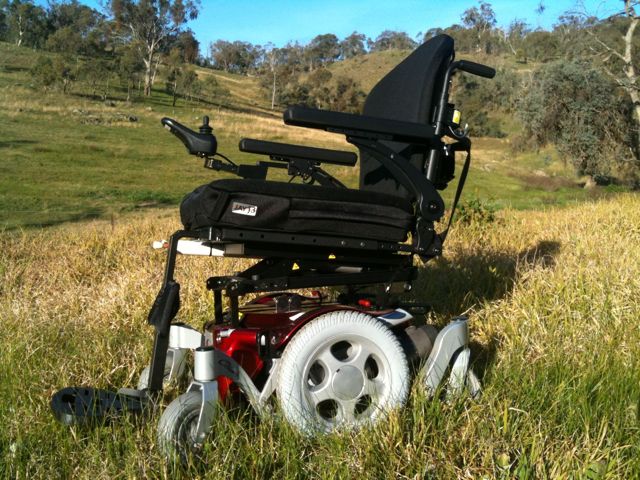
This weekend we held our annual church conference, “Kingdom 2010”, a glorious day of praise, inspirational speaking and great friendship. There’s a challenge, though, in meeting with friends and colleagues in a power wheelchair, wired up with a voice amplifier to boot. These accessories, invaluable as they have come to be, are more than merely embarrassing. They are a deep and unwelcome incursion on the image of myself that I still cherish. During conference it was strange to see my old unencumbered self on the screen in footage from previous conference years: fit and strong and completely free of medical add-ons.  But more intimidating than all the external paraphernalia is the internal burden of ‘unknowing’; a sense akin to foolishness that sends me groping for an explanation when people ask, “How are you?” or worse still, “Any answers yet?”  Christians above all people should be good at mystery; we should be well versed in dealing with the unknown. We believe, after all, in the resurrection of Christ, the Trinity, the heavenly host of Angels and a host of other mysteries besides.  But when we proclaim, “faith is the substance of things hoped for”, our natural inclination is towards substance over hope.  We want to touch, hear, taste and see.  I suspect many of us regard faith merely as the catalyst that transforms hope into substance.  I, for one, crave the solid reassurance of knowledge.   The dark silence of unknowing is unnatural.

Most days of the week I exchange an email with a good friend whose circumstances are somewhat more challenging than mine. A few years back Grant suffered a cerebral aneurism, an unexpected and severe blow, and I had the privilege of visiting him as an able-bodied hospital chaplain.  Just a few months ago we met again, this time sitting in opposing wheelchairs across his dining room table. How things change!  Grant’s condition has often teetered on the precipice of steepest decline; more than anyone I know he lives on the brink of eternity.  He is well qualified to remind me of “the rich dependence of unknowing” as he did in our correspondence yesterday.  There is such wisdom in those words, and in my friend I see something I deeply admire.

Well, I’ve had my rant; I’ve once again vented my anxiety and to some extent dealt with the grief that presses behind my eyes.  Unknowing is my lot for now; and it is my gift, a gift from above.  Indeed, “The secret things belong to the Lord our God” (Deuteronomy 29:29).  Who of us, after all, knows much about our future?

Perhaps the silence of unknowing is an invitation to true spiritual life. Perhaps faith is the essence of hope. 

The need to know is so finite, so human, and of course that is what we are.  What I do not know provokes my dependence on the Alknowing.

Rejoice!

Edgeworking

Winter 2010 #12

A friend of mine is definitely risk-inclined. To look into his eyes, the bright centre of his vaguely unkempt person, is to peer over the rim of the cliffs and cascades against which he continually pits his mettle. A climber, adventurer, horseman; he’s the fellow who gets a mechanic mate to cut the cast off his broken leg with an angle grinder after the required number of weeks … thereabouts. Jayd teaches the Psychology of Risk at university, and has an evident personal appetite to press the boundary between the known and the unknown to ever new limits. For him, known quantities are such things as the environment, his equipment and his own skill; and the unknown quantity is the outcome. Mystery, unanswered questions and risk are the essence of adventure.

Admittedly Jayd’s exploits are voluntary, and far more daring than mine, but I dare to say we share something in common. We both confront the fragility and resilience of human life, and we each have one foot placed well into the unknown.

Preparing B4 for our first big road-trip the day after tomorrow is much like packing for a few nights bushwalking in the Blue Mountains. Supplies must be chosen, weight considered, lists checked, maps consulted, routes planned, bookings made. There’s not much space on a power wheelchair, it takes ingenuity to fit everything on. This week there will be new train stations, new suburbs of Melbourne, a new hotel, a new hospital, a new clutch of doctors, perhaps even a new diagnosis. Which is why the coming week’s foray back into uncertainty is a little preoccupying.

The trouble with preoccupation is spelled out in the word itself: occupation ahead of time; arrival before departure; destiny without travail. The mental gymnastics of creating a future fantasy in finest detail are an absorbing occupation; and yet if there is one obvious lesson that life offers it must be that the future is always a surprise. I must confess that in the last week I have spent more time preoccupied with the unknowable future than I have in actually preparation for the journey ahead.

Officially there’s not much wrong with me. My last ‘diagnosis’ , for what it was worth, was Functional Illness, medical double-speak for depression. If that notion wasn’t completely spurious in the first instance, I feel it’s looking highly suspect now. The diagnosis before that was Neurological Anomaly, and a good 18 months ago the specialist’s only conclusion was the memorable epithet, “You may get better, or you may get worse”. Hard to argue with that wisdom! Over the last year and a bit, motor neurone disease has been diagnosed, contradicted, suggested and contested; and yet the thing I find most alarming about an appointment with another Neurologist this week is not so much what I fear he might say, it’s the very real possibility that he will say something utterly unexpected. And this is where it gets complicated: my apprehension is more than equalled by anticipation; fear is countered by excitement; mixed in with my alarm is a certain thrill of adrenalin that I am reluctant to acknowledge. It seems a little perverse to take any sort of pleasure in one’s own decline, and yet in facing my unknown future I experience an exhilaration that is as keen as the thrill of every other adventure I’ve been on. I’m having fun – and that seems a little inappropriate!

I find the unknown is both fearful and beckoning, alarming and alluring. By facing peril we discover ourselves, we are reassured that we are what we have always dreamed we could be, and perhaps more. My friend Jayd describes this as Edgeworking, “people going to the very limit of what is possible; their competence just meeting the challenge at hand, allowing them a chance to dance on the brink of disaster…and return”. And in encountering risk we also test our reliance on Providence; free-falling in faith, hoping to discover again that it is true: “Underneath are the Everlasting Arms”. Courage, to my mind, is not a character trait at all, it is an aspect of relationship just like friendship or love. Courage comes from companionship; and there is no point at which we fail and the Almighty takes over, because He walks inseparably with us.

On the brighter side, B4 and I are going to catch some trains and do a little edgeworking together! I wonder what adventures await?

Rejoice!

Sprung

Winter 2010 #11.

It was more than a little awkward when the rehab engineer who is working on B4 pulled into our driveway unannounced with a new cushion to trial.  Awkward because B4 has just returned from several days of modifications in his workshop; and awkward because it was Saturday morning and I had started tinkering a couple of hours earlier.  By the time he arrived there were B4 bits all over the garage floor, with little to immediately recognize as a power wheel chair. The look on his face!  The look on mine!

With barely two weeks of winter left, it’s quite impossible to ignore the urge to modify and create and put a new touch on things.  Spring is in the air!  How can we be still? Like the wind up clocks we had as children, B4 was begging to be ‘opened up’ and understood; and I just reckoned I could also make a few enhancements on the way.  Later the same day a good mate came by to help me put the finishing touches to a ramp to our back door that’s been little more than a dream for a few months.  Our son was here too, and thankfully the three of us were enough to put humpty together again!  B4 is better than ever and finally very close to a comfortable fit.  I do love a day when jobs get done.  There is an infectious promise of warmth coming back into the world, and it seems to me that everything – even B4 – responds to the invitation of hope.

There are certainly glass-half- full and glass-half-empty people; but that doesn’t seem to me to be the point. Some ancient sage is credited with the helpful advice that one should start each day by eating a live toad as an insurance against disappointment. It’s the philosophy of pessimism, but I think it is a contrived way of dealing with life. The world itself, despite being so evidently subject to decay and failure, is a place suffused with hope.  It is deeply woven into the fabric of life, the flow of the seasons, the myths and legends of man old and new, and it is hidden deeply in the human heart.  The presence of the Creator energises all there is.

Both my favourite poets both embrace the theme, in rather different veins:

Spring is sprung, the grass is riz
I wonder where the birdies is?
They say the birdie’s on the wing
But that to me’s a silly thing.
The wing is on the birdie.  See?
                (Attributed to Spike Milligan, and quoted only as I remember it)

And perhaps more significantly…

Nothing is so beautiful as Spring —
When weeds, in wheels, shoot long and lovely and lush;
Thrush’s eggs look little low heavens, and thrush
Through the echoing timber does so rinse and wring
The ear, it strikes like lightnings to hear him sing;
The glassy peartree leaves and blooms, they brush
The descending blue; that blue is all in a rush
With richness; the racing lambs too have fair their fling.
What is all this juice and all this joy?
A strain of the earth’s sweet being in the beginning
In Eden garden. — Have, get, before it cloy,
Before it cloud, Christ, lord, and sour with sinning,
Innocent mind and Mayday in girl and boy,
Most, O maid’s child, thy choice and worthy the winning.

                (Gerard Manly Hopkins)


The great enemy of my hope is only my noise, especially the racket of doubt and fear.  Just as Spring inevitably comes, so also comes the spring of inspiration, creativity and hope; and I am convinced our main task is to patiently wait its appearance. 

Across from the workshop where B4 stands in re-modelled glory, gangly infant kangaroos are unfolding from pouches where they barely fit to bound around their mothers in crazy, expanding and exceedingly fast circles.  They bang about on the green slopes with tangible delight in the discovery that they bounce.  As an Old Testament character declared (in a rather different setting) “The shout of the King is among them”.

And among us.

Rejoice!

Things Collapsible

Winter 2010 #10

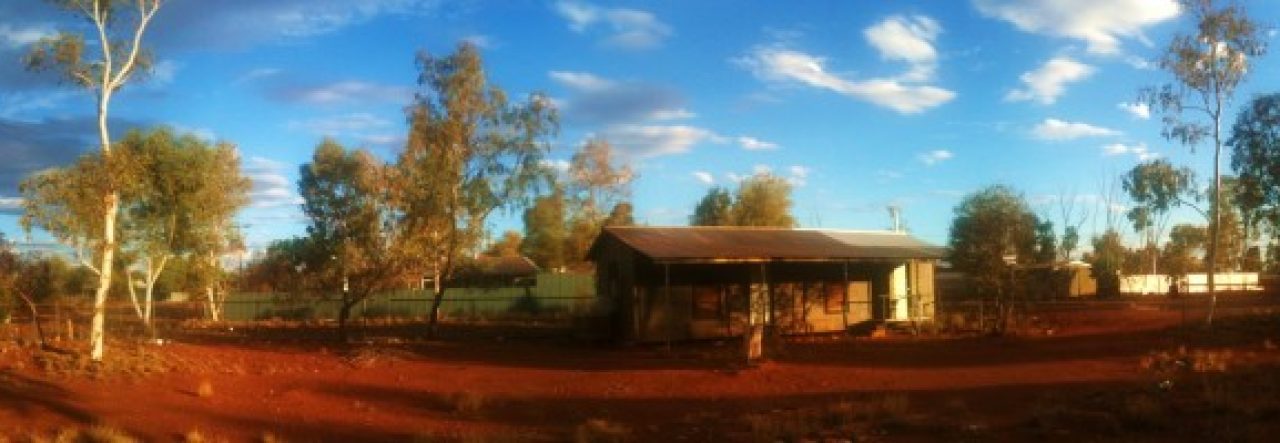
A couple of years ago I watched a sharp and fresh sunrise over the red sand and mulga scrub of the Western Desert. On this particular morning I was surveying our campsite from a collapsible camping chair, looking at all our equipment and the pristine new 4WD we had for the trip. Camping in Central Australia is a superbly simple experience: just find a spot you like, roll out the swag and unfold your chair! Lighting a cooking fire is almost too easy with hard, dry firewood at hand and spinifex grass that ignites just before you strike your match. Sleeping in the open under a brilliant night sky might just change you forever! A friend and I were heading west to a remote desert community where we felt strongly called to offer our friendship. It was a mission with a degree of challenge, as any journey in the desert must have; but on this still, warm, glorious morning the thought had crossed my mind, ‘This is way too easy!’

Well, I never imagined that following the call would become quite this hard. This morning, two years on, I’m sitting on an entirely different style of collapsible chair; one as vastly changed as the scenery. White sand on a south coast beach has replaced the ochre dunes of central Australia (I’ll never know which I prefer), and the collapsible chair has grown wheels. Yes … it’s Bugger. The new arrival, B4-the-beloved, has gone! The Delivery Room recalled her for adjustments that could take days, and in the meantime my Favourite Wife and I are visiting family on the coast. But no matter: give me the simplicity of a manual chair any day! Just Bugger and me and a beach! No fancy tricks, no hi-tech wizardry, no batteries. No whizzing along the water’s edge, no exploring as far as the eye can see (I reckon it’s about 15km!). No comfortable seating, no power, and no independence. What am I saying?! I am bereft!

The worst of it is I have to be pushed. Oh, how I dislike that! Regardless of the character, the kindness, or even the love of ‘the pusher’, the surrender of autonomy is very had to take. Powerlessness is acrid to my soul! I don’t know which is worse: the awkward little questions about comfort and speed proffered by well-meaning and careful pushers; or the impersonal efficiency of hospital wardsmen and airport staff. There is something about the passivity of being pushed along which I find more than repugnant. It’s an issue of control, no doubt, yet I don’t think I fit the profile of a control Freak. In all of us there is a sense of independence which is at the heart of human vitality. At one extreme the need to control encompasses dominance, manipulation and deep insecurity; at the other end of the spectrum lies sheer survival.  Somewhere in the middle you might find dignity, self and conviction: the essence of life.

I had a most wonderful Collapsible Box amongst my childhood possessions. I think I may have found it in a roadside council clean up; back in that golden era when truly great treasures were regularly discarded by the gentry that populated the enormous old mansions of our harbourside suburb. About the size of a lunch-box, its polished aluminium sides folded neatly inwards until they nearly vanished beneath a shallow, square edged lid. I wonder if it wasn’t some sort of specimen container used by a field biologist? At any rate, it fascinated and delighted my boyish eyes. There is, to me, something intriguing about anything designed to fold up, to cunningly change its shape and fit into a new environment. But I am drawn to examine another field of collapsibility altogether: my own.

A week without B4; a week in an unfamiliar setting away from the ordered routines of my home, is a challenge indeed. My erstwhile healthy appetite for a new vista, a new place to explore, or a new room in which to repose is increasingly compromised by a panicky need to remain in control of my world. On a physical level I’m dependent on an array of props and devices: inflatable cushions, walking sticks, my several wheel chairs of course, a curious rubber tipped stick I have invented to reach and poke things with; a tangle of webbing and buckles that add stability to the inadequately small seat in our car. A boot load of equipment! And on an emotional level I battle to adapt to any change; fearful of an overwhelming loss of control. It’s all too easy in these moments of stress to react selfishly; unmindful of those who make up my world and on whom I increasingly depend. I understand now what I have seen and misunderstood in others.

Courage comes easily to youth; bravado is simpler for the strong. But add a little age or limitation, and life is not so simple. The challenge in life’s journey is to remain flexible within. So I am pursuing an elasticity of soul, an ability to live calmly in narrowing straits. Collapsibility is a useful attribute: fitting artfully into a changing environment. Trust might be the very same thing.

It’s a challenge.
Rejoice!

KBO

Winter 2010 #9

You might not immediately think that Winston Churchill and Enoch have much in common, but this week’s much anticipated arrival of B4 (not B4 time!) reminded me that the same lesson can be gleaned from both.

B4, the fourth incarnation of my original wheelchair, ‘Bugger’, is terrific! Made to order in America and then fitted out locally, B4 is a marvel! Centre wheel drive, fast, sleek, and of course red. B4 is amazingly nimble around the house, with a tight turning circle that allows us to access the smallest rooms. A cunning system keeps all six wheels constantly on the ground, making the ride smooth and stable indoors and over rough terrain. The open road is another thing altogether: we rocket along at a good 10 km/h with a purported range of about 15km. I’m keen to put that to the test! She is worth more than our car, and yet in our day and age the greater part of her cost was met by various departments of our public health system. It’s overwhelming.

By rights the new chair probably could have been home-delivered; but my restless independence spoke up, and I quickly volunteered to make the trek by public transport up to the showroom to exchange the hired B3 for the shiny new B4. It’s a good hour and a half on three busses – each way – but a mission on public transport is like the call of the wild! And what a delivery it turned out to be. Like all sensible fathers, I maintain a prudent silence regarding the reported trials of childbirth; but nonetheless there was something about B4’s delivery that seemed to me almost obstetric. Too much emotion, and way too much hard work. I well recall an occasion from my childhood when our extended family took delivery of three brand new Volvos on a single day. It was thrilling, even for a child, and surreal as well. The emotions that attend a new car are almost exactly the opposite of those that come with a new wheel chair. A new car is an exciting achievement, something to crow about. A new chair smacks of confinement. A new car carries promise, inspiring confidence in the good times ahead. My new chair instilled in me a sense of panic. What if it’s uncomfortable / inoperable / troublesome / a lemon? The technician and I laboured for two full hours of adjustments to every imaginable function of the chair. Red eyed and depleted, I finally departed the delivery room with the new arrival.

On the way home I found myself looking in shop windows to see how we looked together, B4 and I. It’s startling to see yourself reflected in such circumstances: hard to look at and harder to look away. My own image akin to the glimpse of deformity which both repels and attracts the voyeuristic eye. After weeks of public outings I still don’t quickly recognise my own reflection. Surely that’s not me? How the heck did that happen?

Decades before Churchill became the famed wartime leader of England, a British military officer declared that the 25 year old possessed the two qualities necessary to one day become Prime Minister: “genius and plod”. Genius is given rarely, and to few. But plod – well, that we can all aspire to. I was usually last in line at the door to my infant’s school classroom where we doffed our caps to greet the teacher. I don’t know why, I just seemed to always wind up there. Eventually though I finished school right near the top of the pile. The secret, not that it’s much of a secret, is to keep plodding on. One foot after the other. Or one wheel behind the other; if that’s what it takes.

This is where old Enoch fits in: a poignant tale from ancient biblical history of a man who, it is said, “walked with God; then he was no more, because God took him away”. The original plodder, Enoch discovered that the path to heaven is one of companionship and constancy. Just stay close; just keep walking; just see where you end up. There is simplicity, purity, even holiness to persistence. A Pilgrim needs only to take the next step, absorbed not by the destination, but in the journey. Fear comes from gazing too far down the unknown path, and regret from a backward glance. Peace is found in doing the next thing. And then the next, and the next after that.

Since the delivery we are seldom far apart, B4 and I. There’s even a night feed we do together now and then: tea in the wee small hours of sleeplessness. B4 has been home for almost a week, and I think we are getting to know one another. I’d say we are even bonding! We might not be in quite the same class of plodders as the two venerables; but I’m mindful of Churchill’s signature acronym, KBO: “Keep Buggering On”, with which he is said to have ended many a wartime conversation.  A little rough round the edges perhaps, but like the original christening of Bugger, the language is appropriately inappropriate. It’s a good motto for B4 and I. However you do it, by foot or by wheel, KBO!

Rejoice!

The Carpenter

Winter 2010 #8

Buttons, spoons, needles and thread, pens, papers, clothes pegs and jam jars – all of these things have become troublesome in recent weeks. I find them all a little less responsive to my touch; vaguely unhelpful, occasionally disobedient. I suspect they are silent conspirators in a domestic mutiny; collaborating when I am out of the room, and synchronising their misbehaviour to heighten my frustration as I move from one task to the next. For inanimate objects they seem alarmingly coordinated! Insurgent implements, a coup in the cutlery drawer, seditious stationary! I’m more than a little daunted; my power over them is weakening. I’m losing my grip!

But I do have a safe haven, one sure place where little has changed. My hideaway is the workshop. And I love it! Projects in the shed have been my delight and indulgence and recreation for many years. I never feel as relaxed or absorbed as when I am creating. Admittedly, I have made a few adjustments: a chair in front of a small, low table now substitutes for my much-loved bench; several battery tools have replaced the big old power tools, I have a smaller, sharper handsaw; and – it must be said – much smaller projects. The workbench is a microcosm of life, demanding patience, vision, commitment and faithfulness. Measure twice, cut once is an axiom I fully endorse, but one that seems inadequate to prevent regular encounters with inaccuracy an even innumeracy. But I get there in the end! Carpentry is not a race for the swift, where the start is everything. No, carpentry is definitely the art of finishing well. And some of my creations aren’t too dusty at all!

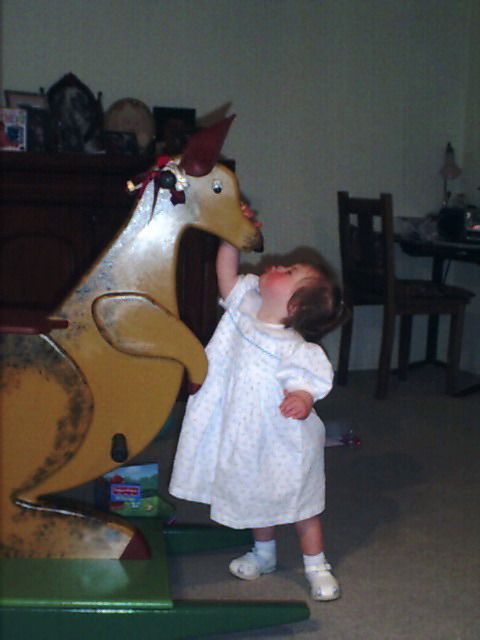
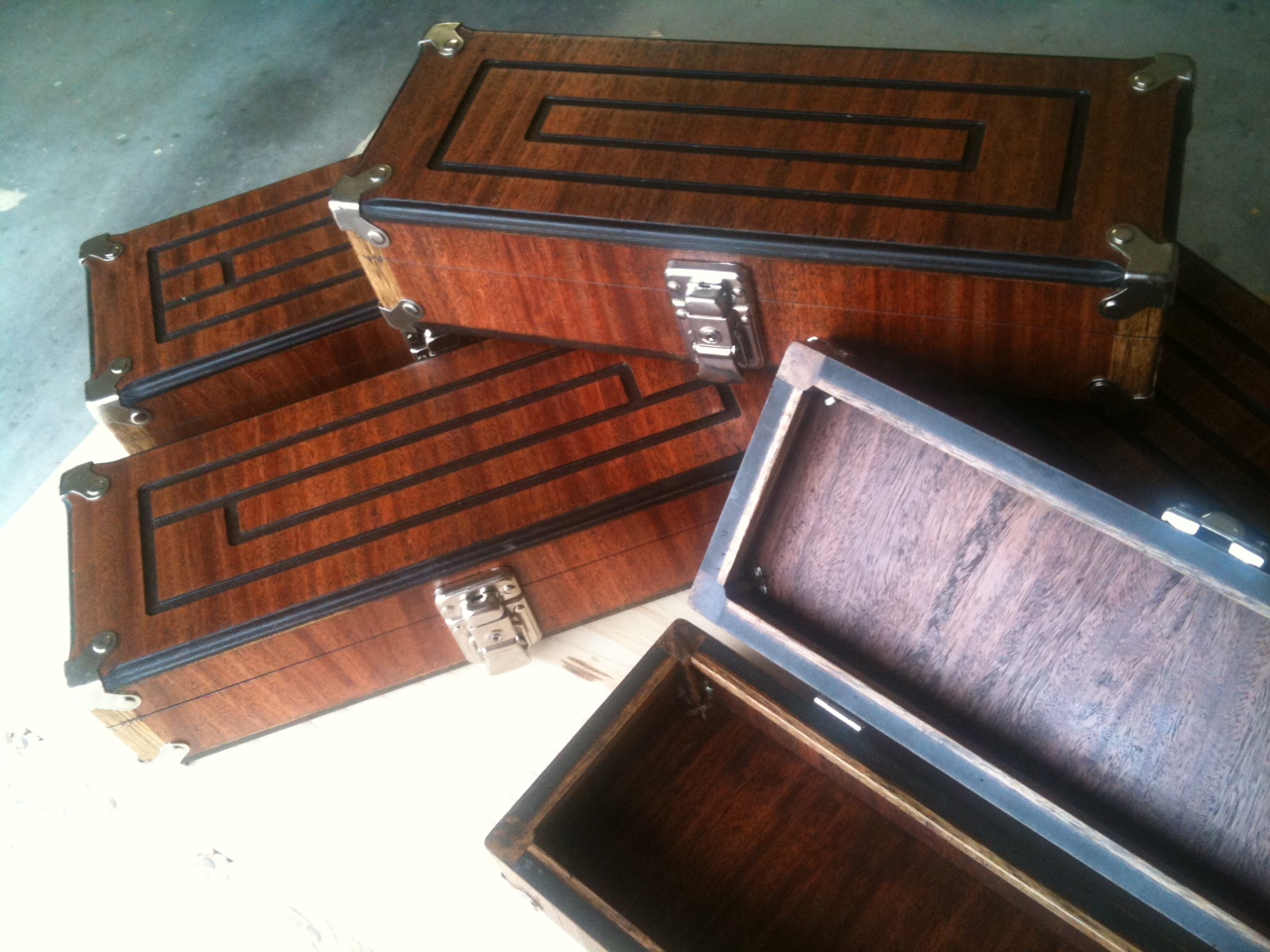
My daughters and I once made a very fine Rocking Kangaroo – an Aussie take on a traditional design – soon after the arrival of our last and littlest. Another time we made a rather grand fish tank out of heavy, salvaged glass, which became the talking piece of our home for some years. The current excursion in the workshop involves a lustrous pile of Red Gum from a local joinery, out of which I am making a ‘Surprise Box’ for each of my children. Six copies of a locked treasure chest we have kept near our dining table through most of our family’s years; and from which various surprises (some valuable, some as trifling as motel shampoo bottles and airline cutlery!) have been produced at meal times, to the great delight of all ages. I dream of many grandchildren around many tables, eyes wide in anticipation! The project is going slowly, but it is immensely enjoyable, and every hour spent on it has the flavour of prophecy.

My workshop is paradise. I am surrounded by familiar cabinets and drawers, some of which I know from my childhood, handed down from my Father whose trade I followed. They are stocked with some of my best and oldest friends, hand tools whose weight and balance evoke a heritage of permanence. One set of shelves is almost archaeological: more than 40 years ago I was putting my raincoat and lunchbox on them in Kindergarten. I can make out the outline of the animal plaques that once identified each toddler, long before they somehow found their way to my Dad’s garage. Roller doors open onto a stunning view of the high, glorious hills opposite our home. Lightly timbered, verdant green, dotted with kangaroos and occasional cattle; these hills become the snowy Victorian Alps if you follow them another hour or so south. Birdsong and fresh air roll down their slopes. My workshop is a pretty special place!

It’s in the shed that I feel most at home. None of my hand tools are in rebellion, and the timber I work with is cooperative – not like the recalcitrant bread, paper and cotton that lurk inside the house! It might simply be that these are the tasks for which my hands have had most training, and so remain most secure. Years as a carpenter may be yielding their fruit. Or, it may be that the tools and materials in my workshop are just more substantial (and manly!) than those in the house, and require less finesse. I really don’t know.

Now, without completely surrendering to paranoia, I have a growing apprehension. What if the loyal workshop cohort catches wind of the mutinous state of affairs inside the house? Could insurrection possibly migrate from the draining rack to the tool box? What if the rot spreads? This place is a sanctum: the workshop, my tools, the sawdust, the bench, they form a holy preserve. Surely my plans and hopes are safe in this quiet little corner of the world.

Aren’t they?

Well …. I’ll keep you posted. Thankfully whatever happens next there is Another Carpenter in our world; one who doesn’t make mistakes, who measures once and cuts once, every time! He finishes every job, He never forgets, His eye is true and His Grip secure.

Rejoice!

Surprise Boxes, ready to wrap for Christmas.

Blind Reduction

I met a blind lady at our church.

And there is such a lot wrong with that statement, most of which I am only just learning.

As I think back to the first time I met Jeanette a few months ago, I am chastened to realise that I didn’t learn her name for several weeks. I’m poor at names; I know their value, but their recollection has never come easily to me and I have made some monumental blunders! I apply myself to the task; I keep lists of new people I meet in my phone with little reminders beside them: clues like ‘teacher’, ‘two daughters’ or ‘red head’. And of course the reminder beside Jeanette’s name was ‘blind’. Obviously! What else? And that’s the problem, right there. The most obvious thing about Jeanette became the only thing; and rather than a name, all that lodged in my mind was a single word: blind. What could be more obvious about a person than their disability? But Jeanette is far more than a blind woman.

Until recently my standard description of myself to people who needed to recognise me, say at a conference, was a simple one. “I am tall”, I would say; sometimes adding, “The tallest person in the building” without much chance of inaccuracy. Today my height is unchanged, but unnoticed. How shall I describe myself now? If I said I will be wearing a red scarf, I could well be overlooked in my wheelchair because the person would be expecting to see a ‘normal’ person in a red scarf. If I said anything other than “I will be in a wheelchair” I feel I would be invisible. Or, to put it another way, I am expected to describe myself in terms of my disability. Normality is such a common, pervasive condition that disability stands out like a sore thumb. It will frequently be the most remarkable thing about a person, and so the sequence of blind reduction begins.

Which leads to a fascinating question: Why is it that people raise their voices when they speak to people in wheelchairs? There may be only a handful of people who unwittingly assume that limited mobility equates to limited hearing; but never the less I have experienced this strange phenomenon on numerous occasions. I have to say it: even one or two of my family occasionally do it! I suspect it stems from an unconscious globalization of disability; or a failure to distinguish between the many subtle hues disability takes. I understand all too well how easy it is to fall into this trap: ‘disability’ is a collective term that is easy to misuse. We have schools for the disabled, disabled taxis (an odd expression!) and disability services – all terms which aggregate us into one large, homogenous mass. We, the disabled.

It’s all rather subtle. Last week I carefully descended a set of aircraft stairs to find, alarmingly, a red Qantas wheelchair awaiting me; while some way off an elderly fellow passenger was happily ensconced in Bugger! Having righted that awkward wrong I took my lawful seat, expecting to be ferried, as usual, by the buggy that runs into the terminal. But the buggy didn’t come, and the airline staff who were waiting with us consulted each other and said, “Let’s just push them in”. I imagine able bodied passengers would have been advised of the change of plans. As a matter of courtesy some explanation would have been offered. But there was no need to secure the cooperation of my elderly companion and I; we just needed pushing. And so off we were pushed. I am not complaining – I am amazed by the provisions that airlines and many other organizations make – but I understand how simply reduction happens. It’s interesting how life changes when you lose a little autonomy; or a little mobility, or a little anything.

Jeanette is, of course, obviously, far more than a blind woman. She is a person of faith who finds and befriends others. She is a thinker, a student, and a musician, surmounting ordinary obstacles to take a place in our church band. Above all Jeanette is a person, deep and real, as are we all.

Reduction seems inevitable in the preoccupied transactions of our world. And yet, thankfully, wonderfully, the story doesn’t end there. Painful though it is to find yourself reduced; less can, surprisingly, be more. Theologians use the term Divine Reversal to describe the often repeated concept of the prisoner being freed, the poor becoming rich, the last becoming first, or the hungry filled. And so I wonder if blind reduction isn’t sometimes also divine reduction? Paul writes, “Therefore we do not lose heart. Though outwardly we are wasting away, yet inwardly we are being renewed day by day” (2 Corinthians 4:16). Grace transforms the very forces that seem to callously reduce, until they become a breath that fans the candle within to brighter light. That may sound a bit pious, but how else can I describe the upwardness of the downward path?

Rejoice!

_________________________

PS…

I read this essay to Jeanette before publishing it. Hearing it gave her a lump in her throat; and there was much for us to discuss together.

The Most Dangerous Game

Some claim that Lawn Bowls, with its fearsome incidence of mid-drive ticker trouble, is the most dangerous game in the world. Well … I know a game more dangerous by far!

I spent two nights in Tamworth this week, travelling north on connecting flights to conduct a funeral service for a family I hold dear.  As I packed for the journey, my Favourite Wife and I allowed our thoughts to roam around the town we called home for many years; the town where we first met and then married. Our wandering thoughts drifted to a property we briefly considered purchasing almost two decades ago: a small cottage on an intriguingly long block of land that stretched down to a narrow river frontage. What a superb home it would have made for our family of six children!  There was an orchard, a work shop, a sheep pen, old sheds, climbing trees, hideouts and a small jetty.   We had quickly realised that it was out of our reach; but what if we had bought? What if?  Would we still be there today?  What would our life look like?  We indulged our rose tinted fantasy a little longer and soon enough created alternate futures for several of our children, vastly different career prospects for ourselves, and a suitably surreal lifestyle to match.  Wisdom, even garden-grown common sense, should have stopped us in our tracks. Enough of this nonsense!  But one wayward thought can follow another, and in the way that all roads lead to Rome our fantasy had only one possible destination, reached with the wistful words, “You might not have got sick”.

That phrase was over-burdened with impossibility and vein hope, and the effect on us was chilling and abrupt.  I felt myself recoil with the furtive guilt of a child caught touching something forbidden.  This, then, is the most dangerous game in the world:  What If….

Growing up as an inveterate day dreamer I found it all too easy to swap the real world for an infinitely less probable alternative. In the briefest moment of distracted dreaming I can still create a detailed parallel world; one in which the trials of today are completely absent, one that is coloured by the most infantile notions, one in which, for example, I am a prosperous professional, (optometry is a favourite disguise), bringing up my family near my childhood home on a pristine Sydney beach.  The elaborate scenarios I have concocted and revisited over the years are more than a little embarrassing. I suspect that some are more given to this pursuit than others; and I feel a certain jealousy for those well grounded folk who keep their minds so firmly on the job.

The week gone by was bracketed by two funerals, seven days apart.  Two people I knew well, two people who could not have been more different, two funerals with barely anything in common. One woman, one man. One black, one white.  One in the east, one west. One in a city, one in the far, far outback. One was a person well educated in European culture and science, the other was a custodian of tribal law. One funeral, the one I attended, was in English; the other in the cadences of Ngaanyatjarra, a language of the Western Desert.  As I reflected this week on the extraordinary divergence of these two lives, it seemed to me to underline the notion that the major themes of life are more given than chosen.  Both of these people had lived life with much to admire in their choices and skills; and yet the factors that made their lives so distinct from each other were largely beyond their control.  As it has often been said, it’s how we play the hand we are dealt that matters most.

Perhaps this is why the game of what if is so very dangerous. It is played in an arena that does not exist; never did and never will. Living in the realm of fantasy saps us of the courage, creativity and humour that are so needed to face reality; and in that depleted state the concrete facts of life will deal savagely with us.

Yet, having said all that, I am very aware that I rarely play the most dangerous game these days.  There have been seasons in life when I pursued this sport with obsessive indulgence, but now I am seldom tempted. I wonder again if this isn’t somehow connected to choice, or, more accurately, to its absence.  The road ahead has revealed itself to be a narrow one, but I find myself ready to walk it, and to enjoy the views and encounters it affords. I am reminded of mountaineer Lincoln Hal describing his envy of Tibetan peasants who, in the confines of their seemingly limited world, seemed to possess the very contentment in life that he was using his wealth and freedom to search for on the face of Everest.

A man’s steps are directed by the Almighty. How then can anyone understand his own way? (Proverbs 20:24).

There are many things I don’t understand, but those things are safe in His understanding.

Rejoice!

____________________________________________________

PS.. the Aboriginal man who passed away was the husband of Tjingapa, who I wrote about in ‘Being and Doing’.

Guiding Star

There are days in winter when the sun sets so quickly that you expect to hear it rend the icy evening air as it falls. I imagined I could hear it over the roar of semi trailers tearing along the highway that B3 and I were valiantly trying to cross in Melbourne’s western suburbs. ‘Coldest Day’ records were being set across the country while we navigated through six hours and 300 something km of connecting trains and busses to arrive here at The Guiding Star Hotel. A beacon of light promising warmth and shelter now beconned to us from the far side of one vast and final intersection and six lanes of peak hour chaos.

“Mate, it’s usually $90 for the disabled room, but we’re giving it to you for $75 ’cause the heater’s broken”. (Thankfully I had heard a rumour of the disabled room’s disability and had packed my own heater!) A fellow wanderer dressed entirely in black canvas and scuffed leather turned a wizened, long haired face to me over his tattooed and beer-bended elbow, and gave me a slow head-to-toe appraisal. Then he offered to guide me to my room. Evidently one of the local wise men, and certainly a good bloke.

I had found this place on-line; described as ‘one of Melbourne’s strangest old-school pubs, set in an industrial wasteland’. What the blurb tactfully omitted to mention was that the Guiding Star is also located snugly beside an abattoir. The smell is appalling: a hideous olfactory beacon, just in case The Star should ever cease to offer its guiding light. But the food was brilliant! Served in the bar, by no-nonsense staff, hospitable to the core. Home away from home!

But all this fun was only the beginning of the adventure. The serious journey would be an inward one, scheduled to begin at 9am the following day.

For some unknowable reason this giant highway intersection in the middle of nowhere has a pub on one corner, the abattoir on another, and a disability showroom on the third. The Independent Living Centre has on display every species of aid from wheelchairs to weighted cutlery. For the purpose of this essay I’m choosing the Attendant Propelled Mobile Shower Commode Chair (item 11:45:037), available in fetching surgical stainless steel and white plastic, as an example of their wares. This accessory makes a robust attack on most readings of the word ‘Independent’. And like so many of the devices on display, its design has a wordless power to chill the core of a man. I realised I had come all this way to voluntarily subject myself to several rounds of intimidation with liberal doses of confrontation and more than a hint of sobriety. One half of my brain was freaked out by the stark medical realties that various items imply, while the other was quietly intrigued by the useful possibilities that various devices might offer. The therapists who were there to guide me through this emotional minefield were, as health professionals always seem to be, dedicated, kind and wise.

I left the centre with a voice amplifier on loan. It’s a small, jet black, understated device. Next to the Attendant Propelled Mobile Shower Commode Chair, the voice amplifier it is svelte and sophisticated; but it is, nonetheless, the first step down a new avenue of assistance. The amplifier works a treat. Its effect is like a cool zephyr in a heatwave, or a log fire on a chilly night. This thing really works! But that’s exactly how I responded to a pair of timber canes a while back (the ones that gave me an air of old world sophistication!), and then my embarrassing secret elbow crutches, and even good old Bugger! Each one was marvelous … for its season. I can’t help but wonder: how slippery is the new season’s slope? Unlike a wheelchair, even a power wheelchair, the voice amplifier is not a common device. I’m sure I’ve never seen one before, and my troubled assumption is that no one else has either. I worry that it will alarm my family and friends.

Guiding stars and wise men appear in the most unlikely places. Sometimes they are sent to us; other times we travel far to find them. Wise men wear odd disguises too, and are found as often among the humble of this world as they are among the great; and at least half of all wise men are women. More I should think.

Guiding stars and wise men. How essential they are on the curious journey of life; and how grateful I am to have found so many of both!

Rejoice!