The Queen of Flinders Street Station

Autumn 2011 #5

It’s late, very late.  Our train is clattering north again, and soon we will be back once more in Paradise, our home in the hills.  Soon Little One will be with us again; and we will celebrate a “Welcome Home” in our traditional style to end her respite days. 

I had hoped to write an eloquent tale tonight.  I hoped to paint a picture of a rose-red face, round as a dinner plate, startling me out of the hypnotic concentration of weaving Bugger through Melbourne’s crowded streets.  “Would you like a nice hot cup of Milo love? Or tea? It’s free!” 

I’ve tried tonight to write about the vacant, distant stare of a thousand faces on a city street. Those lifeless eyes, unable or unwilling to engage with just one soul amongst the countless of hoard.  And I wanted to show you what I see these days: not vacant eyes, but bums and belt buckles: a sight far worse!  I hoped to find a way to capture our Friday night wander along the banks of the Yarra, when a miasma of self-pity took hold; when the stigma of difference, the awkward isolation of a wheelchair, bit more keenly than ever.  (Wouldn’t you have thought that I’d be over that by now?)  I was hoping, too, to find words to describe a quite irrational fear of meeting with family and our closest friends without a voice, or at least not much of one.  How strange that crowds of utter strangers should be the cause of such unsettling thoughts. 

“Well deary, will you have one? It’s free!”  For a moment we were eye to eye, I was shocked to see a human face at last.  Perched on a wheelie-walker, the red-round visage belonged to a Queen – of sorts.  The matriarch of Flinders Street Station, enthroned with aplomb, hailing her passing public with authority and verve that her pedestrian subjects could not match.  She alone dared to challenge the indifference of the masses, inviting them to her table: a curbside food van that was most likely nothing to do with her at all.  But the moment passed and I rolled on.  I had no voice to say to her, “Thanks, but not this time”.  I could have held her hand perhaps, and looked her in the eye.  We could have met at least, but we did not.   

I wanted to tell you how she changed my frame of mind, the Queen of Flinders Street Station, how I saw in her once more the simple fact that I am not alone.  That nothing really cuts us off from one another, that people, all of us, are mostly much the same. 

This is the story I wanted to tell, but it’s just so late, and it won’t quite write!

So this will have to do.
The Bogged Bugger Blog

Autumn 2011 #4

Bugger!
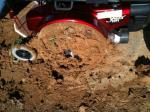
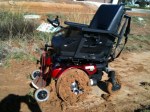
Bugger is bogged, yet again!  

We have been bogged too deep and a little too often.  Mud, wet grass, or just an inch of silt over the footpath, and we are marooned.   B1 was bogged in the red sands of the Gibson Desert. B3 was once so clogged with clay that my Favourite Wife had to help me dismantle her and pry the earth out with a bread knife! 

Oddly enough, rescue almost always arrives in a light truck, and most often it will be a builder who drives past moments after I get stuck, sees the dilemma, and responds with warm, can-do Aussie practicality.  I love it!  But this time it’s complicated.  I’m not out in public where help is near at hand.  I am home; alone, in my back yard, hanging out the washing!

Beside the path to our Hills Hoist is a herb garden; a tangle of provender permanently sodden from the attention of a spring further up hill.  A brief lapse of concentration and three of my six wheels are in the mire; down and out!  At an alarming tilt, I’m feeling slightly panicked in the hot afternoon sun.  From where will rescue come this time, and – more urgently – when?   Barely two minutes have passed and the rattle of a diesel engine is coming up our street.  It’s too early from my Favourite Wife, and it sounds bigger than our van.  Then there voices at the front of our house.  The bog-site is right round the back, and I can’t raise my voice.  Perhaps I could whistle? I’m good at that!  Still no effect.  But whistling through my voice amplifier, now that’s a noise!   Enough noise to summon not one but two postmen, each looking for my signature.  One had come in the truck with a parcel, the second in a postie bike with registered mail, both at exactly the same time.  More than enough man power to un-bog Bugger.  What are the chances?  Who could have orchestrated that? 

So ended the painful week I chronicled in last Sunday’s post; but as if that were not enough reassurance, the same week had begun with another signal event.  My Favourite Wife was given a few unexpected days off work precisely when Little One was in respite care – booked months in advance.  Our life is pretty intense these days, and out of the blue we felt the quite alpine slopes beckon!  I rang the Ski Resort we occasionally visit, soon realising that a gift from friends which I had opened earlier in the morning was the exact amount quoted by our friendly manager for a couple of nights off-season luxury.  The exact amount!  What are the chances?  Who could have orchestrated that? 

These two days, Monday and Friday, bracketed last week like hands cupped around treasure.  When such ‘coincidences’ happen I can’t help but feel secure.  And yet … … it often puzzles me that Providence seems available in inverse proportion to the scale of the problem.  Put more simply: the smaller the crisis, the more likely the miracle.  Many people carry the heavy burden of significant, unanswered prayer in their hearts, while in the details of their everyday lives the touches of heaven are abundant.  I doubt that it is simply a lack of faith.   Why, when my deepest prayer is to get out of my wheelchair, does God answer only by pulling me out of the mud?  This is a vexing question; but in Bugger’s dis-bogging I see the hint of an answer. 

While I peer onward down the path of life, the Almighty savours the moments of each and every day.  I hunger for lifetime security, but he simply seeks a seat at my table tonight.  I strain to arrive, but He loiters on the road.  I look for my destiny, He shows me a detour.    It’s enigmatic!  We finite mortals toy incessantly with our long range goals and ten year plans, while the Master of Infinity dabbles in the instant. 

Why?  Because it is the journey itself that He values most.  I want control, he wants companionship.  I want the weather forecast, He just dances in the rain.  The architect who said, “God is in the detail” * may not have seen it as a spiritual principle; but in the detail of our days a calm and careful eye may see the confident hand of Eternity. 

Rejoice!

_________________________________________________

* Attributed to a number of different individuals, most notably to German-born architect Ludwig Mies van der Rohe (1886-1969) by The New York Times in Mies’ 1969 obituary, however it is generally accepted to not have originated with him (Wikipaedia).

Life was simpler with MND

Autumn 2011 #3

A conversation with my Neurologist this week took an unwelcome turn.

“Any depression?”
No.
“That surprises me.” 

I couldn’t keep my game face as I described the increasing joy I find in life; the companionship of many friends; the wonderful, robust lives of my children.  But he wasn’t buying it, and our conversation for the next forty minutes did not go well.   I have been down this track with other doctors, and it’s not pleasant.  There seems to be an expectation that depression accompanies disabling illness; as if melancholy is a more significant symptom than loss of mobility or speech.

“Who brought you here today?”
I came by bus.  Three busses actually.  I go everywhere by bus, it’s fantastic!
“Why would you do that?  Why not call a taxi?”

I was at a loss to explain my rather stubborn insistence on independence.  I showed him the numerous modifications I have made to Bugger to enable me to travel further and do more.  I could see that this didn’t sit well with him either. 

“You’ve lost a lot of voice function.”
Yes (I whispered), but that’s been happening gradually for more than two years.
“You sounded good three months ago.”

In point of fact the last thing we had discussed three months earlier was my fear of voice loss, which he thought unfounded.    I explained that when we last spoke I was relying heavily on my voice amplifier.  He didn’t know I had such a thing.  I showed him how I had built it into Bugger’s armrest, and demonstrated its amazing effect.    My Neurologist demonstrated how he too could talk in an almost inaudible voice.  I felt as humiliated as I did when another doctor did his own impression of my awkward walk, and then asked me to explain it.  

By the end of our appointment he said he could no longer rule out what he calls a “Psychogenic complaint”.  (Look it up and you will soon read more recognisable terms such as psychosomatic, hysteria, functional illness, stress disorder, factitious disorder and malingering). But this is my safe doctor! The one who’s got my back!  He made the original MND diagnosis, and just months ago he assured me that the dismissive “functional illness” tag – which he described as a “medical abyss”– would not be stuck on my file. 

“Would you consider seeing a Psychiatrist?”
I’d rather not.  Besides, I’ve already seen two.  But I will if you recommend it.
“Psychotherapy could be an option; but only if you want it.”

I remember a Rehab Therapist, caught up in the last ‘functional illness’ ruckus, who was adamant that once I was on the right psychotic drug I would start to improve. 

It was so much simpler when it was MND, I said.
“I’m sure it was.  90% of treatment is correct diagnosis”
And you can’t give me anything on paper?
“No.”

Back in the day, when I had Motor Neurone Disease, the medical profession had some idea where to go.  The speech therapist would tell me what to expect, and roughly when I might expect it.  The Physio and the O.T. would suggest this or that.  Centrelink said, “Yep, sign here”.  The Social Worker pointed me to all the agencies.  The MND association said “These are our resources; we are here to help you”.  

Nowadays no one says much.    MND?  PLS?  Psycho-Something?  Non-diagnosis has muddied the water.  Therapists, not knowing what’s wrong, don’t know what to suggest.  The MND association said, “You are no longer our problem”.  And this week my Neurologist said, “Come back in nine months”.  NINE MONTHS?

I wrote about the singular agony of medical abandonment in D-Day and All in the Mind, and it would be very easy not to write about it again today.  After all, three Neurologists have now reached a similar conclusion (I rush to add that two psychiatrists and at least six other neurologists have not) and when I click “Publish” I will be inviting your opinion too.

To not be believed, to endure the inference that I am putting it on, is excruciating.  And yet I’m appreciative; even for this.  A crisis of faith looms: more than ever before I must know what I believe about myself, and in whom I will believe.  To be brought to know oneself is a great gift. 

On the way back to town (on the bus!) something strange happened.  I was feeling pretty rough, torn asunder in fact, and then I wondered: I am a Christian, so what does God say about all this?  What is his diagnosis?

 I have hidden you in the shadow of my palm. 

These words from Isaiah were in my mind instantly.  It gave me an immediate and lasting calmness; the notion that this might be hidden from men, but not from Him. Perhaps He has even blinded their eyes for His own good purpose. 

Rejoice!

 ___________________________________

Psychogenic: originating from or caused by state of mind; having a psychological rather than a physiological cause. 

Factitious disorder:  any of various syndromes characterised by physical or psychological symptoms intentionally produced by a person and under voluntary control.


Not B4 time!

Autumn 2011 #2

Euphoric would be the only worthy adjective to describe the first day of Bugger’s rehabilitation. Thankfully she never stopped working altogether, but I had taken to making trips around the house slowly and in reverse to minimise the nerve-shattering cacophony issuing from some part of her mangled transmission. So it was pure bliss, unadulterated ecstasy, to select high speed and launch headlong (feet first?) down our drive and into the wilderness of suburbia once again. A handicapped re-birth! Fitted with a pair of brand new motors nothing was out of reach for B4 and I. Busses, shops, the post office, a few hours at our church office, what a fabulous day! I caught myself laughing out loud mid way over a zebra crossing. (Embarrassingly, I think it may have been a quizzical look from a fellow pedestrian that brought this to my notice!) My first day back on the road had – to be frank – something of a virginal quality to it (an allegory that falls technically short of the mark!) The second and third days of liberty were no less rewarding with an overnight train journey to visit our children (and attend a medical appointment, but who care’s about that?) On the fourth day I actually stayed home, but family came from near and far to celebrate a birthday. And today, day five in our emancipation, I preached in our church. (Yes, I spoke in public! A big, fat sound system in a quiet auditorium makes it quite possible to do what I can’t often manage in day to day life). This freedom is like a lungful of fresh air. Or, more potently, like a draught of cool water.

We live on the Murray River; famed of late for its demise. In recent years this once-great river has actually failed to reach its mouth, ecosystems have collapsed, and grand century-old river gums have died along hundreds of miles of its banks. But not this year. Floods have swept the country and the river runs full to the brink. Just beyond the hills beside our home is a sight more astonishing still: a vast body of water that was not there six months ago. Last summer Lake Hume languished, as it has for years, at well under ten percent of its capacity. Now it brims with three million megalitres of water, five times the volume of Sydney Harbour, its twin tributary rivers backed up for over 40 kilometres. Growing up on Sydney’s tidal foreshores I am used to water that stays reasonably in its place. You can expect the ocean to be there when you visit. In contrast this sudden appearance of a gigantic fresh-water reservoir is both wonderful and worrisome – not unlike the sudden independence that B4 and I have been indulging.

Euphoria, fun though it is, is a warning, and exhilaration cautionary. The thrill of my escape to freedom betrays a deficit in my internal world because I was not, in all honesty, content in temporary confinement. It’s a fine line of course: there is nothing fundamentally wrong with excitement, or with busses, or trains, or adventure; just as there is nothing intrinsically superior in seclusion. Indeed, family and church have been the only things to have drawn me out of the confines of the house in a fortnight, and I dearly love them both. Such things – all things – are always a matter of the heart.

I know I am making an enormous fuss over two measly weeks, but bear with me a little longer. I survived my two weeks quite well: I didn’t go stir crazy, I didn’t contract cabin fever. Survival, however, is not my goal. I am not satisfied with endurance. If I aim to thrive and flourish in whatever lies ahead, then there is work to be done in my internal world. I cannot spend my days waiting for the drought to end, the river to rise or the dam to fill. I won’t become captive to freedom. I will have to learn more of the art of silence; more of the meditation of the desert. There is another image that is neither lake nor harbour, a spring of water not subject to season or environment:

“Let anyone who is thirsty come to me and drink. Whoever believes in me, as Scripture has said, rivers of living water will flow from within them.”

Rejoice!

Stony Silence

Autumn 2011 #1

Of more than a few petrifying moments in life to date, there would be few that match attending church on the last two Sunday mornings.  “Petrify” is the perfect word: ‘to benumb or paralyse with horror; to convert into stone; to harden, to deaden, to make rigid.

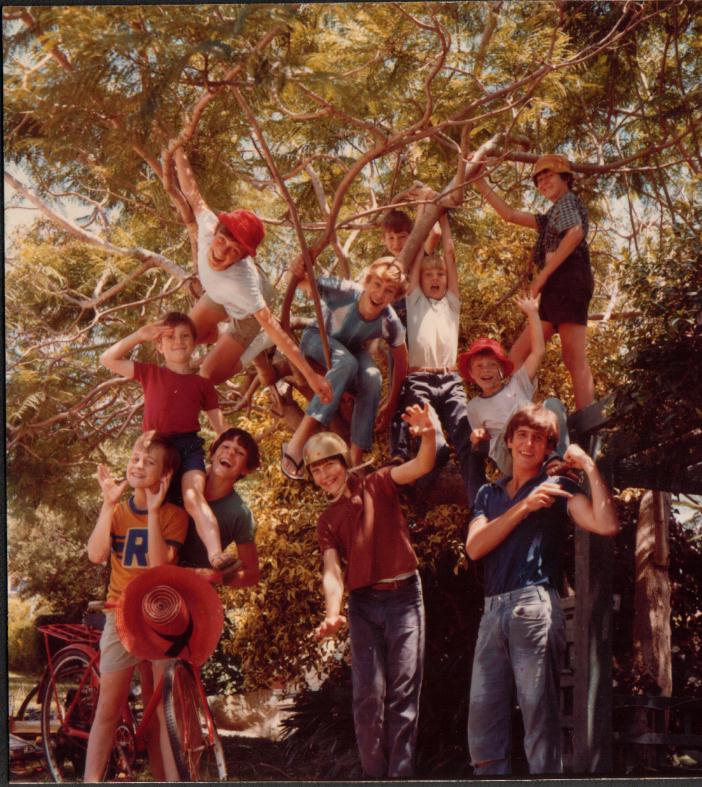
At the age of about twelve I was a fully fledged member of “The Clifton Street Gang”.  I was nowhere near as courageous as most of the troop of cousins and neighbours, but keen to belong I regularly lined up with the rest of the boys at the top of a harbour side cliff.  A thick, coarse, hemp rope was the limit of our equipment to abseil the rock face.  No harness, no karabiners, just the rope. The method was to stand beside the rope facing the cliff top, and then yank it up and over one shoulder as you pivoted round, one foot over the rope, back to the cliff, ready to begin the drop.  With the rope thus running between your legs, up and over your shoulder and down to your hip, we were completely unsafe.  The technique was to try and keep your head above your feet by holding onto the rope with one hand, which using the other to slow your descent by pulling the rope down across your body as hard as possible.  Increasing the friction on the rope had the desired effect of slowing you down and the wholly undesired effect of also cutting you in half.  Two small concessions to comfort were permitted for the girlier boys (like me): gardening gloves and war-surplus army jackets.  Because I was a baby I also had my mum sew bits of foam rubber into the shoulders.  It made me look tough, and slightly eased the pain of the rope slicing and burning from neck to crutch.  Finesse was required to balance the twin agonies of descent:  slide too slowly and the rope would leave you to spend your days as an emasculated Quasimodo; slide too quickly and the smack at the bottom might be your last!

“The Clifton Street Gang” photographed by my uncle in 1972.


If the twin agonies of abseiling were friction and imminent death, the twin agonies of church are silence and immobility. 

And, much like standing in line with the boys on the cliff top, the battle is largely mind over matter.  Embarrassment is like fear; it’s a state of mind.  Bugger, my disabled, motorless, power chair, weighs 120kg on her own (struth! she’s a big girl); and manoeuvring she and I out of the van and over a bump at the church doorway this morning was a small circus. But while I felt like a clown, the people who I imagined were staring at me were an audience with only the kindest thoughts. 

I’ve only missed a handful of Sundays in my whole life; our Church has been a mainstay of our family’s world.  And for much of the time I have actually been running the show to greater or lesser degree.  I won’t try and elucidate the discomfort I experience going from pastor to mute-awkward participant.  Church is a place to talk.  Talk to friends, talk to strangers, talk to God…. talk talk talk.  On a Sunday three weeks ago, when B4 was still going strong, I retreated to a lonely exile in an office soon after the service wound up, overwhelmed by my inability to say anything at all over the background noise of chatter and music.  I eventually emerged from the office to face the music again, and attempted a couple of exchanges with talented people who were able to carry both sides of the conversation, with a few prompts from my deck of laminated cards.   

Two Sundays ago, when Bugger’s motors had died, I didn’t have the luxury of escape.  Unable to run and hide after church I had to stay put, and I experienced a miracle instead.  A young chap I hadn’t seen in a long time came and sat right beside me.  All I could think to do was open up my natty little NetBook computer and type something for him to read.  Well, this worked. It worked very well!  What a joy!  We chatted for twenty minutes, and for the first time I heard the veil of silence rend.  I held numerous conversations at church this morning using the same system.  I’m still silent, but I have discovered a way to be with people none the less.

The morals are many:  The battle is always won or lost in the mind.  In the world of relationship it’s all too easy to fall off the edge.  Harden up.   It’s good to slow down, even if it hurts like heck. Have a go: the alternative is far too lonely. 

Rejoice!

Æthelred the Unready

Summer 2011 #9

Our twelve piece dinner service, precious wedding gift cutlery that we save for special occasions, tossed into the stainless steel tumble dryer on heavy-duty cycle. Let’s throw in the Wedgwood too!  Or perhaps it is more like the sound of the many women of my household (before they started running off and getting married!) talking to me all at once and dragging their amassed 60 fingernails over a dozen chalkboards at the same time. Imagine a sound so cataclysmic, so jarring, so apocalyptic that you would sooner have your teeth pulled than bear it a minute more.  Such is the calamitous, dreadful sound of B4 crawling around the house with a mangled gearbox. She’s chucked a cog! Blown a gasket! Pulled a hammy!

I am suddenly confined to barracks, with emotional results that are, in my habitually introspective way, out of all proportion to the scale of the problem.  I have spent an unprecedented three (3, THREE!) consecutive days at home; and it would have been five days straight but for one brief and nasty outing in the car with good old Bugger, the manual wheelchair that no longer fits the bill.  I can’t recall such incarceration since we were farming many years ago, when I could happily stay inside the front gate a week at a time; occupying myself with a thrilling array of machinery and playing mother hen to fifty thousand chickens.  A few enforced days at home probably sounds delicious to many of my readers.  Others will wonder what the fuss is all about, having spent five months, or five years, in confinement.  But it’s been a tough week; one in which the spectre of the future did its wraithlike best to invade the present, an apparition whose dimensions are known only to me.

In the moment of calamity – and in the hours and days that follow – an awful lot can pass through one’s mind.  Some folks can simply say, “Stuff happens” and move on.  Not me!  I have voices inside my head, all of them bogus, but all of them persuasive!

There are ‘What Ifs’: What if I hadn’t gone to the corner to waive Little One and Favourite Wife off to work? 

There are ‘Should Is’: Should I have been more prepared? Should I have paid more attention to the odd noise that has been slowly developing for months? 

There are Eternal Questions:  If everything happens for a reason, what’s the reason? 

There is Superstition:  What might I have done to ward off calamity? 

There is Illogical Relief: Thank goodness it happened near home!  

There is Blame:  Who did this to me? Who dropped the ball?    

There is also Cosmic Blame:  Is there an evil power conspiring to ruin me? 

There is Existential Anxiety:  God? Are you there?  Am I here? 

There is Guilt:  What did I do wrong to make this happen?

And then there is the long, long shadow of Æthelred the Unready!  

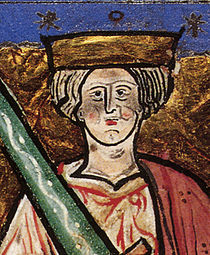
"Æthelred the Unready"

Æthelred, a Medieval King of England whose reign was so plagued by underachievement that history has branded him forever with that single, most unfortunate remark: unready.   What an epithet!  Apparently little ever went well for Æthelred. Invasion, impotence, vacillation, and treachery were the hallmarks of his kingdom.   Is there such a thing as congenital inadequacy syndrome (CIS)?  More importantly, do I qualify?  I don’t think there are too many pilgrims on earth who have not laboured, secretly perhaps, under the insecurity of Æthelred.

What I actually believe about all this is one of the most demanding tenets of faith:

“In all things God works for the good for those who love Him,
who have been called according to his purpose”. Romans 8:28 

In hindsight there seems to me nothing that has proved more true than this; however in the present tense there is nothing I find harder to believe!  So often throughout my life the difficult circumstances have proved, in the course of time, to have been immensely productive.  Salvation has come!  That knowledge should be hugely reassuring, and yet I find over and again that a trying circumstance simply discourages me, when it should fill me with anticipation for the gain that lies ahead. 

Used haphazardly, this New Testament truth can be scandalously dismissive.  For example this week a New Zealand man narrowly escaped the devastation of Christchurch and began the journey back home to his wife and two small children in Lyttelton, where the earthquake was centred.  Finding the Lyttelton tunnel blocked he took to a walking track, messaging his wife that he was just ten minutes away.  He never arrived; killed by an aftershock rock slide, meters from his own door.   It makes no sense to apply this thought to the tragedy of others; nor can we say “everything happens for a reason”.  Often enough there is no reason, tragedy is senseless. 

What is true, I think, is that the Almighty is at work beside us in all things, even as the drama of this life unfolds.

I don’t think the shadow of Æthelred is cast over my life.  Nor yours!

Rejoice!

_________________________________________

Æthelred the Unready, or Æthelred II (c. 968 – 23 April 1016), was king of England (978–1013 and 1014–1016). Better translated as ‘ill-advised’ his nickname has probably contributed to an un-earned reputation.  But it makes a good story!

2 Wordless 2 Wonder

 Summer 2011 #8

Yes, it’s a sequel!

“Ahh… sorry passengers” the gratuitously amplified voice of our bus driver boomed with an equally gratuitous announcement, “I didn’t realise this man wanted to get off at the bottom of Scarborough Road, so we are just going around the loop again.  It won’t make us more than a few minutes late.” 

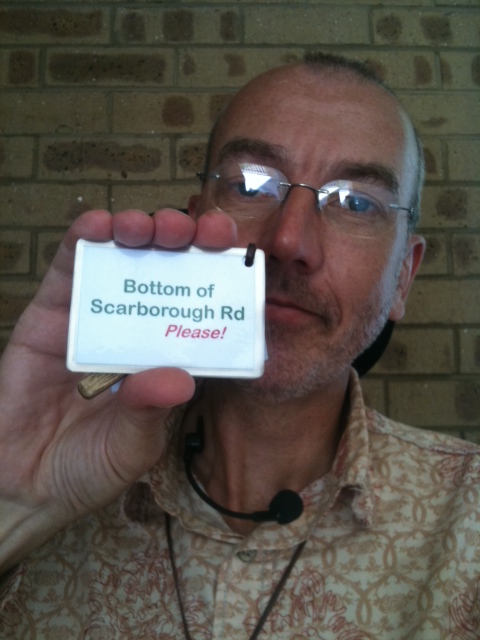
I love the last bus of the day!  The one that tempts fate; the one that surely has regrettable consequences if missed.  It probably betrays the smallness of my world, but I get off on this mild thrill: performing without a net on the bus with no backup!  (And – this is exciting – I love it when the days start to get shorter and colder, as soon they will, and the last bus will deliver me home well after dark, and I will have to travel with B4’s head and tail lights on!  Such adventure!)  The last bus, however, goes by a different route, and the bus drivers considerately make the smallest of detours so that I can disembark reasonably near our home.  To achieve this end I had shown the driver another of my laminated cards:

“Bottom of Scarborough Rd, Please!”

And he had simply said, “No worries mate!” A good response one would have thought; no sign of The Padre, Simpleton, Marcel Marceau or even of the dreaded Madonna (with child). 

At any rate; I now know exactly how many people were on the last bus, even though they were all sitting aft of the wheelchair bay, and even though I never once turned round to peek.  There were 12.  I know this because I could count each of the 23 eyeballs burning into the back of my skull*.  Through that same skull paraded a dozen unfavourable opinions of ‘the man in the wheelchair’ as the bus crawled second by gruelling second back several winding blocks to find the Bottom of Scarborough Road.  I am sure I was staring forward with a fixed, maniacal stare; humiliated to the core.  Or maybe I was smiling?  The driver had read my card, again, and all of us would soon be home.

One of the most enduring friendships of my life began more than forty years ago when I was the one at the back of the bus doing the staring.  I can still summon the emotional mix of fear and voyeuristic lure I felt at the age of eight each time I saw the boy who I later came to know as Stephen.  He always sat right up near the driver; a small, markedly disabled fellow several years older than me.  Perhaps it is understandable in someone young, but I am still ashamed that it was many years before I first spoke to Stephen, and even then it was because I seemed unable to escape him.  Everywhere I went, there was Stephen.  Concerts, public transport, church events, always Stephen was somewhere around!  He had a delightfully proximal sense of personal space, placing his five-foot-nothing-self just an inch away from my six-foot-seven.  He wasn’t big on eye contact either, concentrating instead on a forefinger-jab to my stomach to punctuate his sparse sentences; each of which began in the falsetto range and cascaded to a basso full-stop – with jab!  I discovered in recent years that Stephen has an intimate knowledge of the entire classical music repertoire, and that there isn’t a book on the history of Sydney that he hasn’t learned in detail; although I didn’t glean this from him.  

To this day, decades on, Stephen and I still exchange a letter every few weeks, indeed one arrived this week.  Barely thirty words in length, each letter is practically a carbon copy of the one before it, varying by a word or two at most; and yet there are few people who have ever spoken as strongly to my soul as Stephen.  But that’s a story for another Sunday. 

Who would have thought that one day I would take Stephen’s seat on the bus, feeling the stares that I once gave?  It has taken me a lifetime to learn that the terrifying chasm that I felt as an eight year old doesn’t shelter monsters after all.  Perhaps we have to walk in each other’s shoes to know beyond doubt that there is nothing to fear.   And having learned that lesson, it finally becomes clear that fear, by definition, exists only in the imagination; that curious realm in which dwell also faith and hope. I sometimes give thanks that my world has turned upside down.

Rejoice!

 __________________________________________________

* A glass eye perhaps?

Wordless Wonder

Summer 2011 #7

I simply will not speak to bus drivers any more, not a word! 

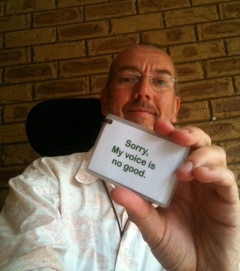
More accurately, I cannot speak to bus drivers any more. Instead, I have a small deck of laminated cards on which I have printed courteous requests for tickets and the stops where I wish to disembark.  For ten days now I have been embarking in mute silence.  It feels eerie, surreal; and I can’t quite believe that I am actually doing it.  I feel like a researcher in a social experiment, launched on an unsuspecting world to discover how people respond to the speech-impaired.  Of my several printed cards, the one that yields the most spectacular response from the public is this one:

"Sorry, my voice is no good"

This brief message is the catalyst for some extraordinary reactions. For example, this week I have met:

The Sergeant Major.  This is the bus driver who helps by SPEAKING IN A LOUD, CLEAR VOICE.   Not only did he raise his voice, but he slowed it down as well; leaning in towards me, with his chops pushed out in a creepy, exaggerated sort of way, presumably to help with my lip-reading.  What is going on here?  It’s my voice sir, not my ears!

The Teacher.  The driver who reads my cards out loud.  Maybe he reads everything out loud?  Maybe he’s speaking for both of us?  Maybe he feels the whole bus should share in the moment?

The Padre.  This bus driver snapped immediately into counsellor mode, going to lengths to reassure me.  “That’s OK, don’t you worry”.  No mate, this is not OK at all! 

The Simpleton.  Then there was the driver who decided that my problems were actually of grammatical origin, and so he helpfully dropped the prepositions from his sentences, as in:  “You go town?”  If one was the type to get offended, one might. 

The Gossip.  Then, and I really liked this one, there was the driver who followed me down the aisle of the bus to find out more.  “Now what have you done to yourself? Where’s your voice gone? Aren’t you going to talk to me today?”  All I could do was smile, shrug, and produce my little card once more.

Marcel Marceau.  There was a member of the public who had some excellent tricks up his sleeve.  I Managed to get hung up (again!) on one of those tricky little ramps from road to footpath.  If they are too steep, and if you hit them too slow, the mid-wheel drive ends up spinning in mid air.  Soon enough a car pulled up and a Gent sprang out with loads of advice and reassurance – until I flashed my card for his benefit. Immediately, immediately, this fellow clammed his mouth shut and began to convey his plans to help me through a combination of mime and some breed of home-cooked sign language that was quite beyond me.  I felt like suggesting he get a little set of cards to help with his speech difficulties. 

The Madonna (with child).  Then there was the clerk at the motor registry.  I had quite a bit to get through, transferring the registration for our new wheelchair vehicle from one state to another, with engineer’s certificates and statutory declarations to be sighted and signed.  For all but a few words I relied on my little cards and on messages typed into my phone, and this seemed to do the trick.  Until we had to go out to the car park to check the engine number.  She held my hand! She held my hand!

What is going on here?  My awkwardness seems contagious; spreading in the way a yawn engulfs a room.  Over the last couple of years I’ve become acclimatised to people’s reaction to disability, and most people are terrific.  But what is it with silence that throws people so out of kilter?  Is it compassion, or embarrassment, or sympathy, or fear, or confusion, or something more fundamental, more archetypal?    My instinct is that speech is so elemental to humanity that its absence is disorienting.  To rob a human of their voice is inhumane.   I think voicelessness is provocative also, drawing out of people an unexpected response that is poignant (if alarming!) in its eagerness to help and its desire to bond. The creation story holds that the Almighty used words alone to make our world; before the self-centredness of man wreaked its havoc, epitomised finally in the Tower of Babel where the unity of culture and language was confused and lost.  Babel comes to mind whenever I board a bus!

It’s early days, but I think the fear of becoming mute is the dread of isolation. And so I feel moved, deeply touched, by the members of the human family on the busses and around my town who reach out to prevent that from happening.  Inept and inappropriate perhaps, but I feel the love!  And I am grateful.

Rejoice!

Esse Quam Videri

Summer 2011 #6

Astride Buggers 2 & 4, Little One and I were indulging in a late afternoon round of a favourite game: Powerchair Tip.   On this particular day a couple of teenage kids were riding mountain bikes on the steep hillside across from our home, and we were no sooner down our drive than Little One volubly commanded them to get of “our” hill, which is, in point of fact, a council reserve.  With a little careful persuasion she recanted, shouting with equal authority that they were now welcome to stay.  It’s important to the story for you to know that the boys were fifty yards away, and might not have heard us, even if they hadn’t been oblivious to our presence.  But, they were heading our way!  Nothing gives Little One more pleasure that befriending complete strangers and she obviously considered the bond to have been sealed, because as soon as they reached the road she was there to greet them with High Fives.  I tried to protect them from her onslaught of affection … a complete waste of effort.

It’s important to the story that you are acquainted with a couple more details.  One is that my ten-year old has Down syndrome, and understanding her speech is tricky, to say the least.  Another is that she sits cross-legged when driving B2, which is a sight to behold.  Yet another is that even with the amplifier mounted on B4 my own voice is increasingly faint.  So here’s the picture:  two people on power chairs, one young, one old(ish); one vociferous but unintelligible, one articulate but inaudible; and two healthy young blokes on bikes.  When Little One challenged them to a race their faces wore an expression of fixed, if polite, bewilderment.  I reckon they were good young fellows, and they soon made a courteous escape.  But it makes you wonder doesn’t it?  What in the world did they make of us?  What did they say to each other on the way home, and how did they describe the strange occupants of the house on the hill to their mates?

I witnessed the opposite reaction several months ago as a passenger on a coach.  We had climbed the scenic Macquarie Pass south of Wollongong, and were passing through the string of quaint townships that nestle in the southern highlands.   I happened to be looking out my window just as our driver gave the air horn two solid blasts – purposeful, cheerful peals – and I was rewarded by the sight of a couple of dozen people on the shady veranda of a rather nice pub, holding their drinks aloft and cheering in salute.  Ned, our driver, flicked on the tannoy to offer his passengers a succinct, two-word explanation of this baffling greeting from the gallery: “My Local!”  I had already taken a liking to Ned, and could understand the enthusiasm of his friends at the Pub. Ned was the authentic, likeable Aussie bloke.  Popular, gregarious, reliable; exuding an understated confidence, he was a warm spirited, knockabout larrikin.  The sort of fellow you feel you’ve known forever.  Ned was a strong, solid man, with sparkling eyes and a beard to match his name.

Appearance is a funny thing.  The world makes much of it; indeed a fair slice of the global economy is generated by our relentless pursuit of public approval.  I think I’ve probably claimed to be disinterested in such things; but deep down I know I’m as vulnerable as the next guy.  That’s why I found the shop-window reflection of myself driving B4 away from the supplier’s showroom so frightfully alien.  It certainly wasn’t the image of myself that I had nurtured all these years!  

“Not normal!” is a schoolyard taunt, offered to intimidate all who fail to fit the mould. But it’s a weak threat; a non-statement. It sounds tough, but delivers nothing; because normality is simply maths, nothing more. It’s a bogey man.  Who on the planet is actually ‘normal’, for goodness sake?

Nonetheless, I want to know this: Can the gradual stripping away of so called ‘normal’ appearance give us the opportunity to live more authentically?  I’ve always liked Isaiah’s prophetic description of the Messiah: He had no beauty or majesty to attract us to him, nothing in his appearance that we should desire him”.  Can the process of reduction – which happens to us all, whether by infirmity, injury or age –reveal integrity closer to the core of our being?  Can the process of disabling help us to truly be, rather than just to appearEsse quam videri, or is that too simple?  Are we too human for that?

What do you think?

____________________________________________________

Esse quam videri:  to be, rather than to appear. Virtute enim ipsa non tam multi praediti esse quam videri volunt  (Few are those who wish to be endowed with virtue rather than to seem so).  From Cicero’s De Amiciti (C 44BC).

A Donkey’s Take on Unemployment

Summer 2011 #5

 “Good morning, Eeyore,” said Pooh.
“Good morning, Pooh Bear,” said Eeyore gloomily. “If it is a good morning, which I doubt,” said he.
“Why, what’s the matter?”
“Nothing, Pooh Bear, nothing. We can’t all, and some of us don’t. That’s all there is to it.”
“Can’t all what?” said Pooh, rubbing his nose.
“Gaiety. Song-and-dance. Here we go round the mulberry bush.”
– Winnie the Pooh

I’m not much relishing sunrise either.  My Favourite Wife will be heading back to work again after our blissful, endless holidays.  Come tomorrow Little One will be at school again, and I will be … well, here. 

Our Holy-Days began on November 20th, long before we were actually on holiday, with the unwrapping of our Nativity.  Our annual ritual held more promise than ever as we looked eagerly forward to the School Holidays, the excitement of Christmas preparations, the arrival of family on Christmas Eve, and all the trappings of the season of food and laughter.  On that day, two months and more ago, a hum of expectancy settled on our home.

As a child I developed something of an appetite for anticipation.  Somehow I stumbled early on what I still believe to be a sacred truth: Better to hold a Chocolate than to eat one!  The aroma of coffee is richer, I think, than its taste.  The smell of a bakery promises more than toast can deliver.  The joy of a holiday begins days and days before you leave home.  A kiss is the tenderest act of love. Gifts are most relished while they are still wrapped tightly under the tree. 

It was the best Christmas I can remember; the taste was as good as the scent!  Our children came, some stayed for days.  We ate and laughed; and when it was over it wasn’t over at all, because two weeks of holiday on the coast lay just ahead!

It was the best Holiday I can remember. Our children came, some stayed for days.  We ate and laughed; and when it was over … well, it was over. 

Returning home last week I couldn’t escape the fact that I was not the same man who had set up the Nativity two months before.  Excitement is a great anaesthetic.  Weeks had passed in relative strength; I had scarcely noticed the inexorable physical decline.  But it was there, of course. 

“It’s snowing still,” said Eeyore gloomily.
“So it is.”
“And freezing.”
“Is it?”
“Yes,” said Eeyore. “However,” he said, brightening up a little, “we haven’t had an earthquake lately.”
– The House at Pooh Corner 

I wish, I rather wish, that I was going back to work tomorrow too; with Little One and Favourite Wife.  I wish I still had that easy raison d’être, that simple definition of life:  an occupation. I could once call myself a Carpenter; and in answering the ubiquitous question, “So, what do you do?” a world of vitality and industry was revealed.  I am rarely asked that question now, which is embarrassing in itself, but if asked what should I say?  A pensioner?

I wish I was contributing to the world in familiar, more obvious ways.  I wish that two years ago I could have kept on working, part-time perhaps, instead of losing my job under a cloud of undiagnosed-incomprehensible-uncertainty.  I wish I still brought home a pay check, as a husband should.  I wish I had something other than my worries to worry about.  I wish I knocked of every afternoon, and I wish for weekends off. 

I hate (yes, hate! – a word I shun) the need to ask for help.  I hate the mounting list of things I don’t do very well.  I hate the growing isolation. I hate the mathematics in my head that proves that someone, somewhere, is picking up my slack.

“I might have known,” said Eeyore. “After all, one can’t complain. I have my friends. Somebody spoke to me only yesterday. And was it last week or the week before that Rabbit bumped into me and said ‘Bother!’. The Social Round. Always something going on.”
– Winnie the Pooh 

I’m pouring over my diary; counting the days and weeks, scraping the barrel of anticipation.  When can we get up and go again?  Better hurry! Before it’s too late.

Dear, O dear.
Woe is me!
That’s the downward donkey gaze.
But, come morning, I might look upward instead.

The old grey donkey, Eeyore, stood by himself in a thistly corner of the Forest, his front feet well apart, his head on one side, and thought about things. Sometimes he thought sadly to himself, “Why?” and sometimes he thought, “Wherefore?” and sometimes he thought, “Inasmuch as which?” and sometimes he didn’t quite know what he was thinking about.
– Winnie the Pooh 


KBO!

_________________________________________________________________

(raison d’être – the purpose that justifies a thing’s existence).