Not Fair!

Winter 2011 #2

Proper snow began falling in the mountains well before we reached home. Within hours of our departure the paltry dozen snowflakes we saw fall must have become twelve million, and then twelve billion; and most of this week’s evening news bulletins have closed with tantalizing footage of great snowdrifts banked up against the very buildings we stayed in, and snowmen, and snowballs, and children bundled tightly in scarves, gloves and hats. While those children frolicked, my inner child sulked in a protracted fit of surly ingratitude. A silent seethe of implacable immaturity!

It just wasn’t fair.
Not fair at all! The snow forecast had been promising, the anticipation prolonged, the possibility unique: the last weekend before the ‘official’ snow season; a final opportunity before the price of accommodation above the snow-line matches its altitude. I want to rant against the heavens for their thoughtless timing, my grievance contaminated by unnecessary fears of the future. “Don’t you know”, I might shout to heaven and its owner, “that we might not come this way again?” (…although I know we will!).

But what really bugs me is the patent fact that my infantile bout of the ‘not-fairs’ is so trifling! We had, let it be said, the most wonderful weekend together, finding at least twelve million settled snowflakes in shallow drifts and dustings across the high-country. It was great fun, a sheer delight, true re-creation. So what, I hear you ask, is all the fuss about? I agree, my pout is indefensible.

Just a few weeks back I wrote of the “the Master of Infinity dabbling in the instant”. I tried to describe the strange conundrum in which the likelihood of a miracle seems inversely proportional to the size of the crisis. Perhaps it is a corollary that the more trivial the injustice the louder we protest. I would have thought, for example, that I had one or two more pressing issues about which to bleat “Not fair!”

Unfairness, climactic or otherwise, is found in our world almost anywhere you look. In recent times the weather bereaved hundreds of thousands of homeless Pakistani families in a deluge that flooded their homeland. A bizarre temperature spike swept Russia with daily temperatures of 49 and 50 degrees adding 500 per day to the normal rate of mortality. Ferocious cyclones have pummeled the United States; a tsunami trashed the coast of Japan. And that’s just the weather.

I saw a poignant, complex picture of unfairness in a tiny, middle-aged woman who labored exhaustedly past me with a built up shoe and elbow crutches. She eyed my power chair with a wistful longing, looked up into my eyes briefly and said with a wry smile, “If only!”

Of course life’s not fair.
Almost nothing really is. If fairness is reckoned as the deserving being rewarded and the rogue deprived; then I’ve scarcely seen it. I know that I was born, like every child, with a pure sense of fairness. Well, perhaps ‘pure’ is the wrong word! A finely tuned sense of fairness, especially when it concerned my slice of cake! Sadly enough, it’s imperative that we leave behind that innocent worldview. But I hope I never, ever, loose the innocence of hope – and not just “I hope it snows next time”. There is hope for every sorrow and every broken bone. There is hope that wrongs will be made right. There is hope for this world, and especially for the next. There is hope that springs from unexpected places, and there is hope for tomorrow!

Rejoice!
The Highs and Lows of the Emotional Old Duke of York

Winter 2011 #1

It’s the ears that suffer most in the icy blast from snow capped mountain peaks.  Mind you, some would object such glib use of the term ‘suffer’, given that the rest of my anatomy was safely hidden beneath water level in a hot tub on the fifth floor balcony of our luxury ski resort. Pain always has a context!  We’ve been chasing snow again in the serenity of the Victorian Alps, barely two hours drive from Paradise.  How wonderful it is to have vast expanses of majestic, natural beauty on our doorstep; and how privileged we feel having the opportunity and means to explore them.  With Little One happily in a weekend of respite care; my Favourite Wife and I were free to load Bugger into our wheelchair-van, and head into the wild!  It even snowed! I counted almost 12 snowflakes in 48 hours. But we found lots of snow on the ground in numerous panoramic settings; the wind howled, sleet blew in our ears, we drank hot tea in cold corners, and we had a wonderful weekend.

I might claim more legitimate use of the word ‘suffer’ in connection with a letter I received this week from a Melbourne hospital, informing me that because I had failed to attend a respiratory clinic my appointment would be rescheduled three months hence. Within days a second letter tersely warned that failure to attend two clinics could result in permanent exclusion from the programme!  One of those automated SMS messages had come to my phone a week before the clinic, offering the twin options of attending or ‘ringing’ (key word!) to cancel.  Instead of ringing I emailed the clinic, as I had been doing for some time, informing them that I would not be attending because after weeks of waiting for a hospital bed they had still not admitted me to their hospital.  I reminded them also of my voice predicament and of my inability to ‘ring’.  But, as we all know, medicine can be a merciless machine; a battering bureaucracy. If this farce runs to three additional months it will make a grand total of nine months of miscommunication and general blundering since the first referral to the respiratory service was written in November last year. Breathing is a fairly important matter, I would have thought.

It’s extraordinary what can happen in a week; indeed the heights of exultation and the depths of disappointment can be scaled in a matter of hours.   Some people seem innately better equipped to deal with life’s tidal ebb of satisfaction and frustration.  Some manage to hold an even keel … but not I.  I revel in excitement, broadcasting the thrill; and then bleed quite publicly on my sleeve when it’s all over.  As I mature I had rather hoped to refine my skills in this arena; but emotional stability is surely a slow art to master.  The pattern of elation and anguish seems to have become more intractable and more complex in the last two years; fuelled, I suspect, by a seemingly endless supply of extraordinary mountains to climb – many of which I have written about here – and their attendant valleys to plumb.

How should we manage ups and downs?  Is there an alternative to the back-to-work-blues that strike us all when holidays end?  I’ve tried stoic repression: hiding your feelings so deep that they scarcely exist. But that is alien to me, despite my stiff-upper-lip Anglo-Saxon heritage, and basically dishonest. Perhaps I could practice a style of Eastern detachment; I could become a devotee and withdraw. But all of life is a gift, and I cannot rebut the giver. Does the Grand Old Duke of York hold the answer? Is it better to live life neither up nor down, but always half way in-between?  Not for me: what a tediously grey world that would be.  Most tempting to me is probably ambivalent, existential angst; but I end up tied in knots just considering that.  More and more I see that the answer is simple gratitude.

“In everything give thanks:
for this is the will of God in Christ Jesus concerning you”
(1Thessalonians 5:18).

Gratitude in everything, perhaps even gratitude for everything that life holds.  Gratitude is simple, but elusive.  How easy it is to forget to give thanks for the gift in the moment of elation.  How disciplined we must be to express gratitude in the valley when, as one of my daughters would say, “everything sucks”.  Gratitude constantly takes me beyond myself.  Gratitude removes the absurdity from life.  Gratitude saves me from the rude outburst of my mood. Gratitude can honestly recognize the incongruent vivacity and cruelty of life. Gratitude sets things in order, it puts me in my place within a created world.  Gratitude only requires that I believe. Gratitude declares that all of life is a gift.

Rejoice!

_________________________________________________

PS….
Almost a day late, I know!  The Sunday Post is important, and I must adapt to the changing pace of my ability to regain that prized routine.

Clever Bugger

Autumn 2011 #13

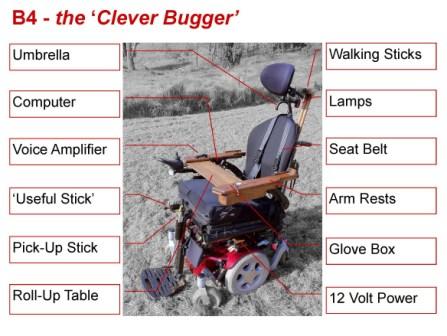
Most of my stable of wheelchairs, all known by the colourful name Bugger, have been modified out in the shed before they first set wheel inside the house. But when B4 finally arrived it was immediately evident that there was a great deal of work to be done! Bugger Mark IV is actually the property of our local health service (a fact I sometimes forget, perhaps because we paid a fair slice of the cost…) given to me on permanent loan.  In order to take possession of this wonderful vehicle an official ‘letter of loan’ had to be signed, and hidden within the fine print were these enticing words….

“…shall refrain from making inappropriate use of,
or modification to, items supplied.”

Well, what could I do?  There were any number of highly appropriate modifications just begging to be made!  In my travels I’ve not seen another chair with much done to it, and from the comments of health workers I gather B4 may be fairly unique. The basic out-of-the-box wheelchair is a pretty inflexible and often uncomfortable contraption.  I’ve often thought that some simple additions could make a world of difference to other wheelchair users; and so this essay is a step towards sharing some ideas that might be useful to someone, somewhere.

Without further ado, may I introduce you to my great friend…

Arm Rests
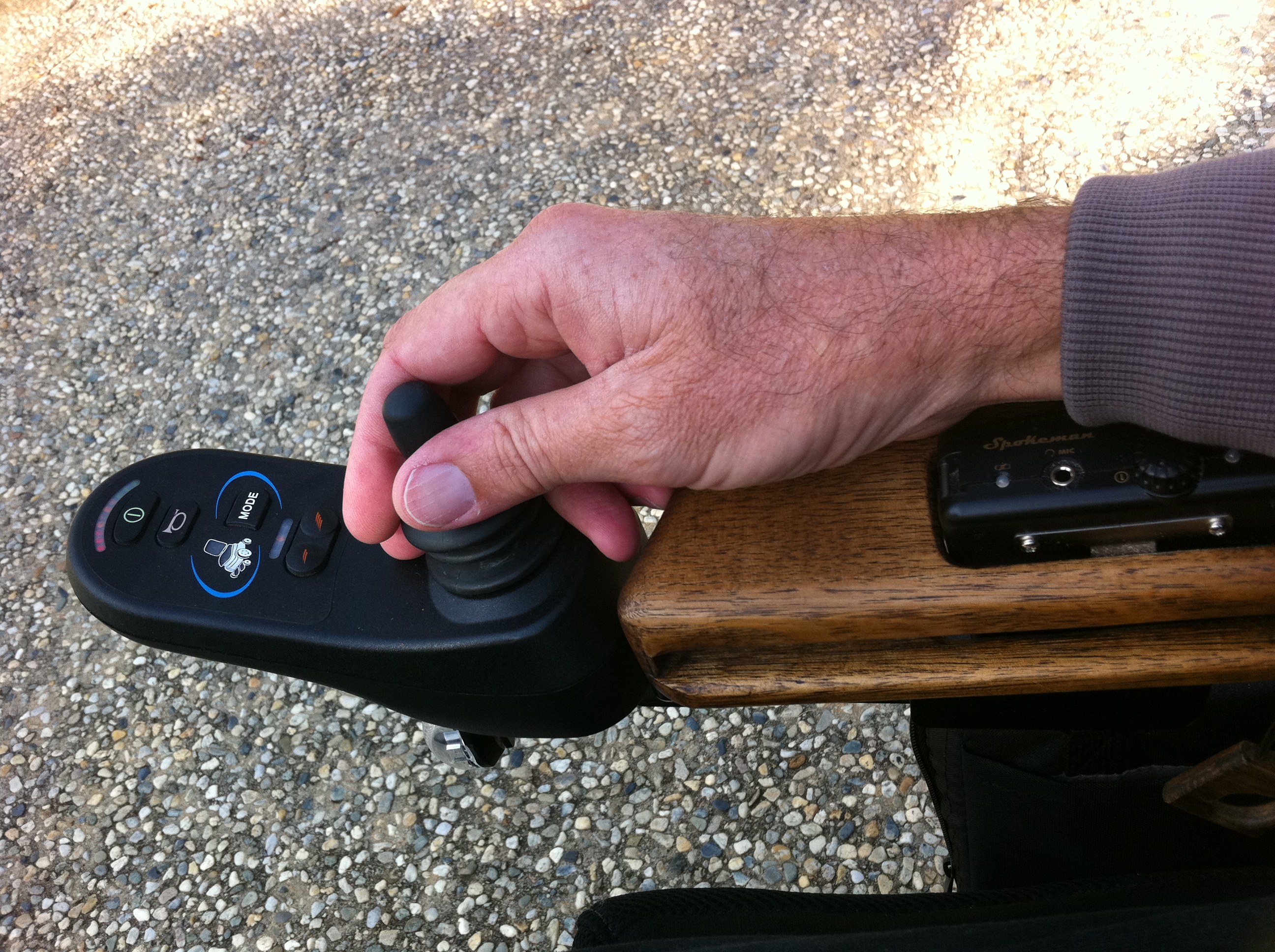
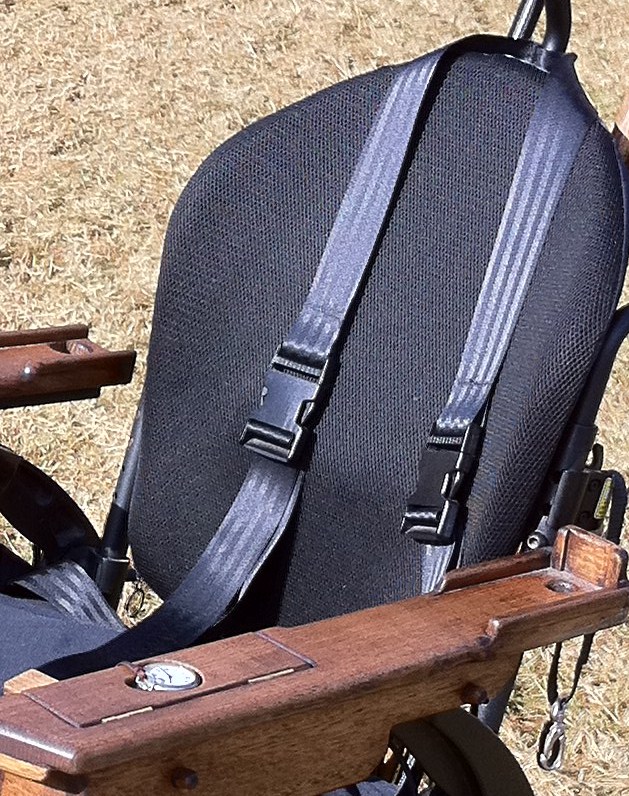
The chair arrived brand new  with short, narrow arm rests that provided very little support.  A longer, contoured arm rest was available from the supplier, but the cost was absurd – like so much else in the world of disability equipment.  These arms are made from $20 worth of Tasmanian Oak from Bunnings.  They are of slightly different lengths, so that the user’s arms are in matching position while operating the controls.  The arm rest is long enough to support the user’s hand right up to the control unit. At the back are two small rails that support the driver’s elbow, and at the front a small rail underneath the arm provides good grip.  Without exageration, these armrests changed my world.

Glove Box
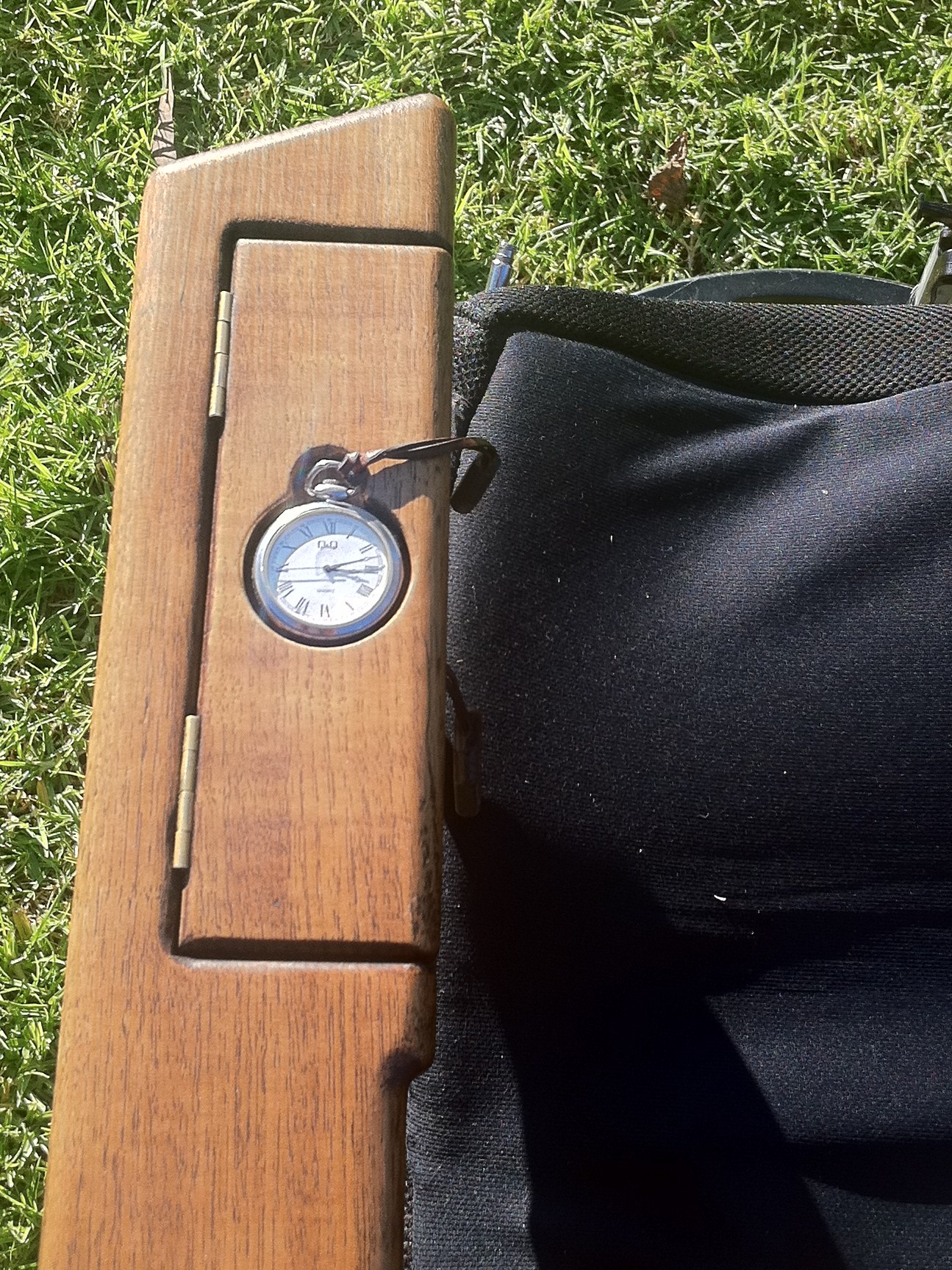
It’s impossible to get to your pockets when you drive a car, and a wheel chair is no different.  In the glove box I keep my phone, keys, a pen, small tools, a telescopic mirror, voice cards and various special things that my Little One deems suitable!  Recessed into the lid is a fob watch, essential if you don’t want to miss the bus!

Roll-Up Table
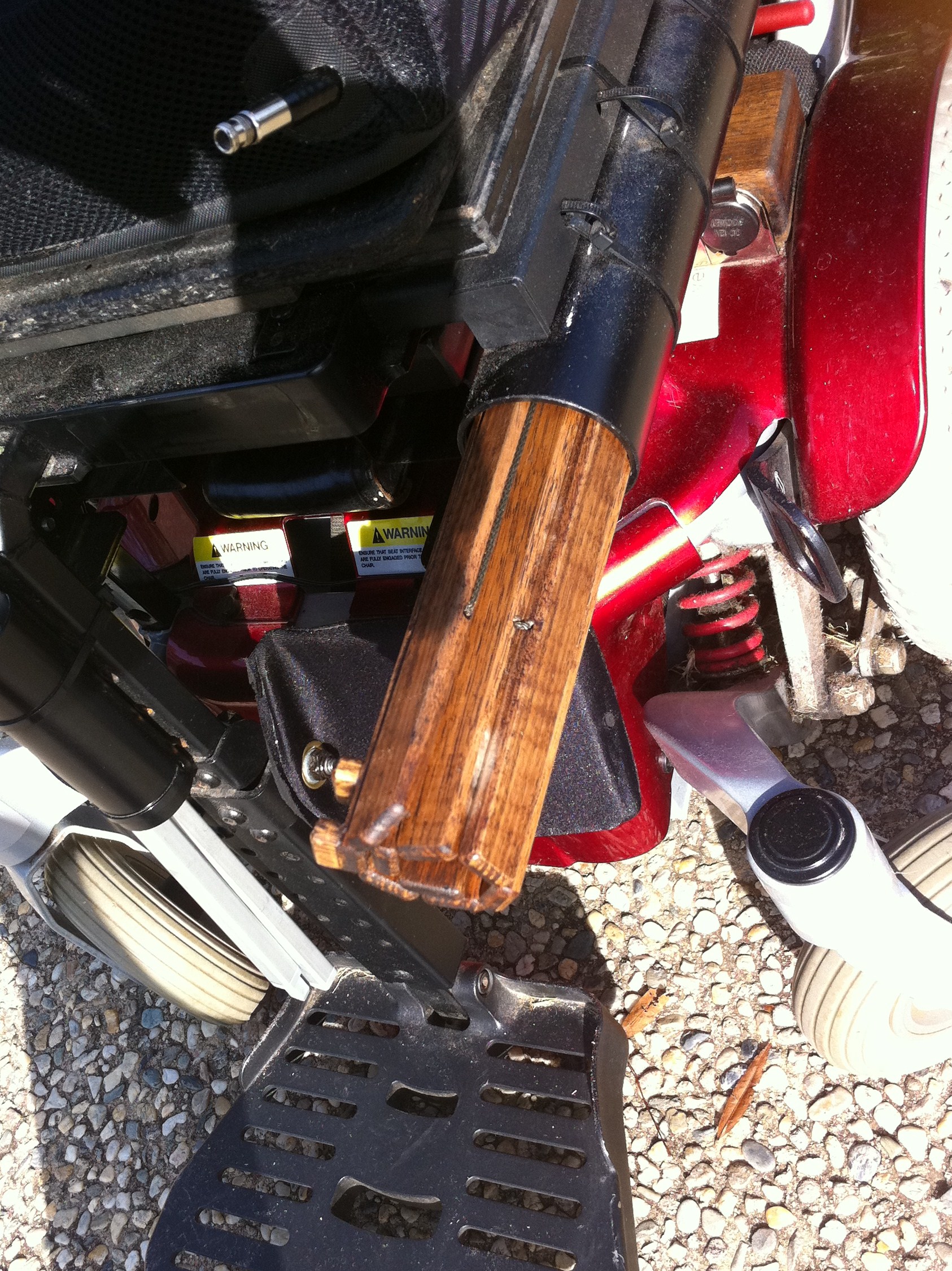
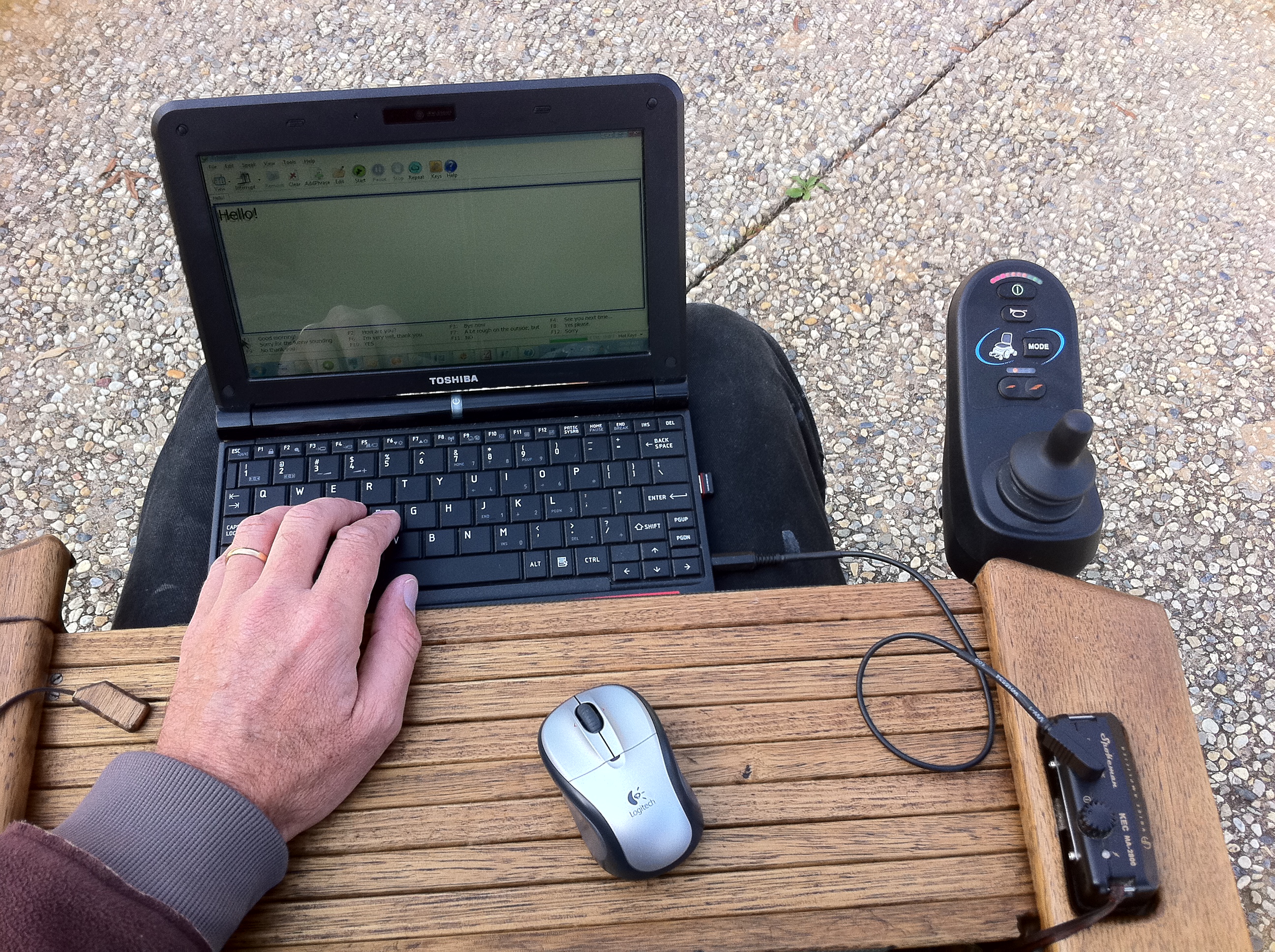
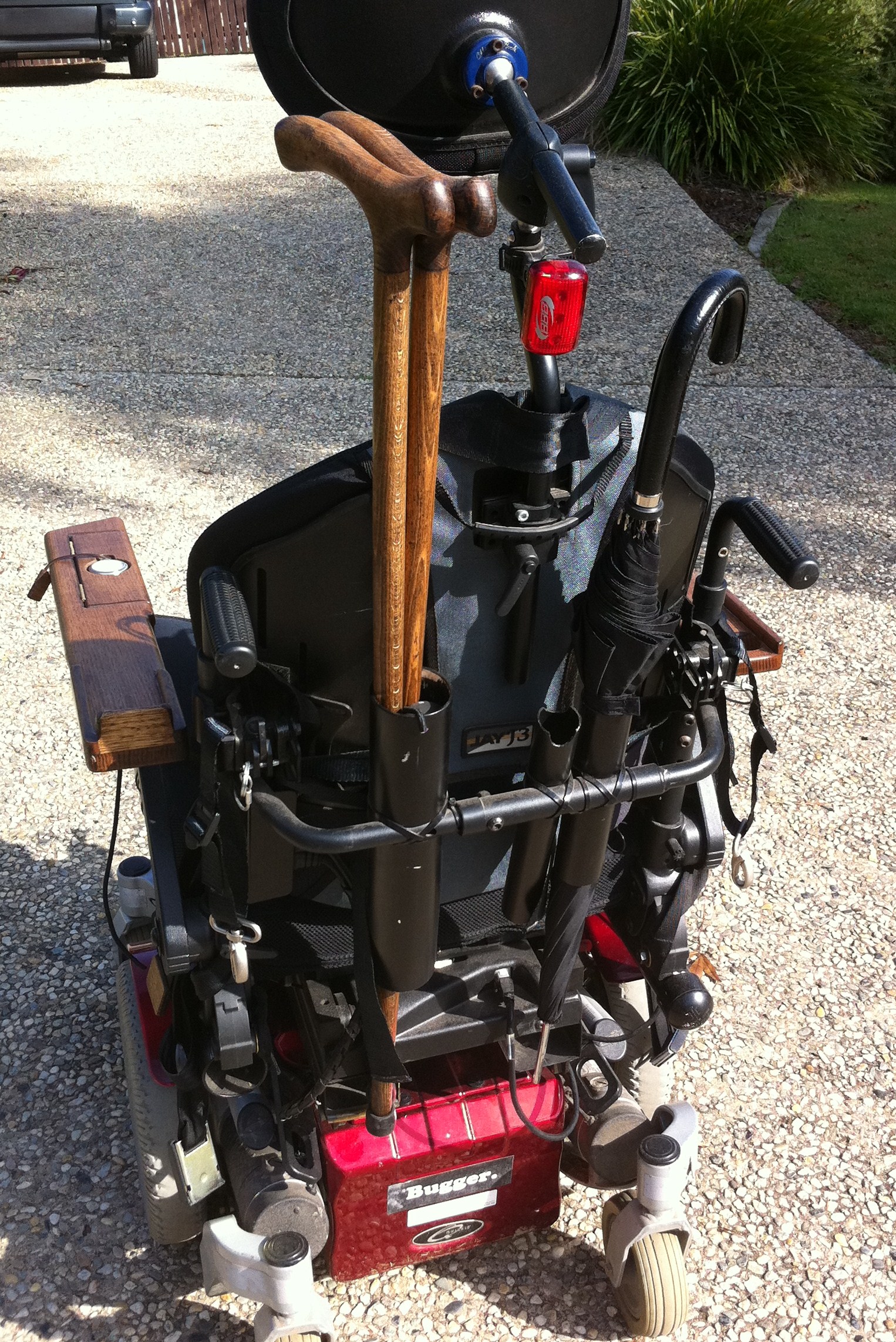
The most useful thing!  I’ve seen an occasional wheelchair with a table, but they are large and ungainly, and there is nowhere to store them onboard.  A table is so handy when travelling, or outdoors, or even indoors, and especially when using a computer.  This table is made from timber slats strung together with elasticized cord; it sits in a slot in the right hand armrest, and under the lid of the glove box on the left.  It rolls up, and is stored in a 60mm PVC pipe under the seat.

Useful Stick
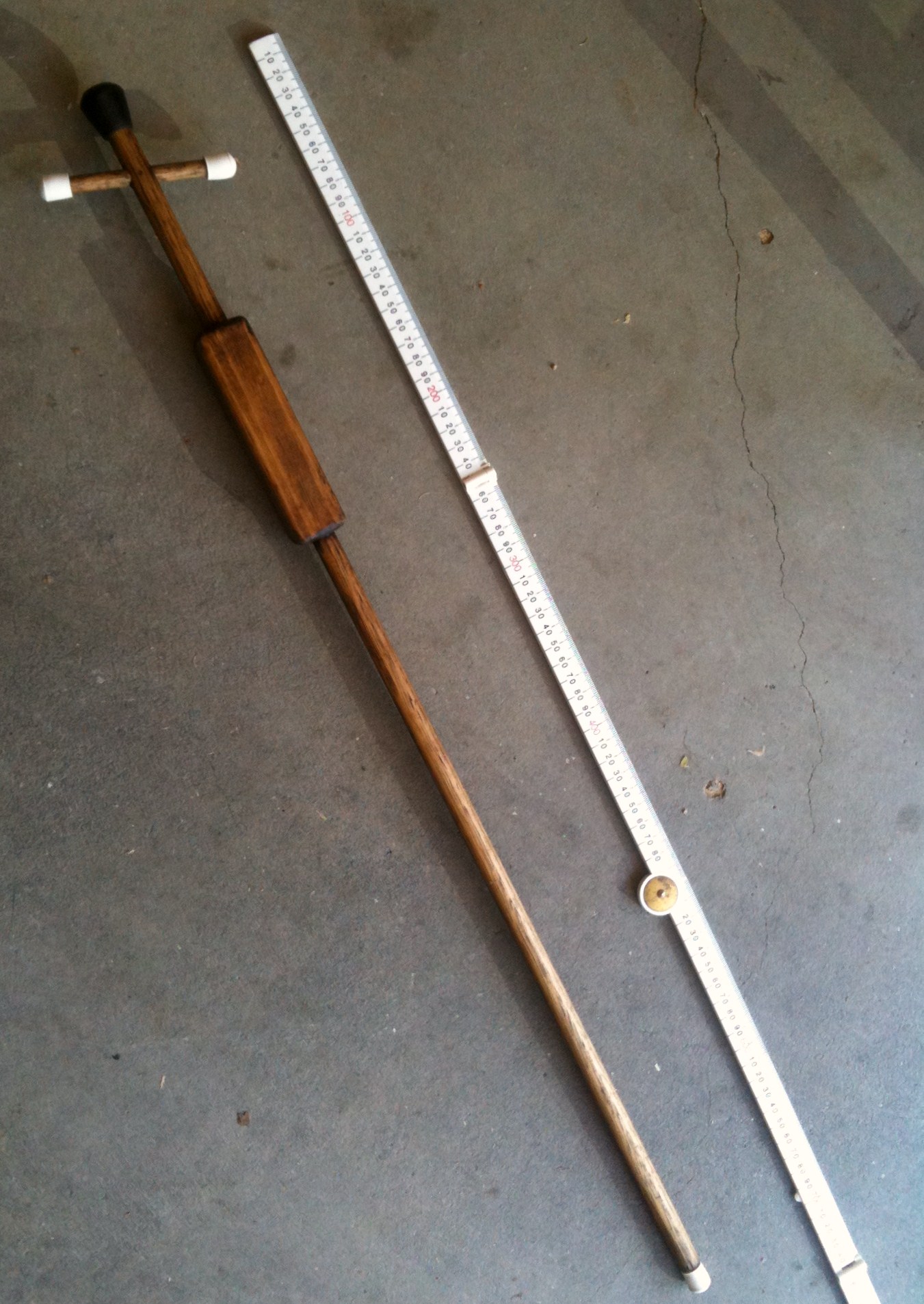
Stored in another PVC pipe, this stick is useful for everything that is slightly out of reach.  I use it a dozen times daily for power points, self-closing doors, and even for driving the chair itself when it is parked too far away.

Voice Amplifier
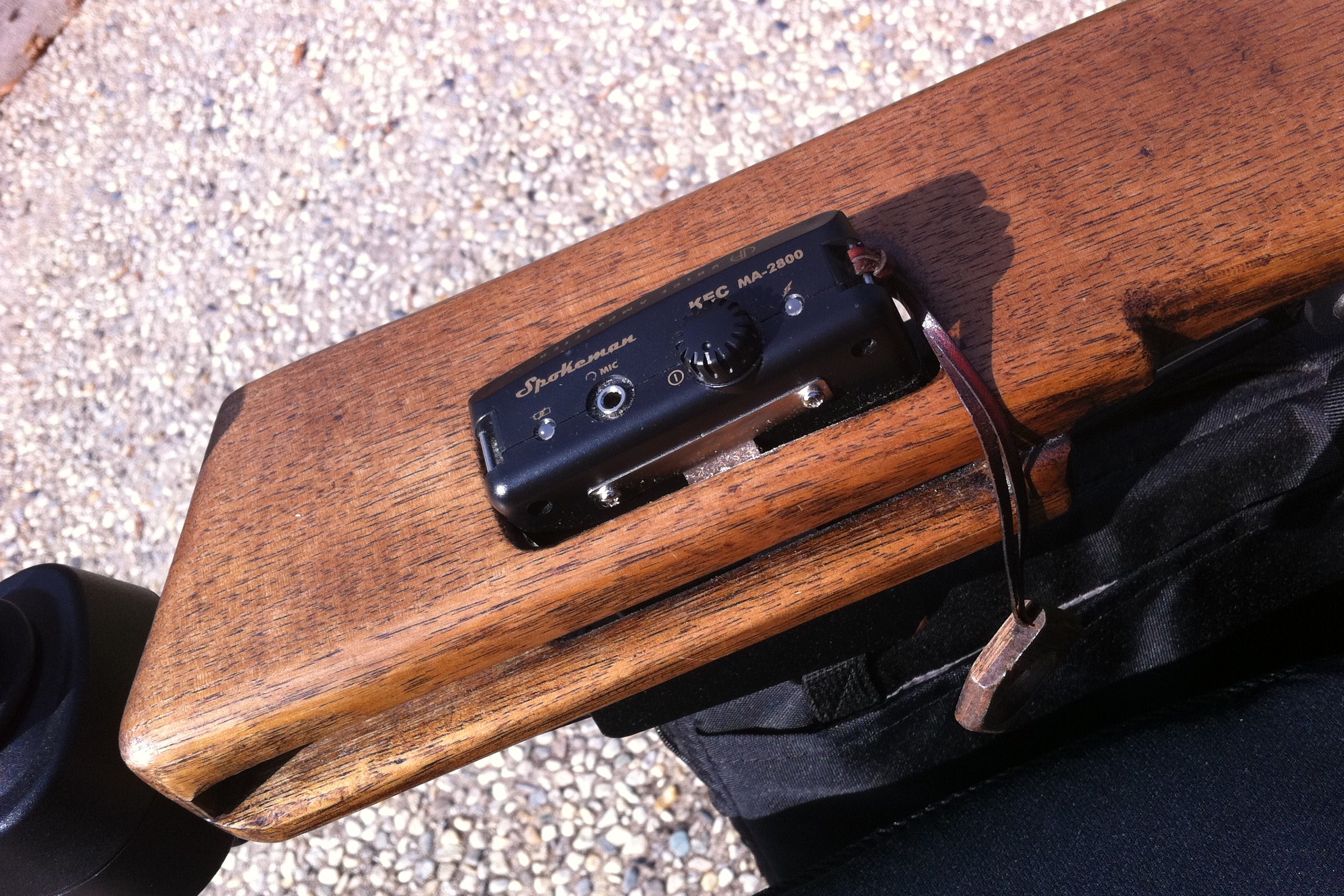
Voice amplifiers are usually supplied with belt clips and neck straps; cumbersome ways of managing the device.  This voice amplifier sits in a recess in the right hand arm.  The volume control is always at the user’s fingertips, and because the loud speaker faces away from the microphone the volume can be turned up considerably without feedback. I now use the amplifier with a netbook computer to produce synthesised speech. The netbook’s carry bag can be seen hanging beneath the armrest, and is easily accessible from the chair.

Pick-Up Stick
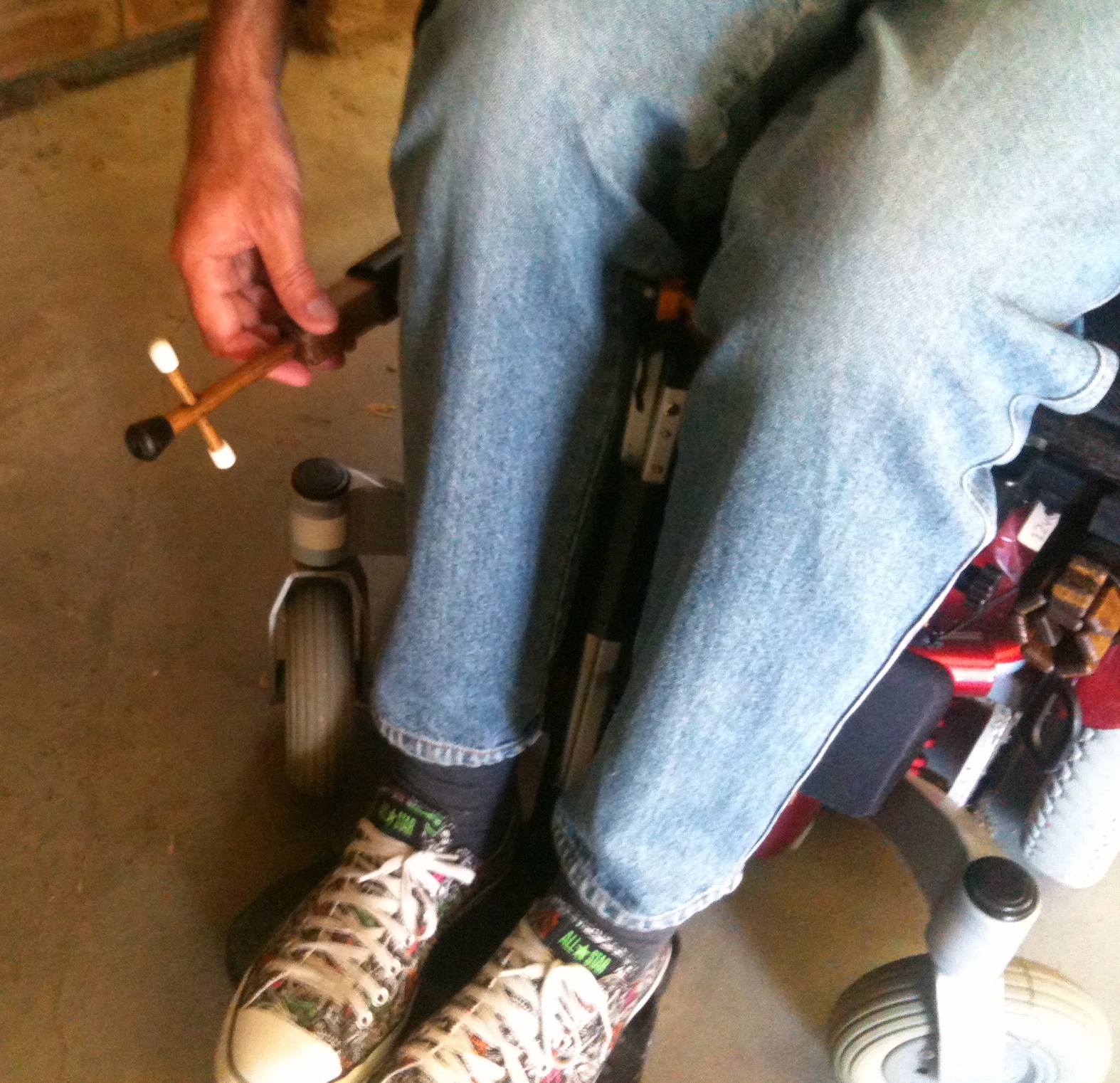
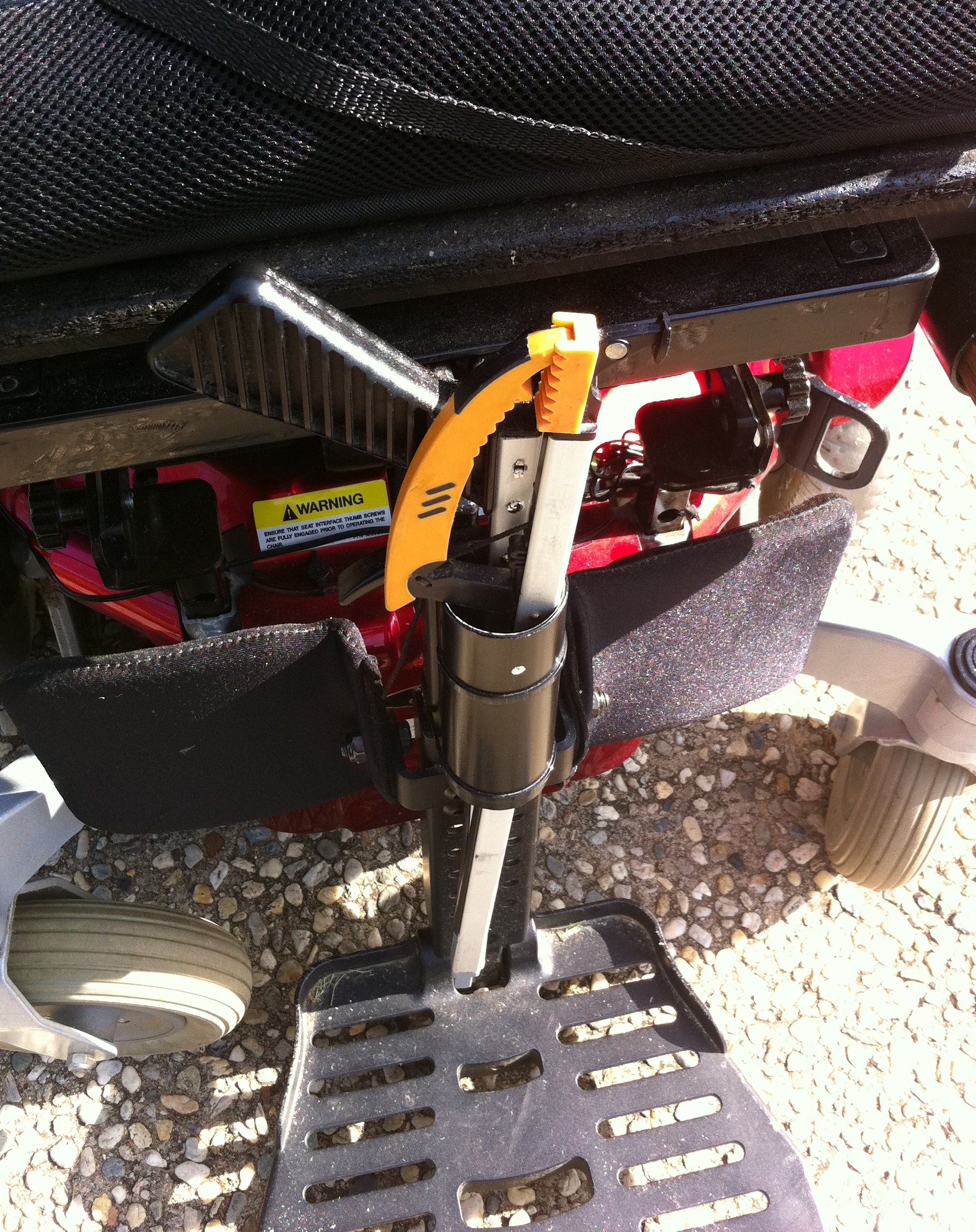
A collapsible pick-up stick can be stored in a length of PVC pipe, and is always on hand at the front of the chair.  In wet weather this is also a good place to stow the umbrella once undercover or on a bus.  Althougth the pick-up stick looks exposed to damage in this position, I have found that it has lasted perfectly well throughout a year of constant use.

Walking Sticks & Umbrella
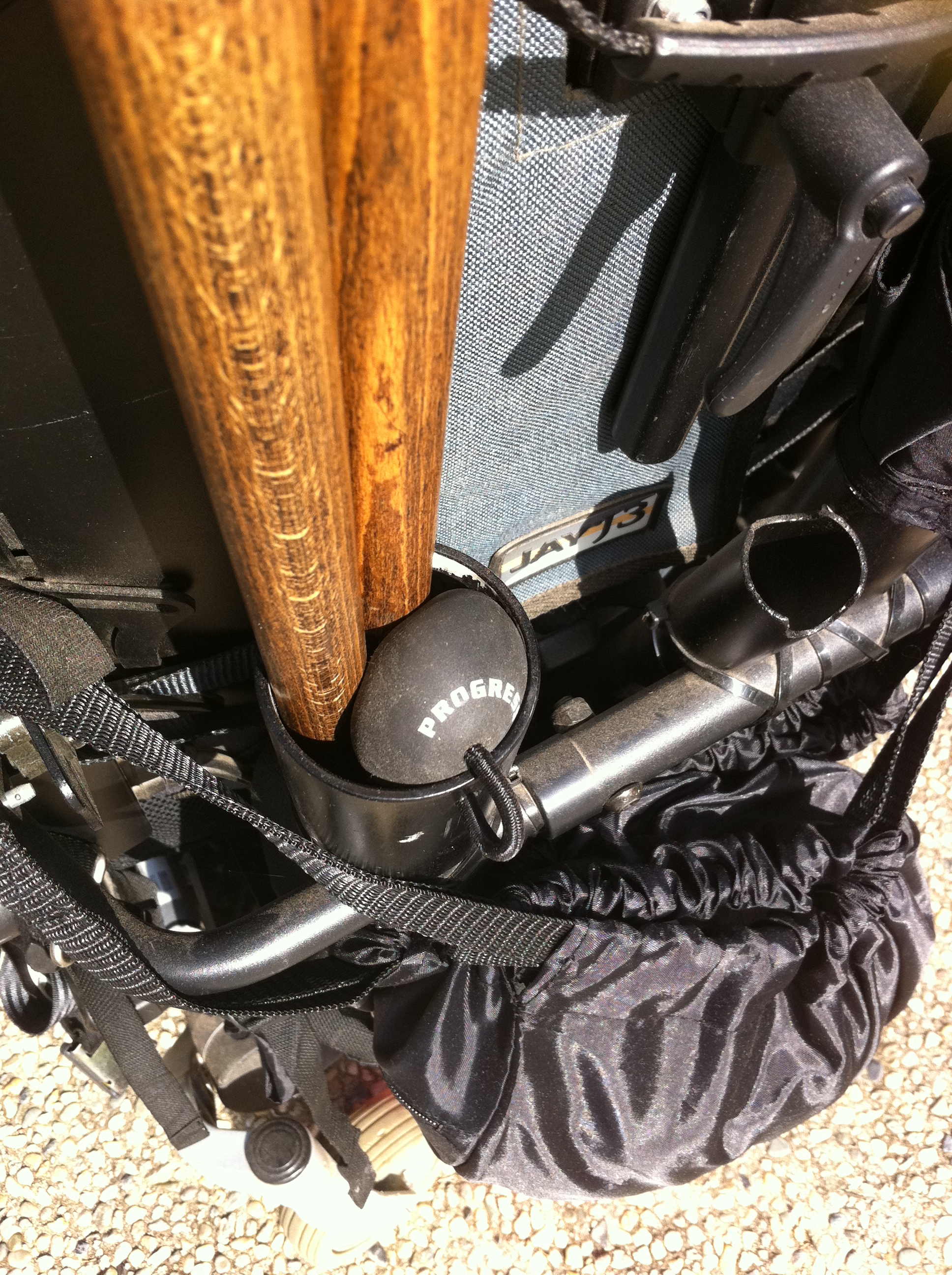
Never leave home without them!  A squash ball keeps sticks secure in a length of PVC pipe and prevents them rattling.  A spring-loaded, automatically opening umbrella is a great asset.  Mounting the PVC pipes at a single point on the bar behind the seat allows them to pivot when the chair is tilted backwards.

Seat Belt
A ‘racing harness’ style belt is made from 50mm webbing and plastic buckles that loop onto the chair’s lap-sash belt.  Adding this has provided much more stability, greatly increasing my range and reducing fatigue while driving.


12 Volt Power
I ordered the chair with two 12 volt power outlets, useful for charging phone or computer.  A 12 volt charger on the other side of the chair keeps AAA batteries charged and ready for lamps and for the amplifier.  A timber guard protects the wiring from weather or accidental fingers.

Head and Tail Lamps
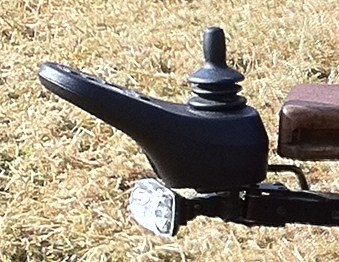
Lamps are essential for travelling after dark, and are useful indoors as well.  You can’t exactly ‘feel your way’ down a dark hallway in a power chair!  Bicycle lamps are an affordable alternative to purpose built wheelchair lights.

__________________________________________________

I feel sure that I would not have achieved nearly as much in the last twelve months without these straightforward improvements.  Of course, not everyone has the opportunity to tinker with timber and screws in the shed; and I’m grateful to have grown up in the home of a carpenter, where there were tools aplenty and every encouragement to learn to build.  I’d love to think something here might be of use.

Rejoice!

_____________________________________________

PS… if you recieved the email version of this post the pictures may not have been beamed to you.  It might be a complete mess!  Who knows? Find it online at www.roderick.me

Flying Blind

Autumn 2011 #12

At 11.25pm a day of great richness is about to close. The date, May 20th, is a memorable anniversary, although not one I cherish.  The twentieth of May in 2009 was the day on which the Neurologist said I had Motor Neurone Disease; and on the twentieth of each month since I have earnestly prayed  these words:  “Two years standing, two years eating, two years speaking … and then I’ll ask for more”.  Prayer is, I think, a tricky subject.  So much about prayer is deeply confusing; not least the question of exactly what to pray for.  After all, how often have the things we don’t want turned out to be invaluable; while the things we have pursued most energetically show themselves in time to be mere ephemera.   But I felt those words were inspired by the Spirit.  And, perhaps they were!  Here I am today at the very end of two years; and just two weeks ago I performed my daughter’s wedding, standing up, using my voice, and we ate together at the reception!  Today I celebrate victory.

What, though, is the “more” to be?  What should my prayer become from this day onwards?

Flying Blind

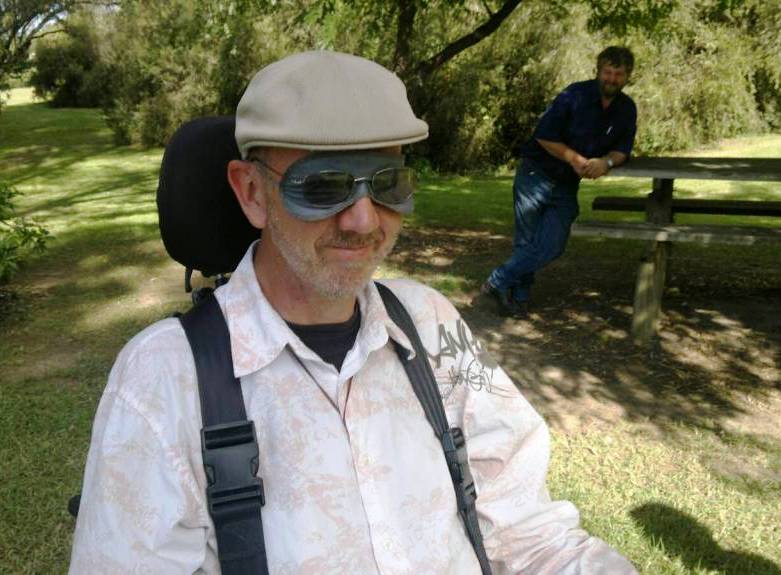
Just a few weeks back Bugger the power chair and I did some blindfold driving.  In a leadership training exercise designed to build trust amongst team members, each of us took a turn being led blindfold on a circuitous route by the spoken prompts of a companion.  On foot this would be novel, in a wheel chair it is exceedingly, diabolically nauseating.  Without the physical feedback that a blindfolded walker would receive from his feet and legs, I could not tell if I was travelling forwards, backwards, left or right, up or down.  Speed is impossible to judge, and very soon the sense of disorientation becomes appalling!  It is fundamental to have a sense of your own direction; and terrifying when you do not.

Following the consultation, 24 months ago, I went straight to our church office.  Later I would drive the lonely hour and a half to our home; but first I needed to  shed some tears: an avalanche almost as alarming as the diagnosis itself. Our pastor was kind and strong; earnestly reminding me that all of life is a Gift, even its most challenging hour.  At some point he disappeared next door in search of bottled water, and returned instead with a tray set with glasses, napkins and a carafe of iced water. “It’s a Gift!” the cafe owner had said.

Driving home in the early evening I called at McDonalds for a customary mocha. Several customers in the queue were quick with advice when the young barrista-in-training admitted he was not mocha-savvy. (It’s so reassuring when the general public rises to assist the person with a walking stick who isn’t getting a fair go!)  He followed the proffered advice, and presented the finished beverage with a flourish and the words, “No charge Sir, it’s a Gift”. True story!

Today, May 20th 2011, has been a gift indeed.  Both our recently married daughters were with us, filling our home with their excitement after a shopping day about town.  Wonderful, joyful day!  Best of all, perhaps, was our early morning moment together for reading and prayer, when my Favourite Wife and I opened the day’s passage:

What, then, shall we say in response to these things? If God is for us, who can be against us? He who did not spare his own Son, but gave him up for us all—how will he not also, along with him, graciously give us all things? Who will bring any charge against those whom God has chosen? It is God who justifies. Who then is the one who condemns? No one. Christ Jesus who died—more than that, who was raised to life—is at the right hand of God and is also interceding for us. Who shall separate us from the love of Christ? Shall trouble or hardship or persecution or famine or nakedness or danger or sword? As it is written:    “For your sake we face death all day long; we are considered as sheep to be slaughtered.” No, in all these things we are more than conquerors through him who loved us. For I am convinced that neither death nor life, neither angels nor demons, neither the present nor the future, nor any powers, neither height nor depth, nor anything else in all creation, will be able to separate us from the love of God that is in Christ Jesus our Lord   (Romans 8:31-39).

In the face of the unknown, flying blind, still with no diagnosis, this passage speaks with great reassurance.  As for “more” … right now I am content with faith-filled surrender.

When memorable, joy-filled days end, as they must, I sometimes find myself in a wistful mood; the air of celebration dampened by a melancholy thought… will there ever be another like this?  Not a new phenomenon, I’ve been indulging in this glum moment for years!  But the great thing is that the rich days, the gift-days, just keep coming.  Not every day or every week, but often enough.

Rejoice!

Naked Truth

Autumn 2011 #11


“The first step will be an Assessment Officer coming to your home to watch you take a shower”
Say what?!
Did you just utter the words I think I heard you utter or did I imagine you uttering something that was not your utterance at all?

Such a moment has much in common with a near-death experience.  Time decelerates.  An other-worldliness descends. A thousand crystal-clear words pass through one’s mind in the time it takes the other person to say three. But the other person’s words are lost.  Their lips are moving, oh so slowly, but the noise is all white.

Sorry, what was that?
“Yes, an assessment.  Don’t worry; all our staff are very well trained”.
As if training were somehow a blind for the supreme immodesty of being observed whilst showering.
“Just hop behind my diploma and take of your clothes please”.

Until a fortnight ago I had scarcely noticed the nineteenth word in this phrase: “Who shall separate us from the love of Christ? Shall trouble or hardship or persecution or famine or nakedness or danger or sword?” (Romans 8:35).  Abruptly this passage became my daily meditation, a mantra perhaps, as the dreadful day of unveiling drew near!

(If, by the way the way, you are reading this and actually know me, or – worse – happen to be related to me, or – unthinkably! – you are one of my children; then you may prefer something else to read at this point. There, you have been warned!)

Showering, as it turns out, is actually the pinnacle of human physical prowess.  Harder than playing a musical instrument, which I can still do; harder than catching as many as seven busses in a wheelchair to get to the office, or the hydrotherapy pool, which I can do excellently!  So difficult, in fact, that I marvel it has not become an Olympic event.  Showering I cannot do.

The Designated Day of Disrobing finally arrived; dawning in welcome relief to a sleepless night.  The Assessment Officer, a she-assessment-officer as it happened, came with a clipboard no less!  I am currently applying under the Freedom of Information Act to gain access to the contents of the clipboard, as I must know what there was about my exhibited physique that she found so noteworthy.

And so, beginning with the visit from the District Nurse, a Routine of Revelation has now commenced: every day or two a pair of nursing eyes – highly trained no doubt – come to Paradise and behold all.  Thankfully I am finding that the New Testament’s words hold true.  True in that the more things change, they more they stay fundamentally the same.  True in that when the worst of all things comes along there is little to fear after all.  Is it embarrassing to undress for a complete stranger?  Yes it is.  Is it worse still to be undressed by that stranger?  Far worse. Does it matter? Not in the least.  In fact the paradigm “less is more” rings true.
No, not less clothing!
Less apprehension – more trust.
Less self-consciousness – more acceptance.
Less pretension – more ‘stark’ reality.
Less pride – more acceptance of the fact that I am, after all, just me.
Plain old naked me, needing help in the shower.

Many years ago the shoe was ‘off’ the other foot when I worked as a volunteer with Sydney City Mission.  It was often my job to supervise the showering of intoxicated, derelict men that the vans picked up nightly from wintry, inner-city streets.   I can’t help wondering: did I, as a twenty year old drenching old men with litres of ghastly de-lousing tonic, show any of the kindness and tact that I now receive?  I have no way of knowing.  I am almost … almost … glad to have discovered by experience something quite wonderful: we are a community that can comfortably and competently care for one another’s intimate needs.  How good it is be one amongst many.

Our ensuite bathroom is no Garden of Eden.  There’s not so much as a potted fern in there, let alone Devil’s Ivy.  Nonetheless, in its confines I feel no shame.   Well, not much.

Rejoice!

Family

Autumn 2011 #10

I am the most fortunate of men!
Once more I stood at the altar as my daughter, transfigured in white, elegant, dazzling, walked down the aisle. 

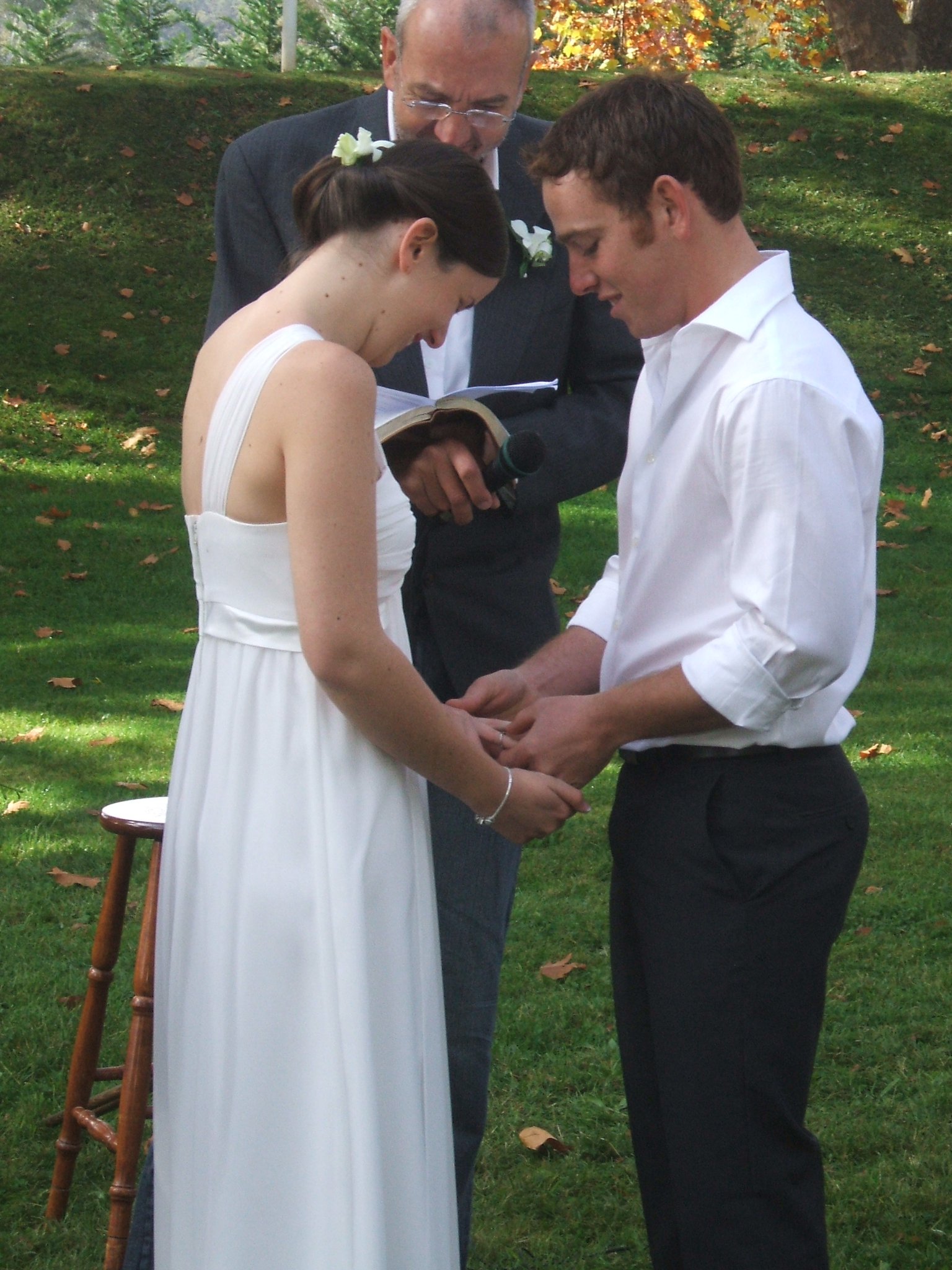
A wedding!  Nothing in life speaks so profoundly.  Nothing embodies so completely the mysteries of promise, hope, destiny and choice.  I love weddings!  I love performing a wedding ceremony, as I have done from time to time; but nothing comes close to the extraordinary privilege of celebrating the marriage of your own child.  Four of our six children are now married, and I have taken part in each of their weddings.  It is, without shred of a doubt, one of my life’s highest points; an indescribable honour.  The first intimacy of parenting is innate.  It’s nappies and homework and hard work.  Then there is the intimacy of the shared journey through years of joys and tears.  And later comes this joyful intimacy of invitation, of being welcomed into our children’s adult worlds. 

Paradise feels empty now; a quiet Sunday evening with just my Favourite Wife and Little One at home.  It’s hard to believe that just hours ago the walls were bulging with our children, their spouses, our grandchildren, and even some bridesmaids jostling for a bed in which to sleep or a mirror in which to preen.  So much noise, so much fun. 

Family. The wondrously imperfect agglomeration of souls. I gaze on the most familiar faces in the world, I listen to intonation and turn of phrase that are so well known that I feel I could write the script; and still I wonder: how did we end up together? Related we are, and yet so stunningly, delightfully different!  For me and mine this is especially true, as we are a family of adoption and blending, or, as we like to say, a family by choice.

The wedding day was not, it must be said, without a hitch.  There were glitches aplenty truth be told!  But it was magnificent, and each challenge, each drama, was embraced with calm good-humour. Laughter won the day. We did it!  My daughter, my son-in-law, my wife, my whole family … we did it!  And I am one proud Dad!

Tonight I feel lonesome, as the sun’s last beam rapidly crests our hills.  But there are more good days for us, as there have always been.  What is a family?  It is certainly more than any one of us, much more even than the sum of us all.  A family is history, embrace, destiny and hope. A family is love, and love is choice, and I feel chosen.

Rejoice!

The Invisible Man

Autumn 2011 #9

So… there was a man with three eyes, no arms and one leg trying to hitch a ride.  Walk a mile in his shoe, as they say, and you will appreciate the challenge that he faced.  Anyway, there he was, hopping up and down on the spot and flashing his three eyes at every passing car; but nobody pulled over for him, in fact no one paid him a moment’s attention.  Which is odd, given that it’s not every day one sees a three eyed, one-legged man with no arms.   “Am I invisible or something?” he thought to himself.  But just at that moment a car braked rapidly to a stop and reversed back.  A door flew open, a cheery face appeared, “Aye aye aye, you look pretty ’armless, hop in!”

There was another man with a wheel chair, a mobile phone, and a bunch of little printed cards which sometimes served instead of a voice.  This man was trying to get into a shop, a rather difficult sort of shop, which had a steep, rubberised concrete ramp from the footpath up to its plate-glass, non-automatic doors.  So steep was this ramp that the only way the man in the wheel chair could negotiate it was in reverse – a little trick he had previously learned about his power chair and sharp inclines.  He needed to access this particular store, and so he waited for the next customer coming, hoping ride in on their coat tails.  He waited, and waited, and a score of focused, busy people came and went from the glass doors, but not one of them stopped.  He even tried a tentative wave once or twice, without any effect at all.

The man chose one of his printed cards, the one that said, “Sorry, no voice”, and held it hopefully towards a few pedestrians as they sprinted up and down the rubberised concrete ramp.  A certain, creeping loneliness descended on the man in the wheelchair as the shopping crowd paid him no attention whatsoever.   “Am I invisible or something?” he thought to himself. 

His next strategy was to type into his phone, in large black letters, a simple statement of the predicament:

“Could you hold the door please?”


Douglas Adams best describes the escalation of invisibility that immediately beset the man in the wheelchair.  In The Hitchhiker’s Guide to the Galaxy the Starship Bistromath is able to land smack in the midst of a cricket match at Lord’s, rendered invisible by its SEP field.  In the words of the intergalactic hitchhiker Ford Prefect:

An SEP is something we can’t see, or don’t see, or our brain doesn’t let us see, because we think that it’s Somebody Else’s Problem…  The brain just edits it out; it’s like a blind spot. If you look at it directly you won’t see it unless you know precisely what it is. Your only hope is to catch it by surprise out of the corner of your eye.

No longer did the general public simply ignore the man on the footpath, now they seemed able to stare right through him; and the creeping tide of loneliness swelled to a deluge of alienation.  “Am I really that strange?” thought the man.  It was a vaguely terrifying feeling to discover that the public, normally so friendly and helpful, could become cold and ambivalent to his plight.  Balancing on a precipice of isolating self-pity, the invisible man realised that he had passed a tipping point; that his form had become somehow unpalatable to those around him. He was too different.  He saw that he had become so absorbed in the crisis of circumstance that he himself had, for a moment, forgotten to reach out.  Needing help, he had unwittingly alienated himself from his helpers. 

It was an epiphany.  The invisible man put away the cards, put down the phone, and simply smiled.  He sensed a change in the river of humanity.  He was becoming visible once more. The relief at re-entering the world of men and women was so intoxicating that his smile broadened, and was for a moment in danger of spreading to a manic grin – the catastrophic result of which would have certainly been instantaneous propulsion back into SEP oblivion!

The erstwhile invisible man caught someone’s eye, and they responded to his smile, read the message on his phone, and gladly broke their stride to assist.  The man rather awkwardly drove backwards up the rubberised ramp and delicately edged through the sheet-glass doors.  An exchange of smiles was enough to convey gratitude and willingness from either side of the bond.   

What a relief!  What a lesson.  Just smile, and bridge the gap. 

Rejoice!

Grace

 Autumn 2011 #8

Like the Crucifixion, Paddy’s story is a sad and ugly tale, and one with unexpected beauty. 

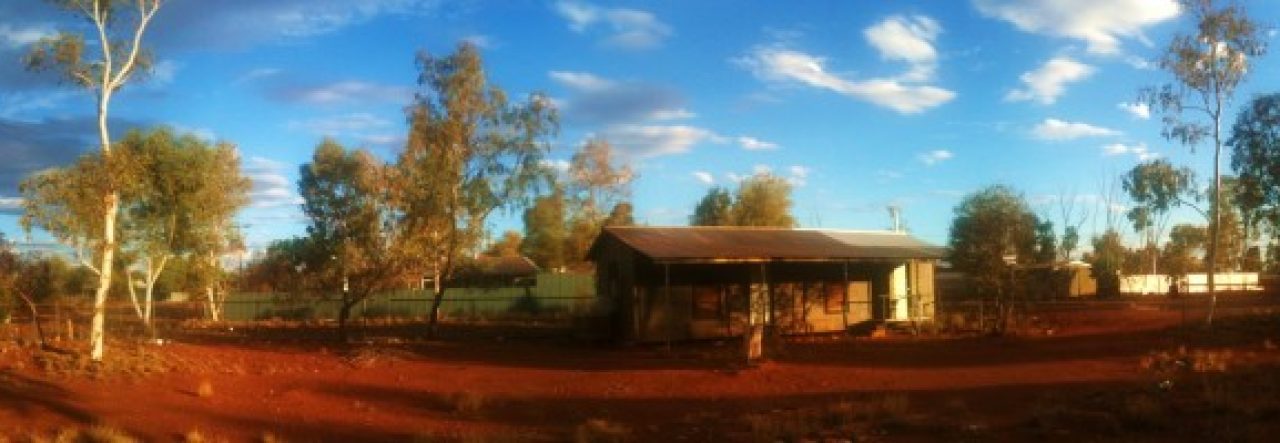
One year ago I celebrated Easter in the crisp of dawn on a remote community in the western reaches of Central Australia.  As we gathered in a bough shed to remember the power of resurrection; tiny, hopeful drops of rain fell through the pale gold of sunrise, and the wonderful voices of Aboriginal women sang Ngaanyatjarra songs of faith and grace.

During Easter week I had spent several evenings with a good friend; a gifted raconteur, a man of humour and wisdom, and a leader in the aboriginal community and church.  As on other occasions, I listened in rapt attention to tales curious and profound; my friend’s wife always by his side to prompt him gently back to the middle ground when the tales grew too curious or too profound!  Each night’s rich discussion would conclude with reading and prayer.  On one evening he shared the tale of Paddy Holland, an aboriginal man I had known in the early ‘80s when I was living and working on this same outback community.  I was in my late teens and Paddy was one of our regular customers in the Community Store.  He was a character, to say the least; a wily, larrikin sort of bloke.  I always felt there might have been some serious steel beneath the glint in his gradually ageing eyes; that his joking ways may have had a sterner edge in years gone by.  The story held that Paddy had been arrested long ago for an unknown offence; major, trifling or imagined.  Paddy was shackled in neck irons, and forced by a mounted Police Constable and his Black Tracker to walk several hundred miles to holding cells and magistrates in the mining towns down south.

This was a long, long time ago; and between my friend’s recounting and a little reading I have pieced together a glimpse of the horrors of a forced march through the Great Victoria Desert.  Constables were paid a very basic salary, supplemented by a living allowance from which prisoners were fed.  For the constable there was an obvious advantage in chaining together as many captives as he could, maybe a dozen or more, as there was a handsome profit to be made from the allowance that was paid per head.  And once he bagged his dozen he stood to capitalise further still by taking his time on the return journey.  If he took a detour, wandered around the sand country for a month or two while his investment matured, nobody would any be the wiser … if those in authority actually cared in the first place. 

My friend is wonderfully animated, but this tragedy was nearly beyond his scope.  He mimicked the constable on horseback; parodied the strange-tongued black tracker; and pulled exaggerated and hopeless grimaces to introduce each of the aboriginal prisoners. Tears began to course freely down his dark and lined face and his eyes grew impossibly wide in horror.  He seemed to be walking once again in irons with his people. 

It was not, you see, in the constable’s best interest to let his captives catch bush tucker.  These lean and wiry folk lived well on goanna, witchetty grub, and the odd kangaroo when times were good.  But the cheapest and safest solution for the constable was sugary black tea and damper, week in and week out.  Stomachs finely tuned to the feast and famine of nomadic life soon protested the white man’s muck; and chronic diarrhoea became a permanent link in the chain gang.   Tribal Aboriginal people were unembarrassed by nakedness, but like people the world over were discreet with life’s functions.  My friend portrayed this scene in a manner I will never forget, and can never repeat.  Men and women chained together night and day, forced into degradation that breached and annihilated the last scrap of dignity.  The notion beggars description, and I find it horrendously confronting to think that all this happened to a man whom I had known.

Pain is the most subjective of experiences.  A minor ailment can sometimes be as difficult to manage as a major one, but my own sense is that illness, disability, material loss, and physical pain – trying though they are – come nowhere near the soul-crushing agony of suffering at the hand of a fellow human being.  Although I have felt little of it in my own life, of this I am sure:  be it hatred, injustice or simple indifference, man’s inhumanity to man is the chief among torments. 

The beauty of this story comes years later, and is embodied in its teller.  My friend was speaking of his own uncle, and his sense of injustice and outrage were absolutely real.  Yet he bears no animosity whatever against the white-man perpetrators of this crime.  He forgives them, because he knows that he too is a forgiven man.  He told me this truth with tears in his eyes and a hand raised to heaven.  This is grace.

I have been reading John’s Gospel over Easter.  In four days I have scarcely covered one chapter, running aground on verse 38 with Christ’s first words, “What do you want?”   Why would the One “who was with God, and who was God, and through whom all things were made” ask that?  I cannot begin to record the dreadful answers that simple question has dredged from the depths of my soul this weekend.  But there is one thing I do long for, the chief among gifts, and this is grace. 

Rejoice!

Dedicated to David; a man of wisdom, humour, faith and grace; who left this world today. 

____________________________________________________

(Footnote:  My own western mind has wondered about the dates and details of this story; and if you are reading this and share the privilege of having lived in the Western Desert you may wonder also.  I resisted the temptation to consult with people who could perhaps have shed historical light on the story; and I have simply told just as I heard).

The Androgynous Wheelchair

Autumn 2011 #7
 
The van from the wheelchair shop has come to Paradise, yet again.  I was unequivocal:

“Well, you can take that one straight back again mate.  It’s got a hole in it!”

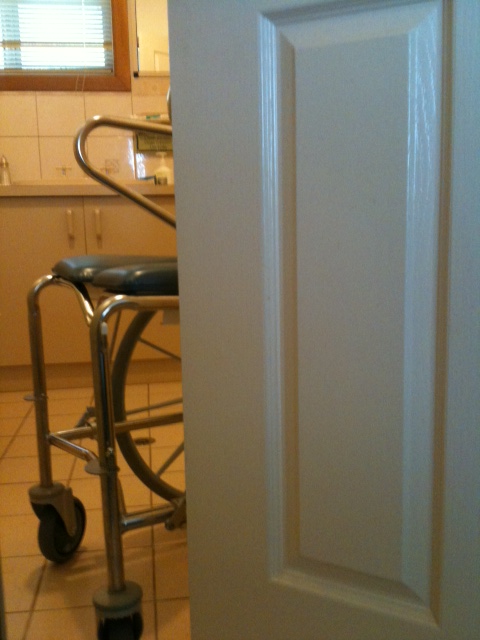
Poor B5, fifth incarnation of Good Old Bugger, is a chair like no other.  Cold and utilitarian, it is no vehicle of discovery, no machine to take pride in; in short, B5 is no B4!   Nine months ago I wrote with voyeuristic horror about a device I examined at Brooklyn’s Independent Living Centre: the Attendant Propelled Mobile Shower Commode Chair *.  Poor B5 at least has the distinction of being Self Propelled, but there its dignityends.  My favourite Wife informed me that Little One gave Poor B5 a thorough going over yesterday, paying perplexed attention to the carpet directly beneath the mysterious and highly inappropriate ‘hole’.
A rare glimpse of the coy and camera-shy Poor B5

A note on Gender. 
B4 – indeed the entire Bugger stableis of the fairer sex.  It’s immediately evident in the cut of her jib and the style of her footplate. She has the graceful lines of a skiff under sail. Poor B5, however, is another matter.  Male? Female? I honestly can’t tell!  ‘It’ has no personality at all, nothing to suggest either masculine stamina or feminine wile charm.  ‘It’ is all white plastic, shiny stainless steel, and pallid blue vinyl.  Awkward and anaemic, Poor B5 evokes a lingering sense of pity.  How terribly, terribly sad.  Who ever heard of an androgynous wheelchair? 

Why, I hear you ask, would I write about such things?  If you aren’t actually asking that question, I know I surely am!  Why would I want to exhibit this obnoxious contraption on the World Wide Web?  Well, for starters there is a certain macabre humour about a Commode that I find appealing, but difficult to justify.  Then I admit that there is hidden within me – and not at any great depth, let it be said – something of the nature of the attention seeker.  (I have long had a visceral anticipation for the moment during the flight safety demonstration when the life jacket adorned airline stewardess says “and a whistle to attract attention”.   When they wave that whistle around I so badly want to blow it!  Give me the whistle! Pleeease let me have the whistle!).  And I guess it’s part of the human condition to parade our problems now and then for everyone to see.  Especially for us blokes who make such miserable patients and thrive on sympathetic attention.  But those are not my reasons for this expose.

No, the simple explanation is that Poor B5 needs friends; people like you in fact!  Poor, reclusive B5 is a hermit; ‘it’ desperately needs to get out.  In a full week Poor B5 has not ventured out of the house once.  In fact ‘it’ rarely leaves one particular room; a dark, airless room at that.    After letting ‘it’ have a couple of days to settle into our home I was gunning for a trip to town; a coffee in the mall, or at the very least a run round park down the road. Do you think Poor B5 was interested?  Not for a second.  A firm rebuttal.  No go. 

A definition:   Occult; (adjct)
1. hidden from view.
2. secret; disclosed or communicated only to the initiated.
3. of or pertaining to secret and supernatural powers or agencies.

I am not – not for one second – suggesting that there is anything unseemly or evil about Poor B5.  But one must ask: just what is ‘it’ getting up to in there, locked away in secrecy for hours on end?

Privacy is no secret.  Privacy is a curious practice, given that we diligently hide from each other the very things that we share most fundamentally in common.  Secrecy, in contrast, involves hiding what others do not know.   Privacy is a false blind, and provides a tangible bond amongst members of the ‘normal’ world.  We are united by the unspoken knowledge of our private commonality.  And that, I think, actually explains my strange desire to tell the world about Poor B5, the Self Propelled Mobile Shower Commode Chair.  If everyone had one, then concealing ‘it’ from view (as we hurriedly did yesterday when visitors came by!) would simply be a matter of privacy.  But because a Commode is not part of the ‘normal’ person’s world, privacy quickly becomes secrecy. 

Secrecy I cannot abide.  If I tell the world it is a bid to belong to the world.  You know my secrets, therefore we aren’t all that different, and therefore I am not alone. 

KBO!

______________________________________________________________

*Attendant Propelled Mobile Shower Commode Chair (item 11:45:037), available in fetching surgical stainless steel and white plastic. This accessory makes a robust attack on most readings of the word ‘Independent’, and like so many of the devices on display, its design has a wordless power to chill the core of a man.  (Guiding Star, July 2010).

The King in Federation Square

Autumn 2011 #6

Bleak perhaps, but last week’s post was fact.  ‘Bums and belts’, however, was only one facet of our Melbourne weekend.  This, then, is the flip side, the head to last Sunday’s tail; the uppermost half of the brim-full glass:

A tiny Little Blue Man, barely two inches across, caught my attention amongst the flagstones of Federation Square where we were meeting my Godmother for lunch.  It’s worth stopping for a moment to note that this beloved friend and I have a long history of remarkable, coincidental adventure; Dumbstruck’ being the most astonishing.  The Little Blue Man held my puzzled gaze until eventually it dawned on me that there was another about two feet away, and another, and another; all marking a wandering trail up through the centre of the Square.  With my Favourite Wife and Godmother in tow, the hunt was on.  How could anyone resist a trail marked by such reliable friends as Little Blue Men?  Icons of access, harbingers of the privileged path*.

A two inch Little Blue Man

The terminus of our trail was a wheelchair lift; but more attractive to us was the restaurant next door.  Perfect!  We were shown to one table, but there was another, further in, against a dramatic glass wall.   We settled in, Bugger and all, we ordered, the food was superb, and the view utterly absorbing.  In the near distance the Yarra River; beneath us through the glass wall the timber-lined elegance of the Edge Auditorium; at its heart a grand piano, and at its keys a piano tuner engrossed in his trade.  Perfect indeed!  We sat enthralled in a sensory feast of good company, fine food and the intriguing drama unfolding below.  Seats were being set and a growing number of black-clad minions with the insignia ‘VO’ were scurrying to and fro.

As we ordered dessert, and then coffee, and then more coffee, just to keep a stake on our table, the excitement was building downstairs. Through the glass wall we saw a well known face, that of Richard Gill, conductor of the Victorian Opera!  Then through the glass wall we saw another well known face, that of my cousin!  Crikey!  A flurry of excited hand waving and urgent SMSing conveyed an invitation to come downstairs.  And that is how we came to join in a rehearsal, and later that night to sing in a massed choir with soloists from the Victorian Opera.  Crikey indeed!

"Sing Your Own Opera", BMW Edge Auditorium.

Well, advocates of the Chaos Theory propound something called the ‘sensitive dependence on initial conditions’.  Hence the Butterfly Effect, where the tiny beat of a butterfly’s wing in Brazil creates – or cancels – a tornado in Texas.  And when life seems to turn for better or worse on a moment of chance, one can wonder if chaos is king.  But there was nothing chaotic in our day!  It was perfect; rich with unexpected adventure, exhilarating friendship, good food, music, laughter and life!  I much prefer the Congruence Theory, believing that even a Little Blue Man points to destiny.

 As for the King in Federation Square … well, who could have organised all that?  You be the judge.  

Rejoice!

___________________________________________________________

*More on the wonders of Little Blue Men.