Walkie Talkies

Winter 2001 #12  

I DETEST the use of capital letters to add emphasis. And I LOATHE!! the inane habit of doubling or tripling exclamation marks to further exclaim their exclamity.  But what I ABHOR is the way people invariably direct their questions and comments to the taller, walking person when I am out with an able-bodied companion.  Their (perfectly reasonable) assumption that I can’t fend for myself DRIVES ME NUTS  !!!  

I was slow to notice how frequently this happens; and I had well-developed defensive mechanisms in place long before I consciously identified the ‘Walkie Talkie Effect’.  For example, in able-bodied company I would race to be first at a counter; I would prepare all my typed messages in advance; and I would always keep my computer on standby, ready for action should anything need to be communicated to anyone!  Over time, however, I have learned that my defenses are ineffective against the powerful Walkie Talkie paradigm: people will chat over my head, and there is little I can do to stop it.  I am hypersensitive to an ironic cruelty that occurs with regularity: while I am the one with no voice, the able-bods above me instinctively revert to non-verbal communication to mutely discuss my competence.  I have seen this a hundred times: in a furtive glance away from me and up to the Walkie Talkie, the person I am attempting to engage will search my companion’s face for some clue as to my fitness to conduct business in public.  I can read it in their eyes, “Is it OK to talk to this man, or should I talk to you instead? Are you his carer? How handicapped is he?  Can you rescue me?”  GOSH I hate THAT.

Recently I was travelling by train with a cherished (nameless) family member, and the Walkie Talkie Effect was in full swing!  On this occasion I was definitely the ‘expedition leader’; my companion having considerably less rail experience, and none whatsoever with a wheelchair. But do you think anyone believed that?  Not for a moment.  CRIKEY!! It was on for young and old (there is a tiny clue there) with railway staff almost oblivious to my presence, let alone my consummate ability as a locomotive pilgrim.  My DISPLEASURE reached a crescendo when a passenger standing onboard our carriage (my unnamed relative has rather a penchant for engaging complete strangers in jovial banter) said, about me, verbatim: “And doesn’t he look smart too, nicely turned out in his cap and scarf”.  AARGH!!! How DEMEANING!! The memory makes my skin crawl.

I understand the Walkie Talkie effect, and I’m certain that if I were either one of the walking persons, instead of being the odd-bod in the wheelchair, I would do just the same.  I probably have done.  Most folks genuinely want to help, after all; and how are they to guess the degree of my ability?  I suppose it’s reasonable for anyone to conclude that my difficulties are due to some sort of brain damage; or a mental handicap.   I sometimes get the feeling that is what people are thinking, and I have a little card in my collection that I flash now and then:

It HURTS! In the same way that we often feel much younger than our years, I am inclined to forget starkness of my circumstance until something or someone reminds me.  These moments can be tipping points for many collected emotions: ANNOYANCE, FRUSTRATION, JEALOUSY, EMBARASEMENT, FEAR, UNCERTAINTY – you name it. 

But mostly, it pains me to say, it’s sheer pride. Few of these feelings are any different in nature or intensity from those I felt in different circumstances as a ‘normal’ person throughout my life. It’s so tempting to make excuses.  It’s all too easy to indulge the feeling of being wronged.  Attribution is a delicate matter: a wheelchair can be a great pretext for making one’s own issues everyone else’s problem.  I have had a long attraction to the ‘quieted soul’ that King David describes in Psalm 131:

My heart is not proud, LORD,
my eyes are not haughty;
I do not concern myself with great matters
or things too wonderful for me.
But I have calmed and quieted myself,
I am like a weaned child with its mother;
like a weaned child I am content.

Rejoice!

A Golden Watch

Winter 2011 #11

Little One can be a touch slow of a morning.  But let’s delve into the thesaurus for a moment and refine that description:  She can be obstinate, obdurate, refractory, ponderous, intractable and just plain stubborn!  Getting her out the door for school on some mornings requires super-human creativity.  Something within her adorable character is acutely sensitive to the tiniest hint of urgency; and once triggered her cooperation is then available in inverse proportion to its necessity!  The more dire punctuality becomes, the less likely we are to achieve it.  But, I guess parents the world over have played School-Morning Stand-Off.

Little One takes this pastime just a parsec or two further than our other children dared to even dream.  Back when we lived in a home with a rather grand front staircase, Little One would sometimes commence a special morning dance on the top step: three steps left, hop, three steps right, hop-hop; stamp both feet, rock side to side, and…….jump!  Three steps left, hop, three steps right, hop-hop; stamp both feet … you get the idea.  The OCD two-step. Our sole parental defence against this attack was complete absorption: watch, smile, don’t blink.  The slightest whiff of frustration, or a stolen glance at a wrist watch, could risk a dramatic escalation to the OCD Salsa, or even the Tango!  You may think we are soft, indulgent parents:  I assure you, with six children and almost 250 parent-years clocked up between us; that is most certainly not the case!

Little One also had imaginary pets that attended preschool.  Impressively, the invisible companion that left in the morning was often the very same friend that came home six hours later, and we could read up on the activities of this exact animal in the teacher’s communication book that evening.   My favourite was a crocodile who first visited our home around the time of Steve Irwin’s fatal encounter with a stingray.  In order to be put in the car the make-believe croc had first to be violently spear-tackled in the hall by our then four year old, wrestled into submission, roped, and dragged unwillingly with one hand, school satchel in the other.  Several years on my Favourite Wife still rises at 5.30am, hoping each day to gain the strategic high ground in the daily battle of wills!

Lately I am also ‘a touch slow of a morning’.  So slow, in fact, that three weeks ago I finally called it quits on the all-important Tuesday bus ride to our church office, where I have held a gradually diminishing role these past couple of years.  This journey has been the regular highlight of most weeks. The productivity and banter of our staff and team have been a rich delight, and a privilege to share.  More recently communication (or rather its absence) has eroded much of the pleasure of this routine; but the death-knell of my career was sounded by something far more mundane: Personal Grooming.  I can no longer both dress myself and catch a bus on the same morning.  For weeks I have been juggling options, tweaking bus connections, even arranging Home Care to come in the late afternoon – just to squeeze the last little bit out of Tuesdays.  But all to no avail. 

Like a midnight ebbing of the tide, the last days of my thirty year vocation went unnoticed by friend or colleague. No fanfare, no gold watch. I don’t know why, perhaps the required words are too hard to phrase, but more likely no one noticed.  It’s a pathetic little tale, don’t you think?  And I am dreadfully aware of the indulgent self pity in my melodramatic retelling!  

Nothing has been as hard to surrender as this; perhaps because one’s occupation is something of a metaphor of other strengths.  As a carpenter when we were first married there was immense satisfaction in packing up tools after long and productive days, driving home, sitting at the dinner table with our young family, sensing the pleasure of sheer exhaustion, the tingle of small wounds  and the buzzing of muscles well stretched. Good days!  Later on in ministry my fulfilment sometimes rested on the delivery of a good sermon, or in a valuable counselling discussion, or in the myriad other enjoyable details of a busy church.  I dearly miss the purpose and accomplishment that attended several decades of life; but I also question my own attachment to industry.   Business, achievement and – above all – popularity, are heady opiates that have shielded me from prolonged exposure to aspects of my own soul; and these new days of long and silent inactivity require a fortitude and peacefulness that I wonder if I possess.

But I am fortunate as well, or blessed.  No doubt Little One will entertain us (or terrorise us!) with a new rendition of morning-slowness again tomorrow; and then the house will grow quiet for many hours, until the sun sets and they return home once more.  I will have my own unhurried company for much of that time; to spend – I hope – in reflection, gratitude, prayer, correspondence, language and thought. A Golden Watch, perhaps?


Rejoice!


Familiar Heroes

Winter 2011 #10

We are up in the air.
Figuratively that’s often the case; today, though, it is literally true.  My Favourite Wife, Little One and I are flying home from my mother’s funeral service.  Completing our foursome Bugger, the power chair, is riding safely in the cargo hold somewhere down below. 

We very nearly stayed at home, the logistics of travelling so far with not one, but two disabled passengers seemed way beyond our reach. But early last week I took my chair out to the airport, and after much measuring, weighing, discussion and consulting of manuals the staff assured me that we could indeed fly.  My ever-resourceful brother flew down to be my travelling companion.  Some people call him “Q”, for his uncanny ability to resource almost any exploit.  An aviation journalist and amateur pilot, he is allowed onto the normally prohibited space of the busy runway apron; and it was fascinating to watch him at work instructing the Captain and ground crew in the finer points of loading my wheelchair onto their plane!  He’s a hero, and I could not have flown without him. 

Little One and I flew separately. For her first experience in the air there would be just one parent to give her undivided attention, and definitely no alternate parent in her sight.  Little One is a walking-talking-wedge, dividing and conquering with the skill of a political campaigner.  But she did very, very well, because she is a hero too. She has been a wonderful girl all weekend. (…except for the moment when she oh-so-innocently persuaded me to show her how the hotel key-card worked.  With the door barely open a crack the temptation was too great. Through she shot, a ten-year old filly on the home straight, full tilt, with Bugger and Mother flat tack behind.  We finally caught her just as she rounded the farthest corner of our hotel floor.  She is our Little (tricky) Hero.

Little One flies for the very first time

My Best Girl; now she is a hero of the constant, enduring type.  Her heroism is not the sort that emerges in moments of crisis – although it can.  She is an everyday hero of the most uncommon kind.  Every day she carries us, her family, in her hands and in her heart. Without her we have no tomorrow.  She is my Favourite Hero.

My father, now he is a true Hero too.  I wrote of him last week, and he is still the same: embracing so many with love and gratitude and peace and fun and love.  We have been to a funeral, but we have been fully alive. In coming together to say farewell, our large and diverse family have met one another more deeply and afresh.  I can only speak for myself, but my sadness is far outweighed by joy.  We have lost one of our own, and in one sense must be poorer.  But in dying we live; and a life well lived lives on: not only in its own eternal way, but in the life and love we share as we all live and grow. My mother’s sons, cousins, nieces, nephews, grandchildren, great grand children, and on and on; one and all we are family, an immeasurable wealth. 

Rejoice!

Helvetica Grieving

Winter 2011 #9

I didn’t write last week. Lots of interesting thoughts were jotted down, ready to go, but nothing was close to honest beside the singular truth that my mother was dying, and I wasn’t ready to write about that.

Am I ready now? “It wasn’t time for her to go”, a friend once said to me with moist eyes; adding words I have not forgotten, “There is never a right time to lose your mum”. Right for Mum, perhaps, and in time it might be right for all of us; but today it is wrong.  Today I need to open memories, fondle the texture of sights and sounds from all the years, and fold them away for another day.  I am still wondering where part of me has suddenly gone, a dislocation, an amputation.

I am wondering, also, how to utter this grief.  I’m a talker; not garrulous or even florid (as far as I know!), but I have always talked a thing through in order to find its core.  A mathematics equation at school often fell into its obvious solution while I explained my attempt to a fellow student.  A crossword blank will sometimes jump out in the very moment that you read aloud the clue.  And on any day when my world seems dark, a conversation with a friend – a conversation about anything at all – has always seemed enough to brighten the sky.  I need some banter, a chat, just a moment to tell someone how I feel; how well my family is dealing with the news, how proud I am of my own father.  I’d like to reminisce out loud, to recall the incomparable aromas of my mother’s kitchen, revisit the safety of childhood adventure, embrace – in words at least – my Mum who kept us safe, and talk about the one I dearly miss.  Instead I have this sterile, Helvetica vocabulary of keyboard phrases and the odd whispered thought.  If grief is a passage, I am wedged between its walls; trapped, unable to gain traction and establish my gait. Wordless emotions are lying at bay, itching to emerge, hungering for their cathartic declaration; but their moment will not come. How do you process grief without giving voice?

My father, however, amazes me.  He has set the standard in saying farewell in love.  He has stayed completely at his post, a helmsman of the family ship, steering unerringly to safe harbour with warmth and humour and stamina and great courage.  Our much-loved cousin found words to capture his spirit…

so calmly
so peacefully
so logically
so acceptingly
so positively
so lovingly

so today


Rejoice!


The Cone of Silence

Winter 2011 #8

On Tuesday we will celebrate Bugger’s first birthday!  (less a cause for celebration is the expiry of my power chair’s warranty, somewhat sobering given that we have already had two new motors and two new batteries). 

My primary fascination a year ago was to discover just how far afield Bugger and I could venture; with and without the aid of public transport.  To my delight I discovered we could go a long, long way.  Unaided we could manage some 15km on the footpaths, roads and riverside cycle tracks of our city.  With a little push from a train we once ventured 1107 km from home!

A new fascination has taken root in recent times.  Rather than simple mileage; my goal has become ‘conversational complexity’.  The object of this game is to accomplish increasingly intricate public transactions, and the single rule of the game is that no word can be spoken by me.  When I initially found the need to engage shop assistants, bus drivers and the like in word-free dialogue I was embarrassed and daunted.  I am still a little embarrassed today, but my overriding experience is delight.  I find people are universally happy to adapt to the rules of my world; and with their help I have graduated from buying bus tickets to purchasing clothes and appliances (that was particularly good: I purchased a television and even carried it home on the bus!), registering vehicles, sourcing support, establishing bank loans, engaging solicitors, right up to the crowning achievement of buying a home! 

The Cone of Silence is addictive.  First I flash my laminated “Sorry, no voice” card, and then I flourish my NetBook computer, or perhaps my iPhone, and as I type an aura of concentration descends.  The mastery of technique required by both parties can be intense, and a hush absorbs us until all worldly distractions retreat from the transcendental encounter taking place across the counter top.  I enjoy these moments immensely. Pressing through nerves and anxiety about my typing skills, a tangible, intimate connection emerges.  It’s almost sacred.  Francis of Assisi described every meeting between one human and another as a sacrament; an encounter between the sons and daughters of God.  The public and I become co-conspirators, engaged in a clandestine operation to defeat the demons of disability! The run-of-the-mill dealings in my former able-bodied life were humdrum and impersonal compared to this! 

Another 'Cone of Silence'

The Cone of Silence is a joyful place!

Joyful… except when I am alone in the Cone.  While ever the Cone is a place of shared dialogue it is an enthralling haven of human touch.  But when the Cone descends on me alone I taste its powerful secrets of privacy and isolation in a very different sense.  Language and culture are so closely aligned as to be almost synonymous.  Our choice of words and manner of speech define ‘us’, and their absence is debilitating.  This other, unwelcome Cone of Silence sometimes traps me in the midst of a group of people busily sharing their worlds and lives with each other.  It catches me by surprise in shopping centres and on busy streets, in parks and even in my own living room, or – perhaps worst of all – in our church.  Robbed of the tools of society I sometimes feel I am inexorably drifting away from society itself.  I remember a group of deaf people who once joined our church.  They joined us, but they stayed apart as well.  Their adept skill with sign language allowed them to inhabit a different physical space to the rest of us.  Almost a different dimension in fact.  In the noisy bustle of after-church coffee we able-bods required personal proximity to conduct our chatter.  You have to get close to be heard.  But our deaf friends lived under no such constraints: they could quite happily form a tight-knit group by signing from the four corners of the room. Nobody, neither them nor us, wanted a “them and us” world – but nobody could completely cross the divide either.  We had to embrace our difference, and to some degree remain in our differing worlds. 

I’ve yet to meet anyone who speaks my language, or shares my singular culture.  Or, to put it another way, I don’t know anyone who doesn’t speak the language I used to speak the way I don’t speak it any more!  I whisper sometimes, and manage the odd soft word; but the spontaneity, the depth of conversation – it’s all gone. This Cone of Silence, the alienating, inhibiting, frustrating, sorrowful Cone of Silence; is one I could happily forsake. 

I don’t recall that I have ever entered The Cone when I am truly alone.  In solitude there is another, altogether better Silence that I am learning to hear; as if for the first time in my life.  Here in Paradise this Silence is enhanced by the sights and smells and even the sounds of the bush.  But rich Silence is not confined to pleasant surrounds.  It is something that dwells within, and is unmistakably spiritual.  I am reminded of the Hebrew name of God which could be written in a contracted, code-like form, but never, ever spoken.  Strangely enough, Silence answers the questions I am reluctant to ask.  This Silence is not one that I would have chosen, except in a moment of introspection or prayer; but the Silence is befriending me none the less.  And that’s not all bad. 


Rejoice!


Tomorrow, Paradise!

Winter 2011 #7

By this time tomorrow Paradise will be ours!
For two years we have been tenants at this striking address: a home amongst houses, a dwelling that ministers security to every level of our lives: body, soul and spirit.   When my Favourite Wife first came here I was in hospital, 600km away, and I well remember her excited text message: I think I’ve found our home!  She signed the lease the very same day.

The loss of a home we had owned and the loss of my job had led to our move south, to a new town on banks of the Murray River.  An Occupational Therapist gave us a list of things to look for, and the real estate agents found the place they thought would fit the bill. 

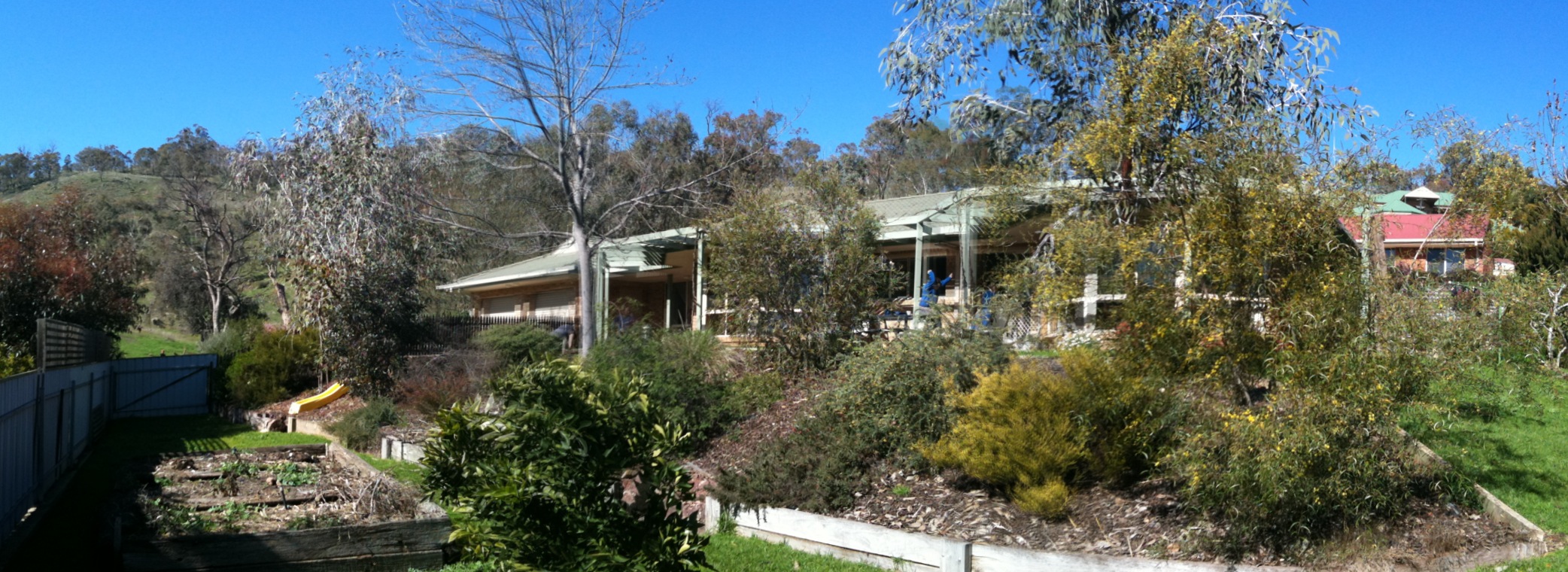
A level home, gracefully designed, beside a lightly timbered hill-side in a quiet cul-de-sac.  Bay windows face due north, catching every drop of winter sun, shaded by luxurious grape vines through the summer.  It is impossible not to be drawn into Paradise. Friends and visitors remark on its warmth, and on its fabulous setting.  Small details confirmed to us (in that ‘signs and wonders’ style to which I am deeply attached!) that we were in the right place.  The street we drive up is called “Balmoral”, the name of our favourite beach, on which my Best Girl and I grew up as kids.  The house has just one key which opens every door – a feature that I had built into our former house at some expense because our Little One will wander, and we must lock every door.  A line of Silver Princess Gums, a favourite tree, wanders through the block.  And we have a glorious view:  our Kangaroo-spotted hill during the day; and the twinkling lights of the town below at night.  It brings to mind a saying from a good friend’s South African family: “Somewhere to look away from your breakfast”.

It was on the very night of our daughter’s wedding, just weeks ago, that we received the valuation certificate by email, and learned that the house was within our reach.  After a glorious day together fourteen members of our family were gathered around our dining table and we celebrated this unexpected, amazing news together.   

The story that ends tomorrow began years ago, when I took out life insurance as an invincible, younger man, with little serious thought for the future.  From memory a close friend suggested a figure, and it seemed like a plan. That figure turned out to be exactly the price of Paradise, to the dollar!  Now, who could have orchestrated that? I marvel that we have arrived here. Amidst the great challenges we face, my family and I continue to find Providence by our side. 

Paradise!

Earlier this year I heard a Jewish man in a BBC documentary recount the strange story of his return to the home of his childhood.  The family’s home in Izbicz, Poland, had been abandoned in a futile attempt to escape the Nazi invasion.  The boy, Thomas Blatt, survived the death camps, and half a century later he revisited his former home.  Blatt told of finding furniture in the house that remained from his childhood, and then described the current occupant’s suspicious, nervous accusation that Blatt was there only to find his Jewish family’s hidden gold.  The owner proposed a 50/50 split. Blatt took one brief look around, and left without a word.  He went back just once more, some years on, to find the house a demolished, uninhabited shell.  Neighbours explained that after his first visit the owner became obsessed, possessed even, searching day and night for the mythical stash of treasure, until he finally destroyed his home.  In jealousy and greed he ravaged his own future.

A strange story to tell at a moment like this perhaps, and I don’t count myself to be above any of the motives in this evocative tale of greed. But it provides a vivid counterpoint to our experience of abundant grace.  Here we are in Paradise, having been given more than we can imagine; but the true value of our home is not in its title deeds, or its elegance, or even its glorious view.  Who we have, not what we have, will always matter most. 

Half of me doesn’t want tomorrow to come, and the other half just can’t wait! The anticipation is delicious, and the imagery irresistible.  Paradise lies ahead of us, the best is yet to come.


Rejoice!

The Kinker

Winter 2011 #6

“Please don’t bend the straw”.
Whispered, typed, hand-written; no matter how you communicate this simple request it will be ignored.

The temptation to kink a flexible straw transcends human powers of resistance. Nurses, hospital tea ladies, even my dear family, universally lack the self control to do otherwise, and all bend straws with panache.  The straw-kink is a deft manoeuvre.  The straw is first transported, unwrapped as required, brandished, then delivered, and just as it approaches the lip of the cup, snapped abruptly with Tourette-like gusto.  This singular deed is a definitive, wordless declaration of starched efficiency, ultimate control, consummate skill, and of numerous hidden passions as well!  Slow motion cameras would surely reveal on the face of the Kinker a tableau of human emotion.  In a split second, ‘helpfulness’ in all its helplessness would be laid bare for all to see.

Kinker, I know you mean well.  But you aren’t helping me at all.  Worse, you are stuffing things up.  Have you ever tried to straighten a once-kinked straw?  A straight straw, only a straight straw, will be of use to me.

Kinker, let me choose how I set my own straw.  Heaven knows Free Will is not all it’s cracked up to be.  The celebrated rights of freedom are limited by many more factors than we imagine; and choice is an overstated commodity in our world.  So many people have very few options, or none at all.  But in this one, tiny detail, surely I can be trusted to exercise my own free will.  Can’t I?

Kinker, I know it’s your straw, from your tea trolley. I don’t want to seem ungrateful to you for your gift, but help is not a simple thing. Real communication, even without the compounding effect of voicelessness, is a rare and difficult task.  You don’t actually know why I need a straw today, and were you to ask I might struggle to explain.  To match help with need is such a challenge.  The helpless don’t always want to be helped, and then even the helpful suffer.

Kinker, I understand how central to human existence is the desire to help another being. I know that you are deeply affirmed by your splendid kink.  I know that in the moment that the straw bends to your iron will, the cosmos itself resonates with affirmation.  The heavens declare you to be all that you know you are: benefactor, healer, counsellor, diviner of all truth, defender of the poor, and more besides!  But if you are here to help me, then let’s just clarify our motivations, shall we?

Kinker, don’t assume I am helpless.  It’s a straw, for goodness sake!  I think I can manage.  Don’t let my wheel chair and my artificial voice deceive you: beneath this legless and mute physique beats a heart of fire!  I can bend my own straw!

Kinker, I am a difficult patient.  At day’s end, aren’t we all?  I’ve been here in your hospital ward a week, another long, long week, with no good news.  With no bad news either, that’s true.  My nerves are frayed, wondering every day what the experts will say.  Most days they say nothing at all, some days they don’t even visit, and their silence is worse than their scowl.  I know you are simply the tea lady, but you are treading on very thin ice.

Kinker, please leave me alone.  No, that’s not what I meant to say. I need your help, Kinker, I want that cup of tea!  But equally I need to face my tea alone.  You cannot drink it for me.  You cannot carry my load, you cannot tread my path.  To be alone is the most inevitable and the most challenging chapter of life.  You can’t hold my hand, you can’t console me; you can’t reassure me that all will be well.  This is my straw now, and mine alone.

A bruised reed he will not break,
And a smouldering wick he will not snuff out.            
Isaiah.

Rejoice!

Public Property

Winter 2011 #5

To date most of my respiratory issues have been solved through the agency of a party hire shop.   True!  My $3000 breathing machine is supplied and serviced by the same cheery gentleman who, on the other side of a brick wall, flogs funny masks, paper streamers, party favours and helium balloons.  Lungs – – balloons – – the connection is obvious.
I guess. 

I don’t know that my enterprising, balloon-blowing respiratory technician from the bush belongs down here in the big city hospital, especially not in the rarefied atmosphere of the thoracic ward.  But – and this is the real surprise – the same paradigm seems to apply:  a single skin of brick often divides hilarity from hurt, merriment from misery, laughter from lament, glee from gloom.

Take the thin brick wall that divides an absurdly spall space passing for an accessible bathroom in our ward.  Some funny things happen in there! Yesterday a nurse accidentally dropped my clean, nicely folded socks straight into the rubbish bin.  You really don’t want to contemplate the contents of such a receptacle in such a place. But she dove straight in after them, and simultaneously we both said exactly the same thing, she with words and I with a gesture:  “3 second rule!”  How disgusting.  How funny!

My height, it would seem, is another source of great mirth for the staff.  Throughout my adult life I have been followed by a whispering wave.  In the general public I hear it as an appreciative, even awe-struck murmur: “…Gosh he’s tall!…” In the school yards where I once worked it was somewhat cruder and less enamoured; but either way it has been my permanent companion for many years.  In my new sit-down world this has all changed of course, to be replaced, curiously enough, by a different chorus altogether, most commonly provided by grey haired biddies on busses crooning: “… Oooh my, look how he can spin that thing around, isn’t it maaarvellous…”   (I do wish they would get it right: “…Look how he can spin that Bugger around…”). 

My height is a secret these days, startlingly revealed only when I stand; unwinding from 4 foot 6 right up to 6 foot 7 inches!  Nurses find this hilarious, especially as I have to slightly duck to get through the said bathroom door.  You might think I am exaggerating, but I assure you, I am not.  I have long known that extra height is the single physical trait that is somehow public property.  Anyone can, and will, ask how tall I am.  It is a daily experience for me, and people don’t hesitate for a moment to add their funny little jokes as well. Overwhelmingly popular is the inane, “your mum should have put a brick on your head”  (If I had a brick right now I’d….).  Can you imagine saying to a stranger, with feigned shock, “Crikey! How much do you weigh?”  or “My word, you’re a little short-stack aren’t you!”  Let alone laughing at the shape of someone’s head or the hook of their nose. 

I suspect these moments in the ward are cathartic.  Welcome flashes of comic relief from the serious, life and death business with which we are all engaged.  From room to room, just a brick wall away, people’s lives are being saved and lost.  There is drama everywhere; celebration and grief are inches apart. 

In hospital our lives are on display to one another in physical and emotional detail that is governed by a new code of modesty, one with very different boundaries.  From the moment of your admission you become public property.  You surrender so much to so many.  In this charged atmosphere life takes on an enhanced clarity, both the glee and the gloom are crisp. I find myself laughing at the antics all around; laughing with staff, laughing at myself; and then crying, quite literally, as I recite (or re-type!) my medical history one more time for one more therapist or one more doctor.  Crying too in waves of apprehension as I wonder: will they believe me?  O will they consign my problems once again to the too-easy bin of unexplained psychological hogwash. 

In a way I like the season of being ‘public property’.  I will be glad when it’s over, when I can return to the privacy of Paradise with my Favourite Wife and my family.  But I can’t deny enjoying the honesty that is demanded here, the bracing truths that have to be faced, and the opportunity to live in the gaze of others that being ‘public property’ affords. These things are anathema in the insular individualism of our modern world, but I think we are more deeply tied to each other than we care to admit.  In merriment as much as in misery, we are together.  To borrow a Christian phrase, “and every one members one of another”.  *

Rejoice!

_________________________________________________________ 

* Romans 12:5

Antidisenfranchisementalism

Winter 2011 #4

Booking an on-site appointment with the architect who is designing our new accessible bathroom (henceforth to be known as ‘The Colosseum’) was unreasonably complex. Stupidly complex. Being unable to simply ring his office, I found myself exchanging a string of SMS messages that were going nowhere fast. Then my correspondent began calling my mobile phone; which, of course, I could not answer. Sensing a rise in the ambient annoyance level, I typed a point blank question: are you an architect? The unequivocal answer: “No.” It was the wrong number; a complete stranger; to whom I bade an awkward SMS farewell.

This is just one example of the daily complexity of life in the margins!

Nothing succeeds like success. For good reason, from which we all benefit, our world is largely geared towards accomplishment. It is delightful to see the tortoise trounce the hare, but in the broadest terms the race must belong to the swift; it’s just the way the world works.

As I write, my Favourite Wife and I are train-bound for adventure. The highlight of our weekend away will be Rachmaninov’s 1st piano concerto with the Melbourne Symphony Orchestra. Almost certainly the soloist will be Simon Trpčeski, a Macedonian pianist of international renown. There is, however, just the remotest chance that I will be called upon to dock Bugger behind the Steinway’s ivories instead. A chance as remote as the Crab Nebula, I should think, because Trpčeski is considerably swifter than I!

Antidisenfranchisementalism
[an-tee-dis-en-fran-chahyz-men-tl-liz-uhm]
– noun
1. Never saying never.
2. An emancipist movement founded in the early 21’st century.
3. An ideological refusal to be sidelined by life.

It’s the recurrent details of everyday living that marginalise the less-able. A little shifting of furniture to freshen up a room for the able-bods can make it virtually inaccessible to the likes of I. Creeping difficulties with food and drink – essential social lubricants – makes social exchange dry and awkward; a squeaky wheel. Changing the method of communication with friends can alter the essence of friendship itself – more than you might imagine. Sometimes when the train arrives at the platform in our city it pulls up with the accessible carriage door perfectly aligned with a particular bench seat, blocking off the ramp. When this happens the neighbouring carriage door, which I can also access, opens neatly onto a pole; and so the train’s doors all have to be closed and locked, guards gather and confer, walkie talkies are brandished, whistles blown, and a few hundred tons of train chug three feet along the platform, just for me. You’d be surprised how often this happens. Booking tickets for the Tutankhamun exhibition (another leg of this weekend’s escapade!) with a keyboard and a computer generated voice was an exercise in angst. “Are you still there Sir?” … “I can’t hear you Sir” … “Can you answer please Sir?” And so it goes on, little by little the margin-ward pressure mounts. All of these issues can be addressed, of course, and help is always at hand. But the price can be an attrition of soul, and the temptation to slip away and hide in the margins is intense.

Is it so unreasonable to think that life can go on in the fast lane? Or should one make a dignified withdrawal and stop imposing on the world? We all know that centre court cannot be played forever: each of us will be sidelined sooner or later. What it is that makes the middle-of-the-road, the norm, the main-game, so attractive?

We sometimes visited a waterfall, years ago, where we would watch the mesmerising, valiant progress of tiny inch-long shrimp as they scaled the immensity of a sheer cliff a thousand times their size; only to be repeatedly dashed on the rocks below by a torrential deluge from above. We would cheer as an heroic crustacean surpassed the throng of his peers, making a solo ascent to within a claw’s-breadth of the rim … then down he would plunge once more, doubtless to try again, driven to find the lush breeding grounds upstream.

The simple fact that there are shrimp at the bottom of the waterfall is proof that there are also shrimp at the top: at least one amorous shrimp-couple must have conquered the falls last season to nurture their brood of shrimplings in some quiet pond. Is it an overstatement to say that life flows from achievement? Can relentless endeavour consummate our very existence in such a way that a new generation is born? I’ve never penned so many metaphors, or posed so many unanswered questions, and it all sounds a bit esoteric I’m sure; but there is something going on here, I’m certain of it! I want to believe that all this struggle, all this self-focused survival, is not just my own, solitary race against the inevitable. I want to know if there is a purpose in perseverance, something bigger than just Bugger and me. I want to know with certainty that antidisenfranchisementalism is valid!

Till then my eyes are on the prize, and who knows, the Steinway may yet be mine!

Rejoice!

Why I (almost) didn’t attend the Healing Crusade

Winter 2011 #3

The invitation was like a spark to a tinder box.  For me it was confronting. For those of my family who happened to be at home when the invitation arrived it was the perfect opportunity to tackle me, once again, on a favourite topic.  The invitation was from our good friends, to go with them to a Healing Crusade at their church.  The speaker would be a noted ‘healing evangelist’ with successes that even the secular media have acknowledged over the years.  I didn’t want to go.

But here I am, nonetheless, because I do believe.  Here I am, out the front of the church, with a couple of hundred eager eyes on my wheelchair.  (I wonder if the discreet “Bugger” sticker on the back is offending one or two?  I hope so).   In my fertile imagination there is one question on everyone’s mind:
“Is he going to walk?……”

I’m not unfamiliar with church; more often than not I have been the one facing the people, and many a time I’ve been the one praying for the sick.  How different it is on the other side of the pulpit.  In the brief moments it takes for me to be noticed (and Bugger and I are hard to miss!) each of my objections to being here roll crisply through my thoughts.

Top of the list: Embarrassment.
Am I not on display enough, without having to trundle to the front of church before of a crowd of strangers to receive the prayers of someone I’ve never met?   My life is already something of a permanent spectacle; whether I’m holding up the queue of passengers while the bus driver climbs out to lower the ramp, or creating a hiatus at the bank by passing my computer back and forth under the glass screen attempting non-verbal transactions with the teller, or providing a living for the team of helpful nurses who keep me scrubbed and clean.  I am forever on display!  Perhaps I am too proud for my own good, but I don’t think I will ever adjust to this perpetual exhibitionism.

Next on my list: Cynicism.
How easy it is to criticise.  I find it so enticing to characterise healing ministry in terms of the excesses of telly-evangelists. I confess I am annoyed by the simplistic approach of the evangelist; reducing almost every condition to the presence of pain, and healing to its absence.  About this I shall write no more, tempting though it is to keep going……

(Is he going to walk?……)

A family favourite:  Dread.
Am I afraid of a wonderful, restorative miracle?  And specifically, am I afraid that it would prove the doctors right?  Those eminent men who insist that my problems are “all in my head”.  It took the loving ministrations of my family to point this fear out to me, initially to my indignant protestations.  But they are right, and I am afraid.

More importantly: Faith.
This is the tricky one.  People regularly say something along these lines: “We are still praying for you”.  Occasionally I ask them what their prayer for me is, and the answer has never varied: “We pray for healing”.  I don’t mind that, of course, but if anyone were to ask me how they should pray, that would not be my answer.  Not now, not anymore.  This sounds like a lack of faith I expect; like surrender to the inevitable.  But people are always wishing things were different one way or another.  True spirituality is to live richly with the way things are.  Not the way you wish they might be.

Dangerously, there is the matter of: Courage.
I’m not sure that it is safe to be here. I cannot afford to indulge in wishful thinking. “No one who puts a hand to the plough and looks back is fit for service in the kingdom of God,” Jesus said.  We all long for the good old days.  I could wistfully indulge that fantasy and dream of the days when I could walk and talk.  But I am alive right now, not back then.  It’s such a trap!

(Is he going to walk?…..  Is he going to walk?……)

Thrillingly, I think also about: Relationship.
I am a Christian; I have a sense that I know God, and that I experience his love and provision constantly.  How rude if I were to endlessly ask for what seems evidently not to be His plan?  I understand persistent prayer, I know how to ‘knock and keep on knocking’; but I remember too that St Paul prayed just three times for the thorn in his flesh to be removed, and Jesus himself prayed three times “My Father, if it is possible, may this cup be taken from me. Yet not as I will, but as you will.”

Lastly, best of all, I have: Contentment.
Our Little One has Down syndrome, and it has never been our prayer that she would be any different.  We pray for her in many ways, but she is who she is; and we don’t reject her by praying that she might be something else.  The preacher tonight spoke about being desperate for God to do a miracle, and gave numerous examples of the fruit of such desperation. I can’t connect with that in any way. Every day is a miracle.  I am not ungrateful, in fact I am thrilled with my lot in life.

Is he going to walk?……

Is he going to walk?……

As you can see, I’ve got my doubts that he will!  And many would say that’s the problem right there.  But I’ve got my doubts about that too.

Rejoice!