Mourning ’til Morning

Centennial Thoughts on a Half Century.

I can’t easily describe the heaviness of waiting for my 50th birthday celebration, or the exuberant joy of its final arrival; but in this 100th edition of Rejoice!  I shall try and do both.

The event had grown monstrously in my thoughts for months. Plans were being laid by my family and I knew little of anything; but being the erstwhile controller of all things familial I could not stop obsessing over the small and large details that might or might not have been considered.  I kept my peace (mostly) but the inner monster was growing tentacles.  Three weeks before the big day we finally broke ground on the Coliseum, our accessible bathroom reno; on the same day that I went into hospital.  Finally the eve of the long-awaited Birthday Party arrived, and with it a flurry of email and Facebook apologies from family and friends.  More than one message contained the saddest news of events preventing dearest friends from attending.   Just who would be there in a few hours time was a closely kept secret; all I had was a growing list of those who would not!

The builders had been contracted to vacate the Coliseum two days earlier, leaving it in semi-functional order (read: “flushable loo”) to ease the pressure on our household which would soon peak at 12 in residence and twice as many visitors.  But things dragged out, and late on Birthday-Eve a problem emerged with the placement of plumbing fittings that required yet another conference with the builder.  I was FINE with everything! Freaked out, Insecure, Neurotic and Emotional. 

Then the family started to arrive; and in a house full of laughter and loud conversation I felt too alone. I can sustain a typed and whispered conversation with one or two, but a roomful or a tableful can be an unworkable dynamic. It was boisterous and chaotic. Bedrooms were being shuffled for new arrivals and there was nowhere to hide.  Late in the evening I retreated to the unfinished rooms in a horrible exhaustion.  I don’t think that I had felt more alienated or alone in all my life. It was just a party, (for goodness sake!), but emotions are often insensitive to the truth.  And parties have their problems.  Parties are happy.  People bubble.  Sadness is forbidden, sorrow anathema.

Saturday dawned with all of Friday’s angst.  And more: more emails, more rellies, more noise and more fun, more reasons to hide.  But the hours of celebration finally arrived.  Good, life-filled hours, crammed with earnest and perfect words shared between a few or with many.  Time flew in a dream-like montage of conversation, recollection, laughter, hope and joy. Such days provide one of life’s very rare opportunities for honesty.  Not old fashioned fair-trading; but the pure, endangered quality of open-heart honesty where we say things to one another that actually matter. All seems light, even the deep places of our hearts are open to the touch of human love.   Speak this way between Monday and Friday and you risk exposure as an intense freak, but now and then on a special weekend sincerity and love come home, the veils are drawn back, and we love one other.   

Is Friday night a necessary part of Saturday morning?  My dilemma is that I cannot lose Friday, and I will not lose Saturday.  How do we engage in sorrow and in celebration with equal integrity?  Friday and Saturday are inseparable and yet we have language only for one.  Nowhere is this more apparent than in the Christian world, where the good times are continually trumpeted (and expected) and where the biblical songs of lament were long ago shed from our books.   Our Australian culture does not have a language for loss either; and so we pursue fun as a god and medicate ourselves in innumerable ways when the quarry proves elusive. We have lost the ability to weep with those who weep; and our world is poorer for the shallowness we have embraced.

On the last night of my father’s weeklong visit to Paradise we were listing to the radio between relaxed breaks of chatter.  Handel’s captivating, aching Rinaldo Aria, Lascia ch’io pianga (Let me weep) was playing on the radio during one of the gradually lengthening breaks in our conversation.  The Italian lyrics in this haunting piece were quite unknown to me, but I later found this translation:

Lascia ch’io pianga la dura sorte,
E che sospiri la libertà!
E che sospiri, e che sospiri la libertà!
Lascia ch’io pianga la dura sorte,
E che sospiri la libertà!

Let me weep over my cruel fate,
And that I long for freedom!
And that I long, and that I long for freedom!
Let me weep over my cruel fate,
And that I long for freedom!

Night gives way to Day.  Dark is always broken by Dawn.  This is not cliché or a fridge-magnet aphorism.  My own Friday and Saturday came in an order which is to me an absolute tenet of faith. “Weeping may endure for a night, but joy cometh in the morning”.  This simple relationship is undergirded by the very core of orthodox Christian faith. “Where, O death, is your sting?” Unlike the chicken and egg conundrum, grief and joy exist in an absolute structure of resolution. The former will always be resolved by the latter, grieving gives way to joy, as it was in the beginning, is now and always shall be, world without end, Amen!

This is why I say, with faith,

“Rejoice!”

__________________________________________________________________________________

PS:  Forty Nine and Seventy-One Seventy-Thirds. 
Seventy-Two on Wednesday!


Forty Nine and Seventy Seventy-Thirds

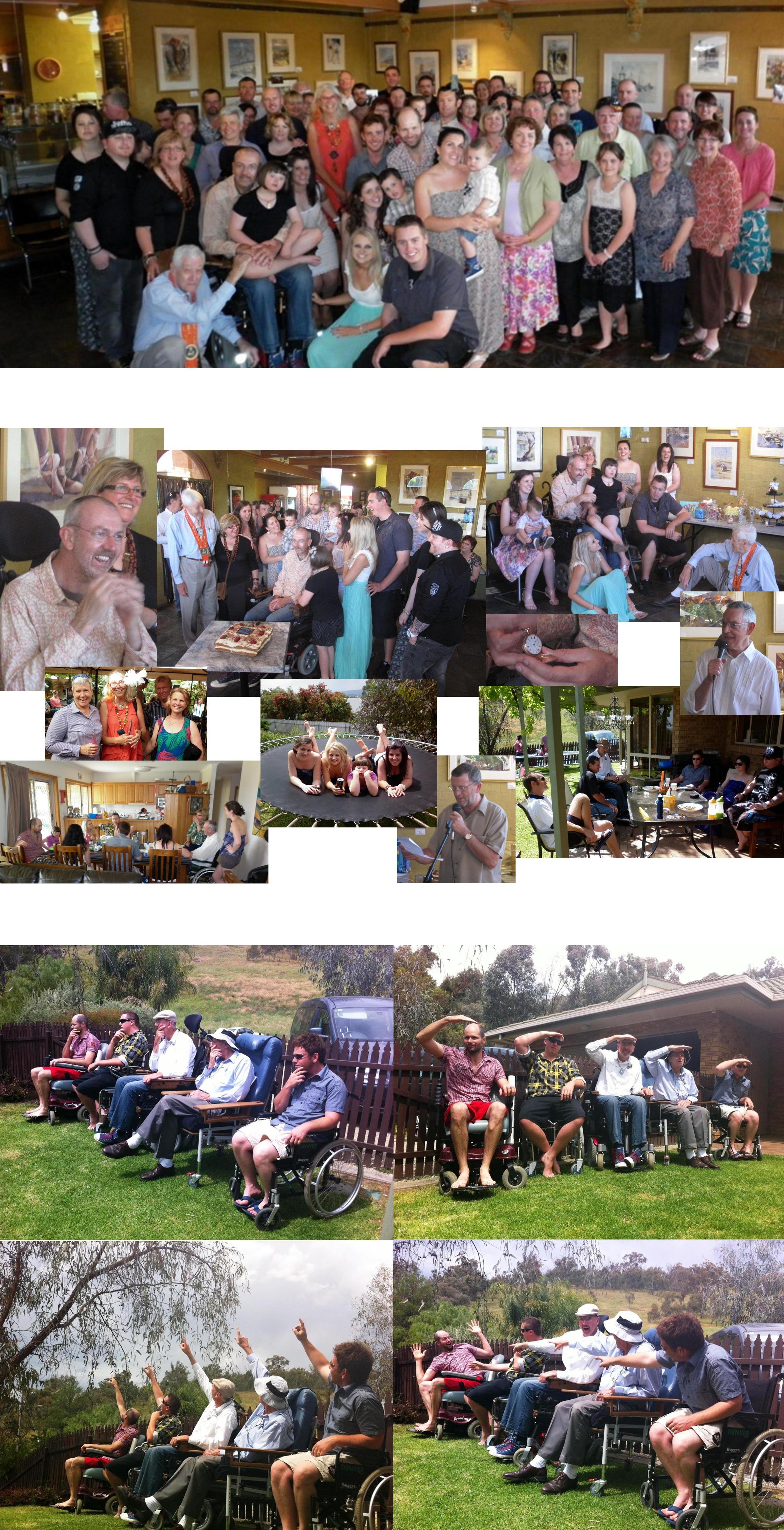
50th Birthday Celebration; but I’m not there quite yet…

Good times. Family young and old, children, parents, grandchildren, cousins , great friends from present and past, generous words, a gift of my Great-Great-Grandmother’s watch, warmth, love, stories, hope, and cake too!

My Father and my champion Sons-in-law with our current range of wheel chairs – B1, B2, B4, B5 & B6. Solidarity!


Rejoice!

Trust

“What is our Prime Minister’s name”?

Such was the opening gambit from the Neuropsychologist I met last week in Melbourne.

“Julia.” I replied, rock solid in my practiced smile of confidence, well befitting a man of forty nine and nine tenths (now fourteen fifteenths!)

“Julia who”? The doctor’s second question carried the faintest tang of inquisition.  Did she lean forward a fraction? Is her brow a little furrowed, her eye a tiny bit keen?

“Julia ………………..”

“………………………..”

“………………………..”

Julia Rudd.  Julia Howard.  Julia Keating.  Julia Hawk. Julia Frazer.  Julia Whitlam.  Julia McMahon.  Julia Gorton. Julie Holt.  Arraigned like prisoners in the dock, every prime ministerial surname in my lifetime was vying for attention; all but one! It was gone. Utterly absent.

“………………………..”

“It begins with G”.  A benign prompt from the doctor.

“………………………..”

Looking for the G word was like opening a too-familiar sock drawer and discovering instead the gaping, chilled horror of interstellar space. A black hole of unthinkable proportion.

“………………………..”

So she told me.  Gillard.

Humiliation.  The official record of my sanity was in the balance, and I had faltered at the break.  I worked on my smile.  A relaxed, confident smile, the one I had practiced in the train window. Have you any idea how tricky it is to produce an unaffected, natural smile for a Neuropsychologist?  Thankfully, however, I had a single word in mind, a word that helps me smile.

Next up we tested recollection. I listened to a list of thirty or so unrelated words, repeating as many as possible from memory; twice, thrice, four times through the list to see if I could learn. And learn I could!  I added a judicious “Gillard” to the end of each list; a token of my endless remorse.  And she smiled. 

It was up and up from there.  Block puzzles, intricate dot-to-dots, and complex geometric patterns all suit me well.  A list of fifty increasingly unusual words to read out loud was difficult only in being ‘out loud’. Delectable words like intransigent and deleterious and vexatious made me smile. More taxing was a lengthy questioning about my medical journey and current outlook on life.  Most of this I typed. And typed, and typed, and typed, and typed, and typed.  Two and a half hours later I had apparently earned five psychological stars.

Then came the really difficult bit: hospital admission.  The second day in hospital is quite bearable, but the first must be the loneliest, most forlorn stretch of hours in life.  But I had a word in mind, a word that made me smile and carried me easily through this strangest day.

The word was a gift from a Nun. 

For some weeks we have been exchanging thoughts, my Sister-friend and I, on the topic of Trust.  We have never met, but have in common a growing dependence on others to meet our daily needs.  Trust, my friend tells me with the insight of years of contemplative prayer, “Is the most difficult work possible, but necessary to enter the Kingdom.”  Why, I asked her, is trust work?  To protestant ears they sound at odds.  And here it is, in the words of Christ:

“Truly I tell you, unless you change and become like little children,
you will never enter the kingdom of heaven.

It’s the change that is such hard work.  I delight in watching each of my children growing into competent and wonderful adults, taking full control of their lives. I once believed this path of differentiation to be the greatest journey in life. “A man shall leave his father and mother”. But now I see another path that stretches further, and whose gradient is steeper yet.  Having gained our independence, the call is to surrender all with grace and trust.  

St. Francis of Assisi taught that every encounter between one human and another is a sacrament.  In the other we will always meet a child of God. 

‘Truly I tell you, whatever you did for one of the least of these brothers and sisters of mine, you did for me.’

I surrender control to the Almighty by placing trust in those He sends.  This is possible, it can be done, and the peace is staggeringly good!  But relinquishing the self-centered need to dictate the terms and conditions of my life is hard, hard work. A life time of finely tuned control must be undone. 

The responsibility to act wisely and live fruitfully remains; but we are sometimes blessed, perhaps, by the advent of these taxing afflictions that force us to trust. “Humble yourself, therefore, under the mighty hand of God, and He will lift you up”.

If you read last Sunday’s attempt at an essay, you may be thinking this is all so much theory, or plain hot air!  You will know that I didn’t finish hospital week nearly as well as I began it. I can only say that Trust takes a lifetime.  My good friend also reminds me that Trust is better as a verb than a noun: it’s something we do, not something we have.  Trust is the daily challenge, the need of the minute.

Rejoice!


Fiddlesticks!

Spring 2011 #7

This article has been classified MA for a mature audience.  It contains nudity, adult themes and strong language. Rejoice! warns that reading may be disturbing or harmful for persons under forty nine and eleven twelfths.

“What we can tell you with confidence” the calm, dignified and heretofore quite likeable Professor intoned, “is it that it’s not nasty, and it’s not progressive.”

“Coughcoughbullsh*tcough” I said.  Inwardly at least.

I found his summary utterly ridiculous, and stealing a glance at some of the  doctors and students crowding my room I suspect some of them felt likewise.

Gathering my courage in the presence of the Professor and his entourage (isn’t it interesting how they surround themselves with a court of underlings to preserve dignity in moments of erudite silliness?) I typed:

I don’t understand what you mean when you say it’s not progressive. When I was here last year I was able to speak, and push myself around in a manual wheel chair.  (In point of fact I had just returned from a superb tour of the Gibson Desert).

“Yes, I have no explanation for that”

“Coughcoughbullsh*tcough” I said.  Inwardly at least.

“Anything else? …(nanosecond pause)… Good then.”

And he was gone.  A flurry of minions made a rather startled path for his urgent retreat, suggesting the parting of the red sea.  Thankfully one observant and compassionate nurse closed the door behind the gaggle, and remained at my side for the next half hour or so. Like many nurses she had a much more sensitive and infinitely more welcome approach, and some actual medical wisdom to share.   Thank God for her.

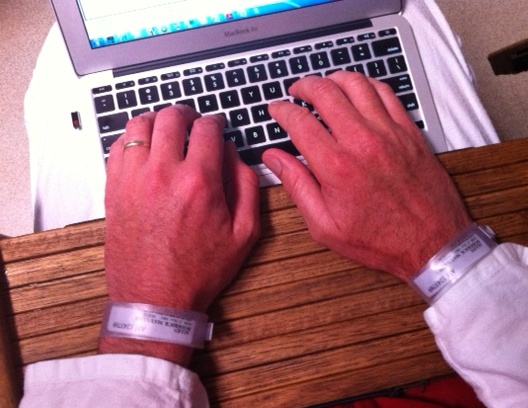
Every patient is given two ID wrist bands, just in case they rip you in half. But can they put you back together again?

Later in the day I asked to see what the doctors had written up in my hospital notes.  A single entry: Explained to patient that disease is not expected to progress. 

What absolute crap. 

It just defies all logic that a seven day week can be spent in tests and interviews and leave-your-dignity-at-the-door hospital showers (that’s the nudity; I hope you weren’t looking for more!) only to end with such brief, flimsy nonsense.  I can only conclude that the words Nasty and Progressive are not the English words I thought I recognised.  They must be part of a medical vocabulary, understood only by the nine-year-trained elite. It’s a wonder they weren’t in Latin. 

One of my objectives on this trip was to garner advice; and so I made a point of asking doctors and therapists to please give me some notion of what to expect next, and what practical steps they could reccomend.  Apparantly I am to expect the deterioration to halt round about now, on the train tonight perhaps?  Other than a reworking of a pain-medication schedule I will leave here with nothing at all, not a notion, not a suggestion nor a word of advice.  I guess that medically this all makes perfect sense, to me it is just absurd. 

But I don’t want to sound utterly dismissive of the hospital team.  The main focus of this visit seemed to be Neuropsychological and Pshchiatric assesment; and happily, wonderfully, the completley unfounded idea that my physical problems are psychogenic has been laid to rest.  I hope forever.  It was interseting to hear the hospital’s head of Psychiatry say, after reviewing my file from last year, that her department had always dissagreed with Neurology about this.   And I did meet some wonderful people.  Kind nurses, excellent cooks, fastidious cleaners, skilled and compassionate doctors, a hilariously funny consultant psychiatrist, and one extreeeeeemly ill-tempered OT who made it abundantly clear from her first breath that the last thing she intended to do in her ten minute visit was help. 

And now I am homeward bound, on the late night rattler, longing for my Favourite Wife’s smile, Little One’s hugs, a thorough inspection of progress on The Coliseum, and a good long look at my new bus shelter; doorway to the whole wide world!

Rejoice!

Fabrications

Spring 2011 #6

They are building me a bus shelter!  This is big news; but first to other things.

My Favourite Wife and I are blissfully rattling our way south to Melbourne, on a glorious afternoon finally hallmarked Spring after an icy, grey and protracted winter.  Generous respite provision for our Little One allows us to make regular forays here and there; and the Southern Capital is slowly growing on us as a new favourite destination.  A couple of nights together, some culture, some shopping, some dining out; and then Best Girl heads home while I stay on a few days to have my psychosis probed.

Every few months I seem to return in my weekly essay to a well worn topic: my presumed insanity.  I’m compelled to follow that obsessive track once again today, and I ask your patience if my perspective seems a little … fixated.

Here is the current fodder for my paranoia, a regular nose-bag of angst:

  • Eight full months of postponement and paper shuffling to achieve a respiratory assessment in a Melbourne Hospital.
  • A year since I have seen a physiotherapist, despite requests.
  • Four months on the waiting list to gain the much needed advice of an occupational therapist on how to build the ideal accessible bathroom.
  • Another eight full months wait for an appointment with a new respiratory specialist an hour closer to our home; recently extended to ten months by the receipt of a new appointment advice card in the mail without a word of explanation. 
  • Four months of delays in the hospital admission I am about to attend; with three admission dates cancelled (including the ward clerk who rang our home one evening to see why I wasn’t there! She ought to have rung the admitting doctor who neglected to tell me…)
  • And to round it all out my local Neurologit’s last words: “Come back in 9 months”.   Six of the nine have passed, and it still stings when I recall his dismissive remarks.

Is there a pattern in this saga of medical disinterest? Is it the fault of the overstretched public health system?  Am I too timid in my myriad exchanges?  Is communication by email ineffective in grabbing people’s attention? (It is!)  

Or … could it be that the label ‘Functional Illness’ or ‘Psychogenic Complaint’ or perhaps even ‘Hypochondriasis’ is stamped on my file, and no one takes me seriously anymore?  Back when I had a ‘real’ medical problem I never waited more than a month, two at the most, to see anyone or be admitted anywhere.  Specialist, hospital, therapist – you name it, I got it. There must be some form of triage in each of these settings to establish priority, and I suspect I no longer attract much notice. 

I had sometimes wondered if my fear that the doctors think my problems are ‘all in my head’ was itself ‘all in my head’ until I received the admission letter for this week’s hospital stay.  I am not, it seems, scheduled for the Neurology review that my GP requested. Instead I am travelling 300km by train to see a Neuropsychologist.  Do they think I am mad? I don’t imagine I will ever know for sure because the medical system is rather impenetrable; there are few avenues of recourse and nowhere much to take your complaint except to the very same Doctors that one slowly begins to mistrust.  I have tried this: and they bite!

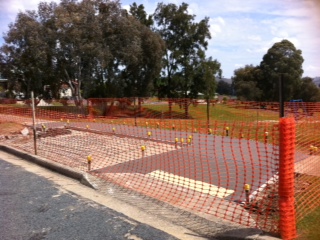
A wonderful surprise the day before we left home: footings for a new Bus Shelter.

At long last, work on The Coliseum (our grand, accessible bathroom) will commence at about the same moment as the neuropsycological exploration begins on Monday Morning.  And, brilliantly, my bus shed will be under construction at the very same instant!  More on the bus shelter next week perhaps; but surfice to say that on a day when my psyche is under attack and the bricks of our home are under the hammer; the council (ever the agent of Divine Providence) are expanding my world.  They may not know it, but those diligent, energetic council labourers are preparing shade for hot summer days and shelter from driving rain – all for me!  It will take more than a dissabled toilet, extra wide doorways, non-slip flooring or even psychoanalysis to keep me down!
Having almost finished my essay, I must apply the remainder of the rail journey to preparation for the awaiting medical horde.  I once read the biography of a German Sergeant who had been a guard in the famous Colditz concentration camp during WWII.  He described in detail the antics of the captured English officers who were ingenious beyond belief, and devastating in their attempts not only to escape, but to abrade the morale of the German guards.  The Sergeant  had found a single, powerful defence against the endless, diabolical humiliation he daily received from his enemies, who happened also to be his prisoners. A smile.  Always smile. Never, he said, never, ever show anything else to your enemy. 

I am preparing my smile right now.  A relaxed, confident smile, befitting a man of forty nine and nine tenths.  I must not smile too broadly, in case I appear to be enjoying life over much.  A broad smile, for people with a disability, is a dangerous mistake around medicos.  The expect one to sulk a little, to bear heavily the blows of life.  Depression, I have been told by a learned Neurologist, is typical, and its absence is a sign of mental imbalance. I’m looking in the train window, smiling at my reflection, just to make sure I’m not mad. Oops!  That was a maniacal leer, I must avoid that. 

Rejoice!

Points on Pointing

Spring 2011 #5

I feel confident that St Matthew had my Pointing Gadget in mind when he spake thus:

Let your ‘Yes’ be Yes, and your ‘No’ be No;
anything beyond this comes from the evil one.

The “anything” he mentioned, the emanation of Sheol, was without a doubt the tiny word “or”.  How could an innocuous grammatical conjunction have its genesis in Hell? Let me demonstrate…

“Shall I boil the kettle?” asks my Favourite Wife.
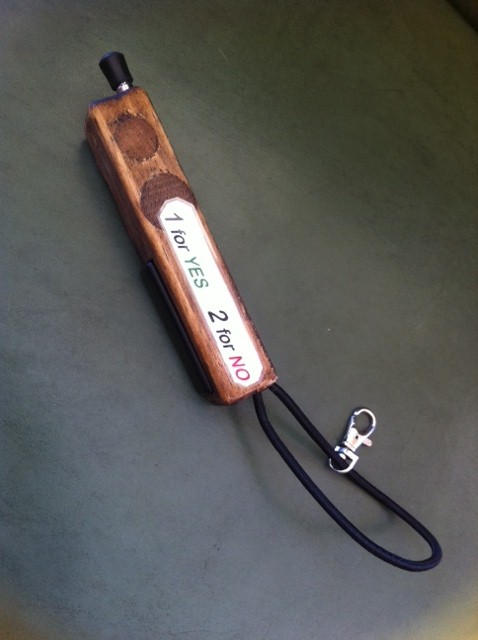
‘Beep’ I reply (One for Yes, Two for No).  
“Anything to eat”? she thoughtfully adds.
‘Beep Beep’
“Tea or Coffee?” (OR!)
‘Beeeeeeeeeeeeeeeep! Beeeeeeeeeeeeeeeep! Beeeeeeeeeeeeeeeep!’ 

That tiny word ‘OR’, the damnable conjunction, has troubled many a simple exchange in Paradise!  It takes a degree of skill and discipline on the part of the questioner to phrase everything in a strictly Yes/No format.  It’s slow going, and requires a calm objectivity sometimes elusive in domestic dealings; but as long as ‘OR’ is avoided, almost anything can be conveyed.

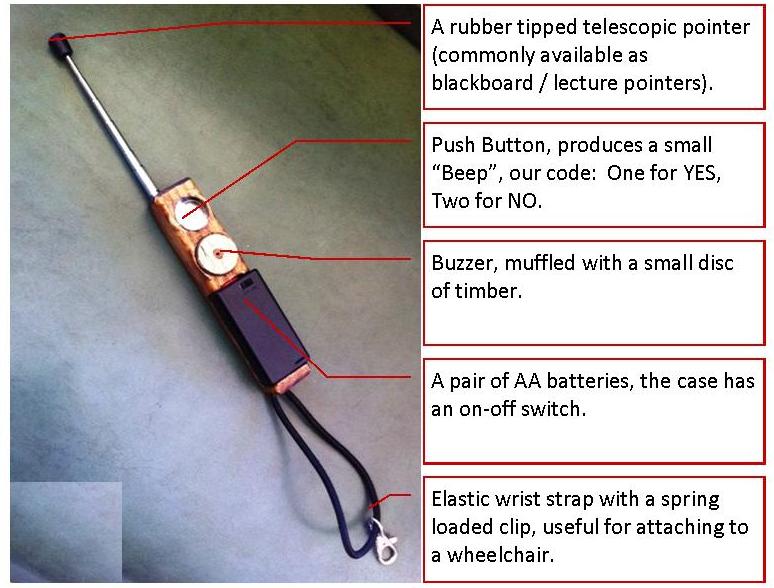
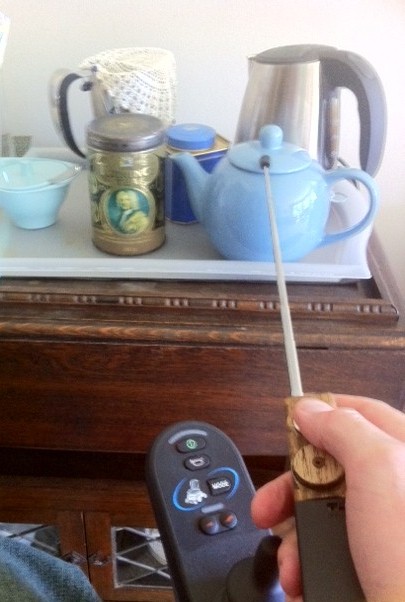
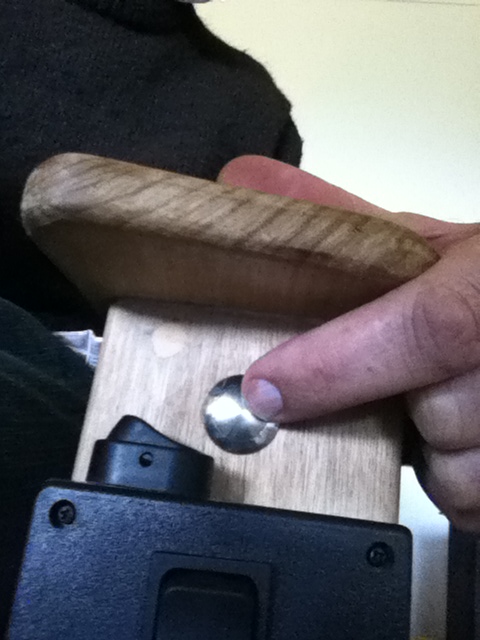
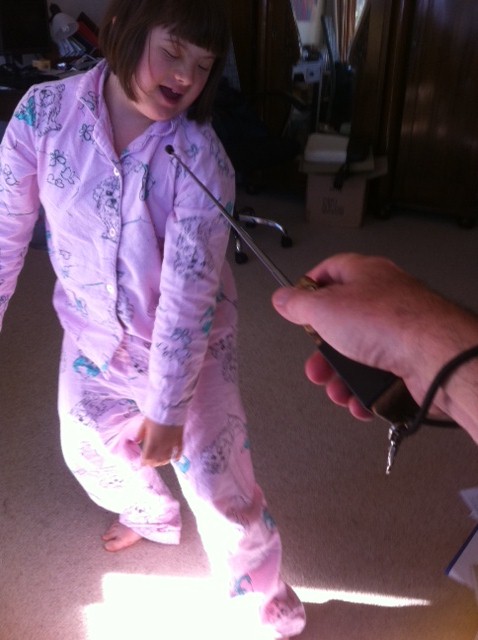
The Pointing Gadget has become an intrinsic part of our new language.  It cuts through the confusion of impromptu hand signals that inevitably arises in non-verbal communication.  It is much simpler to use a hand-held pointer to pinpoint a specific item than it is to wave in a general direction. The built in buzzer is useful for attracting attention, and for communicating further about an item or topic of discussion. 

The pointer is especially valuable when dressing, when asking for food or drink, or when something is just out of reach. The Pointing Gadget is invaluable in the car where typing onto a computer screen is probably not the wisest notion, and background noise prohibits any whispering.  It is also very effective in a manual chair when lip-reading is not an available option. No eye contact is required with the person pushing, which is ideal, and it works extremely well to indicate where I would like to be pushed:  Left here, now right, and so on. 

With a bit of practice a certain nuance develops, giving shades of meaning to each Beep. For example a single “Yes” beep can just as easily mean “Thank you”.  Three Beeps means “What?”, or any other contextually appropriate question.  The act of reaching for the pointer says “I am about to ask for something”, smoothing the way to the request itself. Using the pointer to say “could I have such and such please” seems somehow more polite than other gestures, and infinitely more accurate.


‘Beep’ (attract some attention). 
“Oh, would you like a cup of tea dear?” says my Favourite Wife. 
‘Beep’
Job’s right!

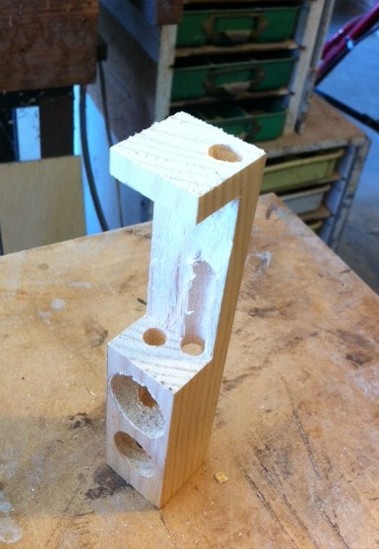
For the technically minded (hoping that a reader might want to make one for someone else in a non-verbal situation) the materials are a short block of 1” square pine, a telescopic blackboard pointer (about $10), a buzzer, spring loaded button and battery holder (under $8 from an electronics shop), a wrist-strap and a hook.  I have also added similar ‘Beepers’ to a couple of chairs.


And the Pointing Gadget does a fair job as a child-tickler as well, if you happen to have a Little One around!

Rejoice!

Typing School

Spring 2011 #4

I didn’t write last week, which troubled me greatly. 

I type an awful lot these days. Every conversation is typed (and how unfair is it that non-vocal people have to spell correctly when they ‘talk’?). Emails, essays, business, friendship; everything comes back to typing.  And happily I’m a pretty fair typist.  Straight from the HSC exams I enrolled in Typing School, graduating before Christmas ’79 with a typing speed around thirty words a minute.  Those were the days when an electric typewriter (gasp!) was a scarce and very new invention; and Daisy Wheels were years away.  Perched high above Circular Quay I was the only male in a room full of skirts; eager secretarial students as far as the eye could see.  But I had one thing only on my mind (the proof: I married my first and only girlfriend) … I was there to type!  On day two my typing teacher flourished a timber box that fitted snugly on the typewriter, and allowed me one last look at QWERTY before she bade me type blind!

Nothing happened.  I was paralysed with blind fear.

       Thewui cj brownf oz jumpz ovf the lszu d ig. 

But I persevered, and eventually took my brand new portable typewriter (with black and red ribbon!) to university where, for a while, I was at the very cutting edge of technology while other students were still handing up their laborious, longhand essays.  Touch-typing has been a great asset ever since, especially as computer keyboards have sprouted everywhere; but it’s today, more than thirty years later, that I have become truly grateful for this skill. 

The quick brown fox jumps over the lazy dog.  
The quick brown fox jumps over the lazy dog. 

None the less, I didn’t type last Sunday.  Words are getting hard to find. By midnight my page was still a disconnected ramble. By Monday night not much had changed, and I gave the game away.  A sad defeat.

For weeks I have toyed with a suspicion that speech is intrinsic to thought: if you change the way you speak, do you change the way you think? I know I am (or was) an ‘out loud’ thinker.  The most wonderful thoughts have usually come to me mid-flight in speech; those glorious, revelatory insights into life are (or were) a beautifully vocal event.  One of my adult daughters once asked me, as we chatted into the night by the ocean, what colours I could see in my mind.  Well, there were no colours at all in my mind!  She is a superbly creative girl, and it was fascinating to hear her talk about the constant stream of colour-consciousness that is to her like language itself.  This conversation awakened me to an aspect of myself: I ‘see’ (or saw) a stream of words of every kind; a continual, textured, sometimes subtle, sometimes comic inner-thesaurus.  But the stream is drying up it seems, and I don’t know what to blame.  Physical ability? Myriad decisions and concerns? Nasty narcotic pain killers? Or speechlessness itself perhaps? 

My typing teacher was a wiry old spinster with her hair pulled back in a bun so tight it flared her nostrils. But she could type at 120 words per minute, hands flying high above a manual typewriter in a crazy racket punctuated by the episodic ‘ding’ at carriage end.  I owe her much; or at least I owe a debt to Providence that took me there to typing school so many years ago.  The congruence of these events – learning to type and needing to type – is inescapable, and often comes to mind.  Although separated by decades they seem a blink apart, giving me confidence that today was seen by Heaven way back then.  This much I understand: I have been well prepared and well equipped.  I feel this providential-preparation in my carpenter’s carryall that I have kept for many years, from which I have been able to create Bugger (the power chair), and other useful gadgets.  I feel it in the many sustaining friendships I enjoy; and I feel it in the schools of faith from which I have learned, which thankfully do not promise every answer here on earth.

Another Sunday-midnight has passed without result; the sun is high and Monday is well underway.  But I shall keep on typing!

Rejoice!


Happy Hour

Spring 2011 #3

Normal begins at the toes.  Gradually, at a pace that would irritate a snail, normalcy spreads up through the ankles, calves and knees; manifesting at the same time in the fingertips, palms and forearms.  There is a moment of trepidation as one’s belly-button becomes ever-so-slowly normal; but the feeling of normalness invading the arms and chest is delicious! At about this point, when one is normal up to one’s neck, the whole fragile illusion can easily be shattered by the whirring-grind of the mechanical chair as it creeps downward into the Watering Hole.  But, a second later and one is blissfully weightless, arms and legs in perfect coordination, adrift in Happy Hour!

Filled with an inexpressible and glorious joy.

Hydrotherapy is the uncontested highpoint of the week.  I’ve been swimming twice every week for just about a year now.  ‘Swimming’, on reflection, is a rather grand description for what I do.  Time was when I swam a mile every Wednesday, and a kilometre on Mondays and Fridays.  These days I float on Mondays, and I float again on Fridays. I am a highly accomplished floater.  A proficianado of buoyancy, with a touch of physiotherapy thrown in.  The water is heated to a delectable 34 degrees Celsius and the entire pool is reserved for me alone. Heaven has briefly come on earth!

Nor will people say, ‘Here it is,’ or ‘There it is,’
because the kingdom of God is among you.

This addictive experience of normal physical function beckons me from home; rain, hail or shine.  I have even developed an exciting array of storm proof accessories so that nothing will prevent me from swimming. The pool is a must! Until very recently this excursion was a literal expedition, requiring three busses in each direction, and a bare minimum of five hours on the road.  The trip was becoming so demanding, in fact, that I had almost forsaken the heavenly plunge. Shudder the thought! But that was all before an Angelic Visitation form a social worker who made a home call to Paradise, and discovered another hydrotherapy pool just minutes from my door. 

From time to time an angel of the Lord would come down and stir up the waters.
The first one into the pool after each such disturbance would be cured of whatever disease they had.

And not minutes from Paradise by bus – this new pool is just 12 minutes downhill roll for Bugger  and I.  You can actually see the pool from the end of our street. It’s absolutely, utterly, perfect.

Inevitably the illusion starts to crumble; helped in no small part by the disquieting sight of a nursing attendant quietly reading a book by the pool’s edge, without whose help I would neither enter nor exit the pool.  I have been studiously ignoring her presence for the last half an hour, and the fact that she will all-too-soon be assisting in a most undignified showering procedure rather spoils the moment.  But, almost by definition, normalcy cannot last.  Sooner or later we all turn out to be frail, or eccentric, or rejected, or for some other reason set apart from the mainstream.  My return to abnormality begins with the laboured whine of the electric pool lift, which interestingly groans more loudly the further out of the water we creep.  The complaint of the mechanical gears exactly matches my own lament: I don’t want to leave!  

But time is up, and I must depart the healing waters and return to my own particular brand of abnormality. Gravity is a dreadful thing. As Happy Hour gives way to the heavy burdens of the ‘real world’ I sometimes wonder: where do I really belong? I am a fish out of water.

They did not receive the things promised; they only saw them and welcomed them from a distance, admitting that they were aliens and strangers on earth …
longing for a better country—a heavenly one.

The great thing is that I am never more than four days from a float.  Heaven, in every way, is just around the corner.

Rejoice!


1Peter 1:8; Luke 17:21; John 5:4; Hebrews 11:13-16

Oops…

Spring 2011 #2

There is nothing more vexing than a teapot that doesn’t pour. (What must it feel like to be such a wretched pot? Knowing in the depths of your ceramic heart that you are fundamentally inept in life’s single calling?) Early on Monday morning we accidentally discovered something quite bizarre: my computer pours tea with a style that makes our best blue Wedgwood green with envy. A perfectly formed stream of hot tea pouring from the corner of my NetBook as we frantically tried to rescue it from misadventure was the strangest and funniest sight!

I had been showing Little One her beautiful online Father’s Day masterpiece, featured in last Sunday’s post, explaining how lots of our friends had seen and loved her very special writing. She was enthralled and excited, and embraced me in a spontaneous hug at once delightful and disastrous. If a cup of tea had been toppled right into the keyboard in a moment of silliness (of which there are many…) or disobedience (not quite so many, but still abundant…) it may have been more difficult to adjust to this catastrophe. But it was an innocent disaster; and we could only laugh.

It didn’t take too long for the merriment to die down, and the stark reality of being not merely voiceless but now computer-voiceless sunk in. Voice, Typing, Email, Facebook, Skype – my links to the world all gone in an English Breakfast baptism. It was a nasty feeling.

I’ve not heard the miracle of my flat, clunky, computer generated ‘MyVoice’ for a week, and I dearly miss it! MyVoice is an amazing technology. Almost a year ago I made some 2000 voice recordings through ModelTalker, an American research group, and they created MyVoice – a software package that synthesises my own voice and allows me to ‘speak’ anything I can type. It is simply amazing. Back when I made these recordings I was still speaking very well, with the aid of an excellent Voice Amplifier that was built into the arm of Bugger, the power wheel chair. None the less, the recording software provided by ModelTalker is extremely particular; and if it didn’t like the volume or diction of a particular phrase it would be rejected, and the same phrase had to be recorded over and again until it was just right. It took many weeks; but I am ever so glad to have MyVoice. It is an astonishing gift, appreciated especially in our home I think. Most mornings I ‘read’ the day’s scripture passage with my Favourite Wife; and it is great fun to speak up unexpectedly with friends, producing some astonished reactions. I recently used it to read from the Bible at my mother’s funeral service; for that alone I am deeply grateful.

The post-diluvian sense of powerlessness and disconnection was mercifully short lived: in our affluent, technological world it didn’t take too long to sort out a temporary fix. Our son made the hour and a half drive the very same day with with our daughter’s borrowed Mac, thus launching the dizzying learning curve entailed in changing operating platforms. Then the research began, lugging this rather large MacBook from store to store, looking for advice on the perfect upgrade from my now-defunct but previously unsatisfactory NetBoook. I questioned friends, read web reviews late into several nights, and finally by week’s end placed an order for a rather high-end device that will soon arrive.

A strange paradox has emerged: Silence is Noisy. My silent, voiceless week has been the loudest in a long while. I’ve been internally deafened by the endless stream of comparisons between one model and another, Mac verses Windows, dollars against performance. In the same week we have also been finalising plans for ‘The Colosseum’ (our new accessible bathroom) with architect appointments, fittings to choose, and builders making their pre-tender inspections; all heightened by the background dissonance of mastering this borrowed (but excellent) laptop for all the necessary communication. 

Technology: wonderful and worrisome. How ironic that enforced silence leaves me yearning for peace.

Rejoice!

____________________________________________________________

ModelTalker, worth a look if you may be loosing your speaking voice. The programme is currently in beta version, and is available free of charge.