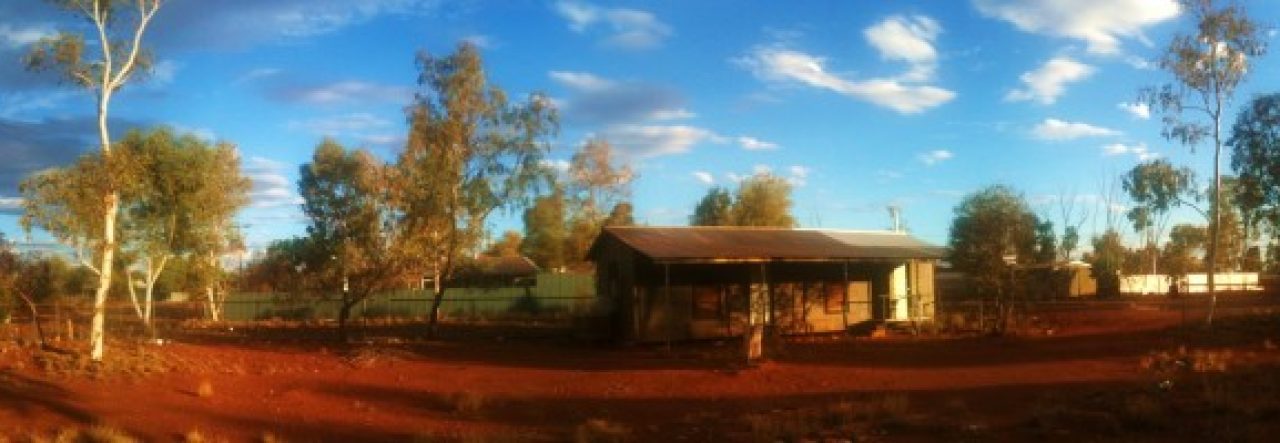
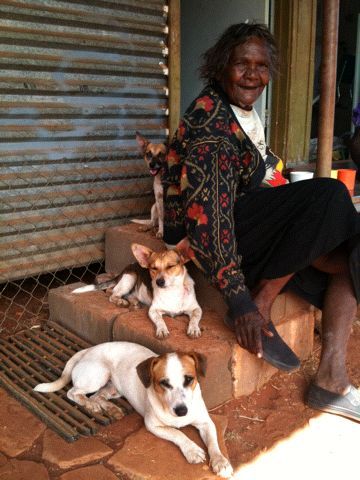
Every few days Tjingapa makes her way down to the old mission hut to find me. She comes with her compliment of 5 dogs: two big ones (with excellent Kalgoorlie pedigrees) that look after her; and three little ones which, I have learned, are two brothers and a sister. In all our conversations Tjingapa uses more Ngaanyatjarra than English, which is how it has always been. Since I was a teenager she has insisted I learn some new pronunciations in every exchange; and she leads the talk gradually away from English and into the rolling and gentle cadences of her tongue. She is always sensitive to my comprehension and, in the winsome way of her people, keeps me well away from the trap of embarrassment; nurturing relationship above all else.
Much of our conversation is familiar; there is a liturgy through which we pass. It includes the declaration that she has followed Mama God since she was a little girl. “I can’t leave Him”. We discuss her husband who lives in a nursing home in another community; but this is her land and this is her home. I hear about the old peppercorn and gum trees nearby, some of which once shaded early mission buildings and others which were planted by significant people in her memory. And we confer about our families; with careful attention to the progress of one who might have been unwell, another who was getting married, or a grandchild. Especially grandchildren! Whenever we talk we also pray, as so many Warburton people do.
We have something in common, this sister and I. We are both on a journey from doing to being. Tjingapa because of her 75 or so years (as she often reminds me), and I because of other factors beyond my control. As we sit together I yearn to know what this journey means. I sense that Tjingapa is way ahead of me, her very culture is one of being, where as mine is one of relentless doing. I think of the many trips I have made to this and other communities in Central Australia, armed to the hilt with the tools of my trade, ready to make it happen! Building, renovating, managing; always working with veritable missionary zeal. I’ve always wanted to be a man-on-a-mission; in a rather dependant sort of way I suspect. Perhaps I can be her disciple.
When city dwellers visit communities the first thing they tend to notice is everything that hasn’t been done: the rubbish lying round, the disorder and general disrepair. What I have noticed on this trip is something entirely different. If I sit on the narrow strip of metal veranda outside my door in the cool of the day, like as not someone will soon come and sit with me. Why? Well, it’s important to be with one another. Coming from a culture riddled with loneliness, I find it sublime.
My own incapacity increasingly forces me to depend on others to do for me what I cannot do for myself. I feel guilty, and sometimes grossly irresponsible; and it is a terribly difficult thing to bear. My temperament doesn’t help. I keep my trusty Leatherman close by, because there just might be something that needs to be fixed! I’m good with my hands and within reason I can make just about anything … or so I think. My childhood was bracketed neatly by the slow completion of the Sydney Opera House, and I can still see its various stages of construction that fascinated me so much. Well … I could have built that! Or so I think.
I remember the enigmatic bible story of Mary and Martha: Mary draws Martha’s ire with her avoidance of the practicalities of hospitality; while Martha resents Mary’s idleness as she sits at Jesus’ feet. But, unexpectedly, Jesus affirms Mary: she has chosen the right path, being rather than doing. When I read the story I always have sympathy for Martha, after all somebody has to do the work. Don’t they?
Is it a matter of priority? Is it a season of life? Does being do any good? Should one do more being? And what of these intrinsic words: fruitfulness, value, and usefulness? If they are the measure of life, am I still locked in the mode of doing? I remember that the One I follow was a Carpenter (like me!) and must also have laboured hard, tools at the ready, to make it happen. Perhaps his finished work was enough for all of us. Perhaps if we become Mary to Christ; He somehow, in ways beyond knowing, becomes Martha to us.
And Tjingapa always, always, talks about happiness. The all important pukurlpa that comes when we sit down together: “Pukurlpalan nyinara mamala ngamu”. There is an undeniable spiritual dynamic, “for where two or three are gathered in my Name, there am I in the midst of them”. “Nyangka-tjananyarna ngururr-ngururrpa ngarama”.
The less I do, the more I become. The slower I go, the deeper I delve. In being I welcome Him; and in the business of doing I have sometimes overlooked His presence, or worse, His purpose.
I am inseparably tied to One who says simply of himself,
I AM.
_________________________________________________________
_________________________________________________________
PS … On the same day that this photo was taken, I read most of my essay to Tjingapa. The concept of a Blog is not within her world, however I did ask for her permission to share this story.
PPS … Early in 2011 Tjingapa went to God. The world is a poorer place without saints such as her; but Heaven is not doubt a richer one. I miss her, good friend that she was.
 Rejoice!