Two Thirds Calamity

Two thirds of our household currently use a wheelchair.

Given that there are only three residents in Paradise, several things are easily deduced:

  1.     We are an even stranger household than usual
    (which is saying something!)
  2.     One of us is extremely busy.
  3.     Two of us are not.
  4.     Leaving the house takes courage and planning.
  5.     As does breakfast.
  6.     And lunch.
  7.     And dinner.
  8.     And everything, actually.
  9.     Favourite Wife is earning her keep.
  10.    Favourite Wife needs a break.
    (Just so long as it’s not a leg that she breaks!)

Little One broke her leg. She came a cropper from her scooter at Vacation Care, poor girl. It’s quite a small fracture apparently, but enough to need plaster for the next few weeks; and a wheelchair too. We gave crutches a try, but they baffled her completely.

On the up side; if you have to use a wheelchair there’s no better home than ours! We’ve got the lot: a selection of chairs, an accessible bathroom (a godsend), gadgets galore, and a wealth of experience. The down side, despite all our fabulous equipment, is bizarre. Take Sunday church for example: We have a special vehicle with a lowered floor, ramp and so forth; but it’s designed for only one wheelchair, and there’s not much room even for a collapsible second. So, Favourite Wife first gets Little One out of the car and into the push chair, takes her into church, hops her into a seat, then leaves her there (with quick prayer – she’s not the sort of kid you leave alone for long) while she brings the wheelchair back out to the car and repeats the whole routine with me. Leaving church is the same in reverse, and I won’t bother to describe the logistics of getting us all in and out of the front door at home!

I’m smiling, but there’s nothing very funny about all this; especially for my Best Girl. For her, although she’d never say so, this is the stuff of nightmares. We were to have gone away for some R&R by ourselves this weekend; probably a quick trip up the mountains, or a couple of days wandering along the rivers and valleys where autumn leaves are brilliantly on show. But sadly the respite carers who look after our eleven year old every month won’t accept her in a wheelchair. The respite house is purpose built for all manner of special needs, so their reasons are more complex than you might think.  The issue revolved around another client booked to stay at the same time, a young fellow who has previously targeted slower moving children such as those in wheelchairs. Crutches would be no better we were told. Without being quick enough on her feet to keep out of his reach the risk of harm is too high, and they cannot allow her into care.

I was initially taken aback by this news. I admit that my immediate reaction was defensive, inwardly questioning the fairness of our family’s needs being put second to those of a young man who puts our girl at risk. But my wife’s years spent working in Special Education have taught me to understand the dynamics. In the classroom the welfare and safety of students and staff depends on continual assessments just like this. In fact, when I broke the disappointing news my wife’s first response was that the other family would need the respite more than us; and I’m sure that’s true. We’ve seen families and marriages break apart, and single parents’ health collapse under the pressure of parenting a disabled child.

I relate this story because it’s a tiny window into the complex and ever compounding world of disability. Few problems are easily solved, and there is often a ‘knock-on’ effect where the solution to one problem leads straight to an intricate string of associated challenges that will be quite foreign to the ‘normal’ world. This is why the cure can be worse than the condition; and why some awful situations go on and on unchanged; and why well meaning attempts to help become quickly frustrated.

Earlier today we three were deeply engaged in the musical chairs I described above, and our parental frustrations with the whole deal evidently washed over onto the child in question. “Your wife”, she growled at me through fiercely clenched teeth, jabbing my torso with a diminutive eleven year old finger to underline each word, “Your   wife   never   listens   to   me!

She doesn’t know how true that is, except that it’s the world at large that turns a deaf ear; not my little girl’s mum. Each one of us comprehends so little about the unique, intricate, fearful problems that we each face; disabled or not. Perhaps that’s because we know, deep down, that once we understand – really, profoundly understand – we will have to get involved; and the cost might be too high. And so, instead, we celebrate all that is safe and simple and bright. We celebrate celebrity, because it’s dark outside.

Fortunately, wonderfully, I’m sure my little family will come through to calmer waters once again. The amazing respite people have already set for us another (longer!) break; we are blessed in many ways, and never without help.  If only that were true for many more that we know.


Rejoice!


An Ugly Divorce

I’m rattled. There’s no skirting the issue: my keyboard’s betrayal is shaking the core of my being.

__________________________________________________________

That’s all I could find to say.

The weeks have been slipping by since my last post, KBO, but each time I set out to write those few words were all I had.

For a long time now I have been rolling along through the various losses and challenges of my unknown condition with a belief that no matter what comes my way, there will always be a “Graceful Companion” alongside each less welcome intruder.  For three years there has been a patch of blue in every cloudy sky; sometimes a small patch admittedly, but redeeming virtue seemed to attend each adversity I faced.  Events have fitted together in such a manner that I have been able to embrace them with faith, by and large, knowing that I was not the lonely victim of random misfortune, but that there was a divinely ordered providence to life. At times the Graceful Companion has taken the form of miraculous provision: extraordinary gifts such as our home in Paradise; or more commonplace wonders like the many successful adventures Bugger, my power wheelchair, and I have shared; often with astonishing timing in regards to boggings, break downs and spare parts. Sometimes the Graceful Companion has appeared as a tangible sense of the presence of the Almighty himself; or as the rich companionship and fullness-of-life to be found in silent contemplation. I tried to capture this experience of paired loss and gain two years ago in one of my favourite posts, The Gift of Loosing Things My current experience, however, has yet to yield that familiar balance.

I think I have misunderstood grief, and especially the Christian response to crisis and loss. Led by my own need to soldier on, never admitting defeat, I have sometimes mistaken faith for stoicism and confused emotion with unbelief. Where does it come from, this insistence that all is well, the grin-and-bear-it mentality? Bravado. I suspect it’s a core value in many cultures, not least that of my English forebears; they of the ‘stiff upper lip’.  I’m certain bravado has its place, but it must surely have its counterpart also. Tellingly, the antonyms of bravado (restraint, modesty, fearfulness, cowardice) might each (at a stretch) apply in some degree to the ultimate example of grief and loss; one which is familiar to all of us, but from which I have more to learn. In the garden of Gethsemane, Christ anguished deeply over the ‘cup’ from which he would drink, the forward path he had to tread. There might seem to be little profit in drawing any comparison between His grief in that horrific setting and my own relatively minor predicament, but Jesus’ suffering was an integral part of his identification with humanity. It is this same suffering, the New Testament teaches, which equips Christ as the Great High Priest to deal gently with his flock. Seen this way His suffering is also an example to us in our many griefs. Bravado, it would seem, was not his style.

“My soul is overwhelmed with sorrow to the point of death”, Jesus said to his three disciples. Although he claimed the authority to dispatch an army of angels in his own defence, Jesus did not. He had come to live in a world of skin and blood and tissue, and he would die by its rules as well. At one point he fell face down on the ground and prayed for some way, any way, out. His sweat fell to the ground in large drops, like blood.

And God stayed silent.      (Philip Yancey).

Many of the Old Testament Psalms share this honesty in the face of desperation. David, especially, throws himself headlong into his sorrow, airing his lament for all to share. The lack of space for lament in the modern, affluent  world – Chuch or otherwise – exacerbates the pain of those who mourn. “Have a good cry”, they say, “It’ll do you good … get it out of your system”. So we do, and they pat us awkwardly on the back, and then we sniff a self-conscious apology, “I’m OK now, thanks”.  Tears are embarrassing, alarming even, especially for us blokes. They are something to be “got over”, another toxin threatening to mar the bliss of our happy existence. Well: bunkum, twaddle and poppycock!

Being so steeped in my own culture I am at a loss for a better alternative, but I envy my Aboriginal friends in the distant desert their communal life and their well worn passages of grief.

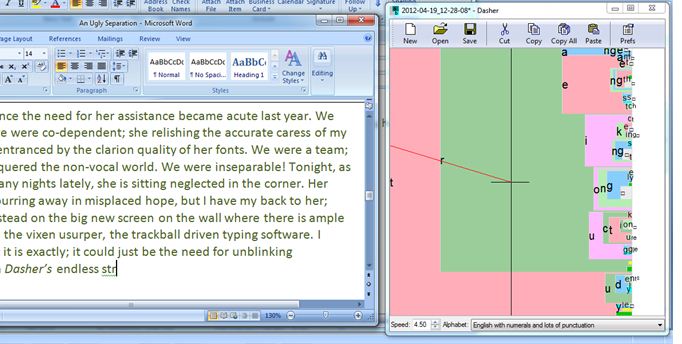
Six months ago I was expounding the joys of the keys in Typing School . The pleasurable years of  touch-typing developed into something much more serious between my keyboard and I once the need for her assistance became acute last year. We were a couple, we were co-dependent; she relishing the lightning sharp caress of my fingertips, and I entranced by the clarion quality of her fonts. We were a team; together we conquered the non-vocal world. We were inseparable! Tonight, as it has been on many nights lately, she is sitting neglected in the corner. Her innards are still purring away in misplaced hope, but I have my back to her; concentrating instead on the big new screen on the wall where there is ample room for Dasher, the vixen usurper, the trackball driven typing software. I don’t know what it is exactly; it could just be the need for unblinking concentration on Dasher’s endless stream of letters and alphabets, but this is hard work. It’s an alien language with none of the type-as-you-think fluency that I have practiced for so long. I feel incapacitated, mute, disabled.

Dasher, on the right, mid way through the word ‘stream’.

Her softly backlit keyboard still flirts at the edge of my vision, longing to lure me back, but it’s over between us.

How terribly, terribly sad.

Yes; but thankfully I still

Rejoice!

KBO

Seems it’s time to KBO, yet again!

(Not to be confused with KYBO; another acronym that still awakens torrid, visceral dread; almost four decades since my Boy Scout days).

But back to the point. KBO is a cherished contraction that I’ve not used here for some time.  It comes from Winston Churchill, who was said to end conversations with this gruff, thee-letter exclamation: KBO! Keep Buggering On.

(Now, there’s an odd connection: Lord Baden Powell, the founder of the Scouting movement, isn’t so far removed from Sir Winston Churchill. Same country, similar era, similar acronym!)

Back to the point: KBO. I’m so attracted to this gritty, determined epithet. These three letters contain a wonderful, resolute courage that I would like to emulate.  And it seems that the time is coming, once again, to KBO.  Uncooperative hands are nothing new, I wrote about them as far back as mid 2010.  But I can’t recall a full day of disobliging dexterity; not like today. I’ll spare you the gory details; suffice to say that it’s arms, biceps and triceps, rather than hands alone that are now giving me grief.

(The first KYBO [pronounced as a single word: “k-eye-bo”] I had the misfortune to encounter as a tender young Boy Scout was a single-trench model. Picture a twelve foot long ditch, six foot deep, surmounted by a sparse array of rough poles lashed together with hemp rope, around which some hessian has been vaguely wrapped.  One pole is suspended horizontally about five feet above the trench; and on this pole Boy Scouts were expected to somehow balance with the aid of a couple more horizontal poles and… KYBO! …… )

Back to the point. Losing mobility is a challenge, but with good old Bugger it’s been manageable, in fact sometimes it’s quite an adventure. Voice loss is trickier to deal with, the solutions are much harder to find, but it can be done. But arms? I know I’d rather think about something else.

(I can tell you’re just not getting this, so I will spell it out: KYBO, Keep Your Bowels Open. These days such psychological brutality would not be allowed; there would be an induction course for innocent Boy Scouts before they were subjected to the KYBO. Or in our modern, lacklustre world a row of Port-A-Loos instead).

Back to the point. I can’t type this evening. (Well, I can, but it’s not worth the pain).  I’ve written this whole essay without touching a key. I’ve been experimenting with a programme called “Dasher” for some time; more out interest than necessity. It’s like an infinite series of alphabets, a new one opening after every selected letter. Apparently a competent user can match a modest typing speed, but I’m nowhere near that yet.

(Thinking back, it wasn’t only the KYBO that traumatised my fledgling Boy Scout mind. One morning on that same, fateful Jamboree weekend, I witnessed a small pack of rogue Scouts sneak up on a Boy’s Brigade KYBO and pull out it’s tent pegs, then rapidly stuff its ropes, its blue plastic walls and its occupant down the hole! No word of a lie. I had nightmares for months.)

But back to the point. I don’t know which is worse: childhood memories of the KYBO, or the current pressing issue of life sans arms.

(Who was the bright spark that stuck a Boy’s Brigade camp next door to a couple of hundred blood-thirsty Boy Scouts?  It’s not called a Pack for nothing!)

It’s not exactly fear that I feel as I look ahead, wondering how I could live without arms; although I can’t deny fear is there.  It’s more of a leaden resignation to what seems almost inevitable.  There is no urgent emotion attached to this grim vision.  Perhaps that’s because I’ve learned in three years that life goes on. And so far, at least, it’s gone very well indeed.

(The colours of 2nd Mosman were red and yellow; I’ve still got my scarf!  Over time I learned to taunt the younger, wide-eyed, Scouts; uninitiated and fresh from Cubs.  Huddled around a camp fire, pitch black night behind us, spooky noises aplenty, we would tell the nervous juniors that red and yellow stood for “Blood & Guts”.  Everyone gets their baptism in fear, one way or another!)


KBO!


God in the Machine

Given her moniker, it’s a wonder Bugger doesn’t cause me more trouble.  She’s been a faithful warhorse, my power chair; and although we’ve had two new motors, two new batteries, two new castor wheels and two new drive tyres in 18 months; she has never let me down in a moment of need.  Granted, there have been boggings and breakdowns, but when the pressure is on, Bugger never backs down!

Or, she hadn’t until Friday morning.

Our brushes with disaster have been monumental.  A fortnight from Christmas 2010 I limped into the showroom (a bus ride or three from home) with heavy heart and a clunking, grinding, misbehaving power wheelchair.  The timing could not have been worse: with Christmas and our January holiday so very close, and the workshop and spare parts people all but raising their glasses of Christmas cheer.
But…  it proved to be nothing more than a loose electrical connection.  An exhilarating escape from doom!

Returning from Melbourne six days out from last year’s Christmas, Bugger shut down completely in the taxi  from the train station to our door!  We had just spent three days flitting around the city, and good old Bugger hung on till the very last moment.  Disaster averted!  It was an electrical cable that had failed, and the service people said they couldn’t get a replacement part untill February.
But…  B4 was originally fitted with an LCD screen (I don’t quite know what for) that I had removed and kept in a cupboard, and it just so happened this gadget had exactly the cable the mechanics needed!  Without it we could not have gone on another glorious January holiday.
Saved, again!

But not on Friday morning.
Little One was to leave for school in two hours for a record seven sleeps in respite care.  A lengthy time away from us (she was so brave!), during which Favourite Wife would head north to spend a week minding our two grandsons.  And me?  Well, I was to embark on my first overnight rail journey in more than a year; catch up with family, attend a school reunion in Sydney, and stopover on the way home for our daughter’s birthday.

But…  straight after breakfast in the early morning light a sickening grind suddenly cut the air.  Bugger was crippled!  (If this was a Tabloid Blog it might have read, ‘Bugger was buggered!’ But you won’t find that sort of language here.  Never!)  Once the others were safely off on their expeditions, B4 and I hobbled by bus to the workshop, just in case there was another loose connection or a remedy of some sort.  There was not.  This problem, the experts said, will take some serious work.

Should I accept the miraculous deliverances, and name them ‘blessings’, and yet resent the day of failure?  Or worse, should I call it ‘cursed’?

The antagonistic and sadly deceased atheist, Christopher Hitchins, had a point to make here.  He cited the example of the ‘Blessed Villages’, sometimes called the Thankful Villages of England.  These are townships that lost none of their menfolk to the First World War.  Many of them (there are some fifty Thankful Villages, although Hitchins claims there are only three) have no war memorial.  Hitchins’ challenge is the naming of every other English village – the vast majority – whose war losses were often horrific.  Should they not, he asks, be called by Christians the ‘Cursed Villages’?  It’s a challenging question; however it stems from a very rude, dichotomous view of life that would categorise every incident as either good or evil, black or white, blessing or curse.  In this paradigm there can be no grey.  It is the harsh, fundamentalist view that tears men apart and ultimately pits them one against another.

I don’t think you can easily carry a black and white view of the world too far beyond youth.  If you do, you must harden yourself against uncertainty, and develop that hazardous form of faith that despises doubt.  Quoting our atheist protagonist once more: “It’s probably the stupidest thing the human race does, to look for patterns in this way and say when a baby falls out of a high rise building and bounces on the grass below, ‘that must be God’. And when millions of children die every day from lack of pure drinking water and just die of diarrhoea in a banal manner, that’s because God moves in a mysterious way or isn’t involved at all.”  He has a point.  That is a thoughtless view of life.

Is it so hard to see the Almighty beside us in the things that delight and in those moments that terrify or merely disappoint?   I’ve always thought it telling that a frequent response to Christ’s appearance was utter, trembling dread.  Our salvation often lies exactly where we fear to venture; and the thing we resist turns out to profit us most.  It is harder, perhaps, to see God at work in world affairs; but too often we blame Him instead of ourselves, forgetting that where we choose to go He walks as well.

On Friday I had to make the difficult decision, on the advice of my mechanic, to cancel my trip, cancel the hotels, cancel the train connections and say hooroo to my family and friends waiting at the other end.  Quite honestly, it wasn’t so hard.


Rejoice!

Every Cloud

The skies have been grey most days for days on end. Nightly on the news we have seen entire states under a deluge of rain, flooding homes by the thousand.  Our home in the hills is well above the swollen Murray River, but the relentless rain and sheets of grey cloud have created a fitting backdrop for my own grim tasks of the week: I have been up to my elbows in disability funding.

In former times those in need were cared for by family and friends, and sometimes by the church.  Nowadays, in this country at least, there are welfare systems; and they rely on paperwork, interviews, and manifold layers of administration.   Parenting two disabled children has taught me to navigate this system fairly well, but it’s no picnic.  The biblical phrase, “you have not because you ask not” sums up the state of things perfectly.  A two pronged attack is required. First, find out who has whatever it is you need; and second, ask for it!  This involves filling in endless forms for a confusing array of government departments and other organisations, and sometimes a detailed, face to face interview.  Every question is asked, especially in regards to one’s mastery (or otherwise…) of ‘les toilettes’.  The bureaucratic fascination with bodily functions is persistent, to say the least.  The usual outcome of such applications is a letter much like one I received this week, and I quote verbatim:  “I am pleased to advise you that our service can be of support and that a Linkages Case Managed Package would be most suitable for you.  Unfortunately at the moment there are no packages available” etc etc etc. This happens all the time, often with a warning that it could be months and more likely years before such a package becomes available. The trick is to find as many government branches as possible, apply to them all, resigning yourself to repeated indignities in the endlessly fascinating realm of ‘les toilettes’.

It’s bleak work, as bleak as the weather.  Spelling out all your problems does nothing at all to lift your spirits; in fact the storm clouds seem to grow wider and darker, until all blue-sky optimism is gone!

I am mindful of an old chestnut in Christian thinking: Do we give thanks for all things, or in all things?  The difference is significant.  There seems to be an obvious contradiction in thanking God for something nasty; after all, good things come from the Father above, who alone knows how to care for his children.  Many Christians take a slightly different route: thanking God in the circumstance, but not actually for it.  Exactly what, though, are we then thankful for?  Is it just a nebulous sort of gratitude that we shield ourselves with in hard times?  Is our thankfulness only a very broad brushstroke that acknowledges that God is greater than the trials imposed on us by the devil, or by the world in general, or by our own maladventure?

Here are some oft cited passages on this question:

Give thanks in all circumstances, for this is God’s will for you in Christ Jesus.[1]

But in everything, by prayer and petition, with thanksgiving, present your requests to God.[2]

Always giving thanks to God the Father for everything, in the name of our Lord Jesus Christ.[3]

Here, and elsewhere in Scripture, there are both ‘ins’ and ‘fors’ to guide us; and so perhaps it’s fair to say the answer may be ‘both’.  But that’s a lazy answer, it avoids the problem.  Everything that happens to us is not good; indeed it might be blasphemous to thank God for the worst atrocities of the human world.  Or perhaps everything that happens to us is good for us in some way. Every cloud has a silver lining, ‘Whatever doesn’t kill you makes you stronger’.  But our strength is not the goal of God’s presence amongst us.

I find myself grateful in an overarching sense, recognising how fortunate I am.  I doubt there are too many people in my situation of disability anywhere in the world who receive the level of support I enjoy.  I am also quick to recognise that many people face terrors daily that I can scarcely imagine. It’s easy to talk about gratitude when there is so much to appreciate.

I also find myself grateful in a specific sense, ‘for’ the circumstances and ‘for’ the challenges that I have met.  I give thanks ‘for’, because I am conscious of the sovereignty of God, knowing that His will prevails over the lives of all humanity in ways beyond my understanding.  I also give thanks ‘for’ because I have learned to see that He intimately inhabits the human world.  The incarnation – Emmanuel, God with us – means that what happens to me happens also to Him.  Jesus Christ, in his suffering and death, demonstrates the way the presence of the Almighty wonderfully transforms tragedy and evil, reworking the most horrendous situations in astonishing ways that demonstrate his love for us.  Sometimes we can see the beauty of this redemption; and sometimes the plans of which we are such tiny members stretch far beyond our sight.  More and more, however, I am learning to give thanks for all things, the good and the bad, the big and the small, the evident and the mysterious, trusting with increasing confidence that “in all things God works for the good of those who love him”.[4]


Rejoice!

___________________________________________________________________


Some context:

[1] 1 Thesalonians 5: 16 Be joyful always; 17 pray continually; 18 give thanks in all circumstances, for this is God’s will for you in Christ Jesus.

[2] Philippians 4: 4 Rejoice in the Lord always. I will say it again: Rejoice! 5 Let your gentleness be evident to all. The Lord is near. 6 Do not be anxious about anything, but in everything, by prayer and petition, with thanksgiving, present your requests to God. 7 And the peace of God, which transcends all understanding, will guard your hearts and your minds in Christ Jesus

[3] Ephesians 5: 15 Be very careful, then, how you live—not as unwise but as wise, 16 making the most of every opportunity, because the days are evil. 17 Therefore do not be foolish, but understand what the Lord’s will is. 18 Do not get drunk on wine, which leads to debauchery. Instead, be filled with the Spirit. 19 Speak to one another with psalms, hymns and spiritual songs. Sing and make music in your heart to the Lord, 20 always giving thanks to God the Father for everything, in the name of our Lord Jesus Christ.

[4] Romans 8: 28 And we know that in all things God works for the good of those who love him, whohave been called according to his purpose. 29 For those God foreknew he also predestined to be conformed to the likeness of his Son, that he might be the firstborn among many brothers. 30 And those he predestined, he also called; those he called, he also justified; those he justified, he also glorified.

Non Modo Sed Etiam


Nine tenths of the way through the Tchaikovsky Polonaise an usher at Melbourne’s Music Bowl tapped me on the shoulder.

“Can we move your wheel chair please?” she whispered over the Melbourne Symphony Orchestra.  I was sitting in a row of seats with a good friend from school days on my left, and Bugger, the power chair, parked in a designated space on my right.

Requests stated in the plural, ‘we’, are often suspicious; don’t you agree?  Something about the looming situation was making the official reluctant to take responsibility. The blame for whatever was about to interrupt Tchaikovsky was obviously being dispersed.

“We have two more wheelchair patrons who have to stay together, and we would like to move your chair away if you wouldn’t mind”.

And so ‘we’ missed the climactic bars of the Polonaise, (as did a dozen more patrons around us), while I supervised Bugger’s relocation and we all shuffled one seat to our left to accommodate a carer for the two new arrivals.  Happily, everything was completely sorted out just in time for the announcement of a 25 minute interval.  I’m glad we didn’t miss that!

I wondered if any of our neighboring concertgoers were completely free of disparaging thoughts about the two newcomers and their carer.  I certainly wasn’t.  If there were any pure souls among us I suspect they, too, fell into our communal moral crevasse during Rachmaninov’s third and final Symphonic Dance, the concert’s showpiece that followed interval.  During the opening bars we overheard whispered deliberations about departure, and then the exit maneuvers of the two recently arrived power chairs began.  While not entirely out of step with the orchestra, one felt it was not quite the dance that Rachmaninov had in mind.

It’s unusual for me to be amongst other wheelchairs, and I couldn’t help wondering if the audience made any distinction between me and the other two.  I doubt very much that the patrons looking on in distracted annoyance saw us as anything other than an amorphous clump of the disabled.  Goodness, they probably thought my school mate was my carer! (actually, he was …sort of).  I doubt the patrons realized that while those two had special needs, I was actually special!  You see, I like to remind myself that my challenges are only physical, not like some people.  And I relish the superior knowledge that I wasn’t born disabled, thank God!  No, my disability is more like a soldier’s battle scars, the unfortunate byproduct of a life bravely lived!

Such odious rubbish is – I hate to admit – actually in my head from time to time.  And I’m not trying to disperse the blame, but aren’t ‘we’ all much the same?  How many of us are innocent of those snap judgments we make of people time and again every day?  Those stereotypes we immediately form, based purely on a person’s bulging waistline, or the thickness of their spectacle lens?  I see a person with a particular hair style in combination with certain tattoos, and I know I have their measure.  An accent that I consider uncouth, or perhaps affected, is enough evidence for me to lock a person squarely in their pigeonhole.  And when it comes to dress-sense, well, the game is over right there!

I think I know how other people sometimes see me.  The clues are hard to miss.  Staring, for example, leaves little doubt.  Then there is the seemingly ubiquitous raise-your-voice-for-the-person-in-the-wheelchair phenomenon.  There is also the infuriating deference paid to the normal person walking beside me: every comment goes straight to them!  It extends occasionally to questions such as, “Can he hear me?”  All of which is probably quite reasonable.

What is utterly unreasonable is the way I see others.  I’m surprised by the depth of character people turn out to have when I have labeled them shallow.  I’m embarrassed to discover intelligence and wit in the person I had catalogued as a moron.  The ones I think are super-spiritual are actually attuned and sensitive; and the facile prove to be real people, after all.

Am I alone?  Or is it a universal law that there is more than meets the eye in everyone we meet.   Non modo sed etiam, “not only but also”.  I am thinking again of my two fellow travelers at last week’s concert:  I do hope they are surrounded by people who listen, and who engage, and who value them; because I know it won’t always be their lot.


Christian Speak

Our church made a fuss on Sunday last.  A fuss over me!

Back in August I posted a sad little tale about the apparent end of my pastoral vocation.  A Golden Watch recounted the grief I felt when my final departure from the church office went unnoticed. It was a glum story, told only from my perspective of loss.  Today, in this post, I want to apportion blame squarely where it belongs.  I will write about it here not in complaint, certainly not to wallow, but only because I consider it to be a story worth telling; a story for our time and our ears; a story that might shed some light on paths that others tread.

Until last August a highlight of my week had been the meeting of the leadership team of our church.  On Tuesdays I would leave our home at about 9am and catch three connecting busses to arrive at church in time for our 11am meeting.  Tuesdays in the office were exhilarating days of conversation, productive work, good banter and fresh brews from the coffee machine.  But winter brought physical challenges last year and, as I wrote in ‘Golden Watch’, on one particular Tuesday I knew that my season was over.

Back then I wasn’t speaking much at all (Little Blue Pills had not been discovered!).  I had given up the trusty voice amplifier that had served so well, and mostly just typed onto a screen for others to read.  I felt unable to discuss my growing challenges with my colleagues or friends.  Even considering the difficulty of transposing deep thoughts onto the keyboard, I can’t excuse my lack of communication.  I had allowed a bubble of separation to grow around myself, which I compounded further by communicating my resignation by email.  At the time I thought it was reasonable, that no other avenue of communication was available.  But at some months distance I now see it as shirking my responsibility to my fellows; I owed them more than that.  Worse, it smacks somehow of self pity: a feeble admission inadequately announced.

What happened next was nothing.  A week passed, and there was no reply, no acknowledgment at all.  Weeks went past, and no one said a word.  As the passage of time lengthened it seemed ever harder to broach the subject, and the pain remained. Tuesdays went on without me, but I would see everyone each Sunday.  Nothing was said, not by me, and not by anyone else. It was not my fault.  It was not their fault either.

I have a theory, which is why I am telling this story:  I think that both sides failed to speak because there were no ‘right’ words to say. If I had been moving onwards and upwards the words would have sprung easily to all our lips; we are very practiced in wishing each other well.  But slowly disappearing with an unknown, unnamed medical condition does not fit the paradigm at all.  The hardest pastoral hours I have spent have been with those who grieve.  The pressure to say something is intense; you urgently want to console, or encourage, or reassure; and yet it is often far better to listen in compassionate, attentive silence.

People of faith have hope, and our hopes take concrete form.  We hope for the best, we hope for the things we value most, and we express our hopes for one another in habitual ways.  We develop hope-filled customs: we wish each other good morning and sweet dreams; we post get well cards; we sing happy birthday; we pray each other for health and strength, opportunity and success; when we sneeze we say “God bless you”!

But we sometimes lack elasticity and struggle in uncharted territory. A great deal of what we say to one another is terribly predictable; scarcely departing from the rule of polite cheerfulness. We learn a set of responses that govern our relationships, and to a large degree we stay within those bounds. We are like politicians reading from an auto-cue; we say what we’ve been told to say.

Last Sunday’s ‘fuss’ was a healing gift. My former role was acknowledged and (embarrassingly) applauded well beyond its actual merit. It was a welcome meeting of hearts.

Finally, to the blame!  Where does it belong?  It belongs with us, we Christians.  We have been given Grace, covering our shortfalls, and yet we prefer to make our own Rules.  Rather than being led by the Spirit of God, we school ourselves religiously in our notions of blessing and success and what we imagine God’s plans should look like.  Consider:

The wind blows wherever it pleases. You hear its sound, but you cannot tell where it comes from or where it is going. So it is with everyone born of the Spirit.1

No eye has seen, no ear has heard, no mind has conceived what God has prepared for those who love him — but God has revealed it to us by his Spirit.2

In these lines I hear of other paths, new words, different hopes.  How often, I wonder, do insensitivity and isolation come as a result of spiritual deafness?  There is a path of love that can unite us all, but not while our conceptions speak above the whisper of His voice.


Rejoice!


________________________________________________________________________________________________

Footnote: The context of a passage is all important:

1.

1 Corinthians 2  6 We do, however, speak a message of wisdom among the mature, but not the wisdom of this age or of the rulers of this age, who are coming to nothing. 7 No, we speak of God’s secret wisdom, a wisdom that has been hidden and that God destined for our glory before time began. 8 None of the rulers of this age understood it, for if they had, they would not have crucified the Lord of glory. 9 However, as it is written:

“No eye has seen, no ear has heard, no mind has conceived what God has prepared for those who love him”— 10 but God has revealed it to us by his Spirit.

The Spirit searches all things, even the deep things of God. 11 For who among men knows the thoughts of a man except the man’s spirit within him? In the same way no one knows the thoughts of God except the Spirit of God. 12 We have not received the spirit of the world but the Spirit who is from God, that we may understand what God has freely given us.


 2.

John 3  5 Jesus answered, “I tell you the truth, no one can enter the kingdom of God unless he is born of water and the Spirit. 6 Flesh gives birth to flesh, but the Spirit gives birth to spirit. 7 You should not be surprised at my saying, ‘You must be born again.’ 8 The wind blows wherever it pleases. You hear its sound, but you cannot tell where it comes from or where it is going. So it is with everyone born of the Spirit.”

Pobblebonk

The title Eighth Wonder of the Natural World has been contested countless times; however the honour belongs, in actual fact, to a high ridge of hills sweeping into a lightly timbered valley in front of our home.  This, of course, is Paradise!

In heavy rain the gully runs with an ephemeral creek, fed from a gallery of steep slopes.  The sound of this small cascade is rare and enchanting; and sometimes heralds a still rarer and more remarkable sound: the call of the Pobblebonk.  Its alternate name, the Eastern Banjo Frog, gives a clue to its very unique croak.  It plonks, or perhaps it plinks.  Its the sound of a single beat from a Monkey Drum – those double headed drums you spin on a stick; the kind that grandparents give to young grandsons as an act of Christmas revenge. A froggery of Pobblebonks sounds like an arrhythmic Monkey Drum choir – spellbinding music if you can imagine it!

Quite recently I followed a Pobblebonk down a dire and seedy path of deceitful manipulation.  Let me tell you how…

A lone Pobblebonk turned up in our garden, nestling beneath mulch and bark.  We had friends working with us in the garden, and they took him in a plastic box to a veterinary practice just to be sure.  Positively, absolutely a Pobblebonk.  In the days that followed our find, a dastardly scheme brewed in my thoughts. I would write a letter to our Local Council, singing the praises of the rare amphibian, briefly touching on its intriguing name and its place in folklore, and finally concluding with a casual mention of the thriving colony of Pobblebonks happily ensconced in our little slice of bushland.  Most of which is nonsense.  Rubbish.  A fabrication designed with one single purpose and nothing whatever to do with froggy welfare.  My plan was a crafty smoke-screen designed purely to prevent anyone else moving in on our private piece of Australia.

You see…..

The bushland opposite our home includes a strip of vacant blocks owned by the same developer who is currently expanding rapidly on the flat land nearby.  Fresh curbing and guttering, virgin bitumen roads, building blocks pegged out, cottages springing up like so many mushrooms after a storm; a brand new shopping complex, a school, a petrol station, a carwash, even the site of a new aquatic centre all lie just over the hill from Paradise. Before purchasing our home I met with the Town Planner, and discovered that much of the glorious bushland view across from our home would one day be built out.  “Inevitably” was the dismal word she chose.

And there my obsessive fretfulness began. I have invested a deplorable amount of mental energy in this pursuit; and drawn others into my silly web of worry.  A relative with experience in development whispered the hot-topic names of an endangered caterpillar and a marsupial, either of which would almost certainly bring building to a screaming halt; birthing years of environmental impact statements and legal challenges.  Another member of my family (not my immediate family, I hasten to add!) offered to set up a sort of commune in the grassland.  A circle of tents in which recruits would live in naked communion with the earth, prancing around bonfires and chanting to the full moon.  That would have scarred the home buyers away!  I would sometimes peek out my window at vehicles that stopped across the road.  Where they harmless council workers, or did they look like developers, coming to steal our view? I caught myself daydreaming in front of my wide new window: prospective neighbours are wandering around on their prospective land, imagining their prospective rooms and looking through their prospective windows when they suddenly see me in my wheelchair staring back at them! That should frighten anyone off!  Such tawdry conniving deserves anything but reward.

And yet….
Yesterday, out of the blue, we received a letter from the city council advising that they had acquired the vacant blocks; swapped them with the developer in exchange for other financial obligations.  The strip of land will be rezoned as conservation parkland, for public use, never to be developed!   Hallelujah! Celebration!

I am so excited that I a little ashamed.  I’ve not given a thought to the Pobblebonks; I’m merely thrilled and relieved for myself and my household.  I do not deserve such privilege, quite the opposite.  So why?  Why have we found blessing added to blessing?  We can hardly believe that we live in our home as it is, and suddenly we have been given more again.

Human nature (my human nature at least) seems more ready to accept judgement than reward; quicker to hear censure than approval.  Our ears seem more attuned to loss than gain.  The evening news is mostly bad, rarely good.  Fear is easier to entertain than hope.  Amongst the oldest words in the Bible are these from Job:

“Naked came I into this world, and naked shall I depart. The Lord gave and the Lord has taken away; blessed  be the name of the Lord!”  (1:21).

Loss I understand, much though I dislike it.  It’s the gift that astonishes me; it leaves me breathless, awed, alarmed, hushed.


Rejoice!

Little Blue Pills

Rather than being rose-coloured, my New Year glasses are a pale, duck egg blue.  Innocuous Little Blue Pills have recently replaced an ever-increasing array of pain killers so effectively that the world itself looks new. But, dear reader, I am loath to discuss my Little Blue Pills with you. I’m striving to understand my utter distaste of this topic, and several possibilities come to mind:

I dislike medicine.
Reliance on pills seems to me to be frail somehow.
I take Panadol behind closed doors, such is my embarrassment.
The whole idea of a chemically supported life irks me as much as a mechanically supported life – a thought that does not bear scrutiny well.

Nonetheless, I am resolved to tell all. I can’t maintain a blog dedicated, as my banner says, to: “Honesty & Faith: my experience of life as a Christian with a Motor Neurone Disorder” if I start withholding.  So, here we go……


One Little Blue Pill
“Endep is an old style, tricyclic antidepressant.”

“Is this a trick?” I interrupted with foreboding panic, “Are we back in the loony bin again?”

“But”, my local neurologist continued, unperturbed by my outburst, “taken in very low doses it has a remarkable effect on nerve pain”.  (Apparently it blocks the signals of pain whereas painkillers merely suppress it … somehow…)

“I want you to try one tablet, and then a couple of weeks later two, and so on till you get to four or five tablets.  I think you will find it helps a lot”.

And it does indeed! Within a few days most of the dozen other daily tablets prescribed the doctors in Melbourne were unnecessary. It’s a strong drug: in the mornings your eyes detach from your brain for an hour or three, pursuing their own independent interests, and your mouth is as dry as the proverbial sandwich. It must be strong stuff:  I felt alive again. I made longer bus trips away from home, and – astoundingly – I noticed my voice returning just a little.


The ante-pre-penultimate dose…
A week or so later the effect wore off, but two Little Blue Pills did the same job and more. My Favourite Wife and I heard Handle’s Messiah performed in Melbourne; a wonderful weekend that I had honestly feared for weeks.  We had taken a break three months earlier which didn’t go so well, but armed with Little Blue Pills I was fine and dandy.


The pre-penultimate dose…
Christmas came and went, and once again the prescription wore off.  Three Little Blue Pills, however, took us up to Sydney for our annual holiday; and what a beautiful time that was.   With Three Little Blue Pills I rediscovered the voice amplifier which had lain disused for some five months.  I even dug out my old elbow crutches – the subject of my first ever blog – and made a gradual trek from back door to beach sand!  Incredible.


The penultimate dose
Four Little Blue Pills; and I have recommenced a daily walk to the letterbox and back; a distance of about forty feet perhaps, which takes me – oh – ten minutes?  I stopped this daily regime of exercise before mid year; and so, as you can see, these pills are quite miraculous, the closest thing to a wonder drug that I have ever seen.


The ultimate dose?
Five Little Blue Pills is the target the neurologist set. When with the ultimate dose arrive?  And what if they wear thin, just as one, two, and three Little Blue Pills seem to have done?  Strangely though, this is far from the only question troubling my mind.  I routinely make a mountain out of nothing, but indulge me in this:

Firstly, it’s harder than you might imagine aligning your thoughts to improvement when decline has been slow and unremitting for several years. Improvement is causing my thoughts to swing erratically between recovery and demise.  In a recent daydream I saw myself enrolling once again at university, graduating with honours and then setting out in a brand new career!   On other days I cannot see beyond another cold Victorian winter.

Secondly, it challenges my faith.  Just as I wonder why the good doctors didn’t suggest Little Blue Pills 12 months ago – and goodness knows I’ve asked for help – so I wonder why the good Lord didn’t suggest them sooner too!  I wonder about the nature of miracles; about the interplay of divine intervention and science; I wonder what healing really means; I wonder about the meaning of life, and the purpose of suffering. From Little Pills, Big Questions grow!

This is my conclusion:  I don’t know. 
I cannot know why a certain thing happens now rather than then; any more than I know now what may happen when.  The miracle-working Christ was curiously harsh on people who looked for miracles: A wicked and adulterous generation asks for a miraculous sign”, (Matt 12:39), perhaps because the true miracle is life itself.  If I analyse the miracle of life too deeply I become a one-man inquisition; inevitably rejecting both God and hope. The art of living is to enjoy the miracle of each day with gratitude, shedding the entanglements of doubt and fear.


Rejoice!