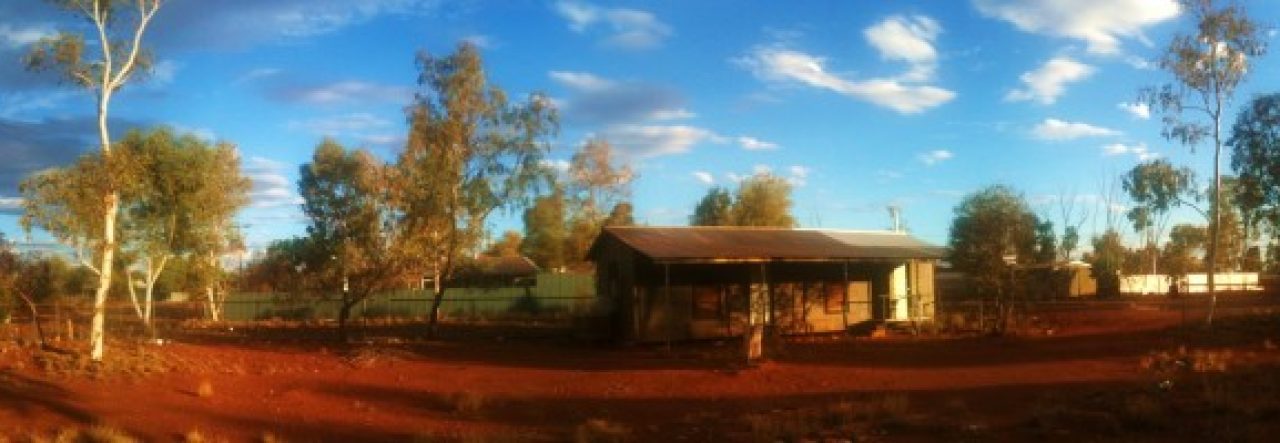
Wednesday* dawned exceptionally bright. The hill paddock was whitened under a deep frost, and we later discovered water in the wheelbarrow frozen a quarter inch thick across the top. The cold was no hindrance though, because a much anticipated astronomical event could be observed straight through my window, right beside the heater!
Only 8 years have passed since the last Transit of Venus, but no one living today will see the next. The Transit will not occur until a fortnight before Christmas, 2117; making it one of the rarest of heavenly happenings. Wednesday’s Transit was watched through countless telescopes and other devices, professional and amateur, right around the globe. From the fractional shift in the sun’s ambience astronomers glean data that will reveal similar planetary star-crossings in far flung galaxies; but the phenomenon was more fundamental when Jeremiah Horrocks recorded the first observation in 1639. From the Transit of Venus Horrocks was able to calculate for the first time the distance between the earth and sun. By the time of the following Transit in 1769, the event was considered so important to science that Captain James Cook was sent around the globe to observe it from Tahiti; as a consequence of which I am writing in English today.
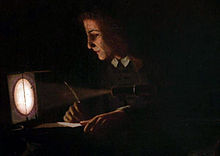


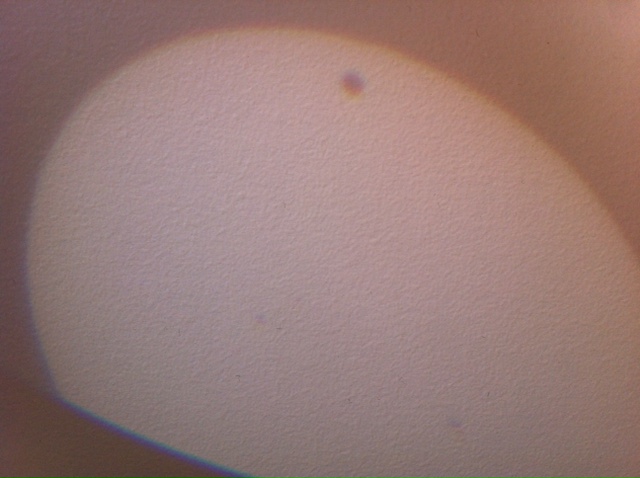
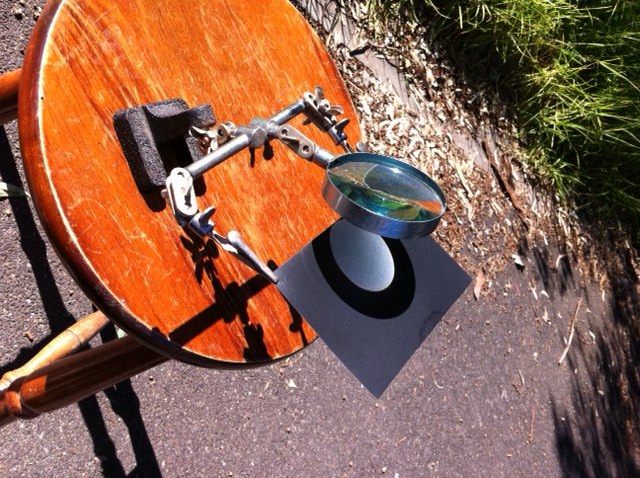
The tiny Venutian shadow on my square of card was delightful and mesmerising. I’m grinning with delight even now as I write, recalling the elements of that morning of science. My telescope, for example, is an old friend that has been travelling with me for forty years or so, since childhood days when it was in constant use on our dining table, identifying every vessel that passed through the heads of Sydney harbour. The day had a palpable sense of history; wrapping the globe in an observatory community of which I was part. Dimly recalled high school trigonometry afforded me a vague connection with the mathematics of the seventeenth century. And the weather! Crystal-blue skies were surely a heavenly imprimatur stamped on the moment. But something else had also begun to steal across my field of view.
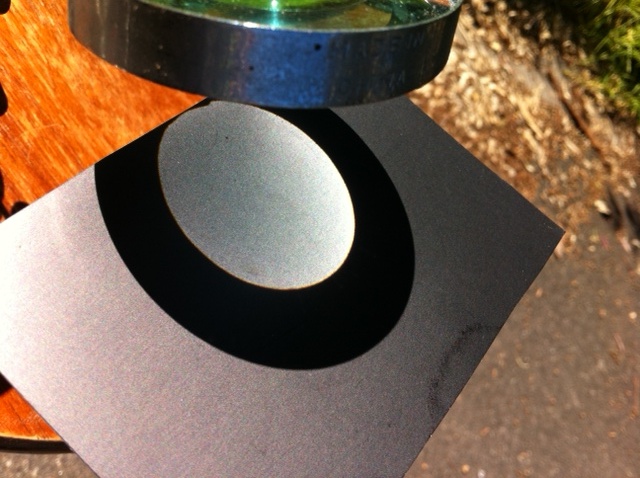

As the second brightest object in the night sky, Venus can actually cast a shadow; and in a corner of my mind a memory was awakening, threatening to darken the morning’s success. I knew that I was courting disaster, tempting a particular aspect of my character to engulf me in a lethal shroud of nostalgia.
I had witnessed the previous Transit of Venus in a curious way. In 2004 I was spending a couple of days each week in a building yard, fabricating roofing trusses. I worked under a high, corrugated iron roof which sheltered the timber stacks and machinery, but offered no protection from the bitting June winds. We would have had a fire bucket well under way before the bright winter sunlight shone through a score of old nail holes in the roof, each sunbeam projecting the image of its star above, so that by noon the shaded concrete floor was pocked with a constellation of Suns, each traversed by a tiny Venus dot. I had seen this effect once before, while feeding hens in a chook shed during a solar eclipse. My Favourite Wife brought the children past the building yard after school, and we caught the image again with binoculars and cardboard. This was a beautiful, happy season in life, one of our golden years. The family was young and mostly still at home. I was strong and fit, there was no wheelchair-shadow on my horizon, and life was good. So very good! Dangerous, dangerous thoughts for anyone prone to fits of wistful longing.
Ever my weakness, sentimentality crouches frequently at my door, eying me with predatory lust. “Your enemy the devil prowls around like a roaring lion looking for someone to devour”. Yet on Wednesday the monster did not bite. It was the words of a friend, observing my observation, that brought things into focus. Having seen my mobile-phone photos he wrote back, “… the sight of that little Venus tracking boldly across the face of the sun brought tears to my eyes; I don’t know why really – the glory and mystery of the universe, the wonder of being human and being able to observe and reflect on such things, the sheer beauty of the image, the glory of looking into the heavens on a telescope – all those reasons, I suppose”.
It was Venus herself who delivered the lesson, and saved me from sentiment. The delight and the thrill of observing the Transit come from its brevity, its rarity, its remoteness; at once timeless, ancient, and present; its steadfast adherence to time and place. Its transitory nature demanded my presence, and reminded me how to live. Within time’s precision there is such beauty.
“He has made everything beautiful in its time. He has also set eternity in the human heart; yet no one can fathom what God has done from beginning to end.”
Rejoice!
_____________________________________
* That would be Wednesday a fortnight back. Writing speed according to ‘Dasher’ is hampering my attempt at a weekly blog. I know… Venus is so old hat now!

 Rejoice!