Grace

 Autumn 2011 #8

Like the Crucifixion, Paddy’s story is a sad and ugly tale, and one with unexpected beauty. 

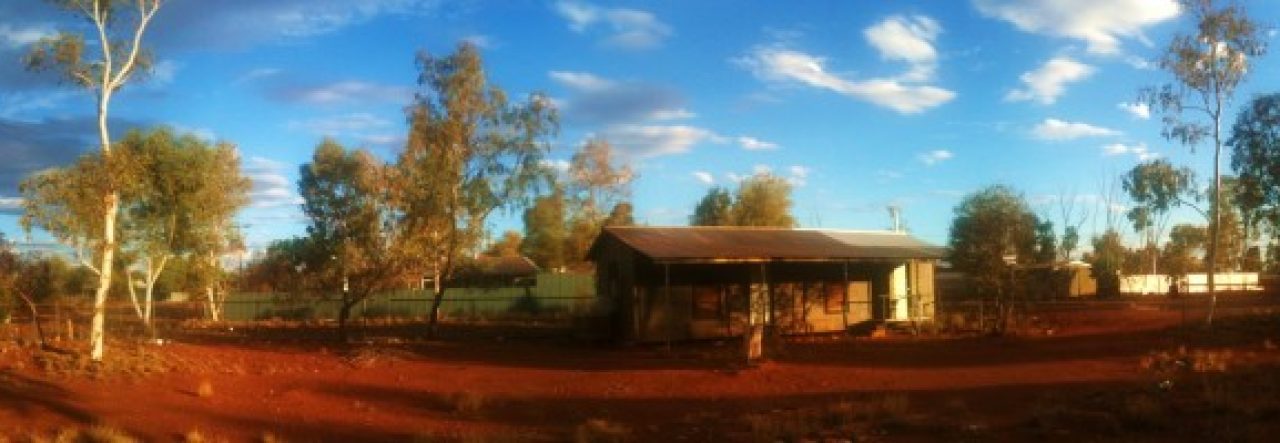
One year ago I celebrated Easter in the crisp of dawn on a remote community in the western reaches of Central Australia.  As we gathered in a bough shed to remember the power of resurrection; tiny, hopeful drops of rain fell through the pale gold of sunrise, and the wonderful voices of Aboriginal women sang Ngaanyatjarra songs of faith and grace.

During Easter week I had spent several evenings with a good friend; a gifted raconteur, a man of humour and wisdom, and a leader in the aboriginal community and church.  As on other occasions, I listened in rapt attention to tales curious and profound; my friend’s wife always by his side to prompt him gently back to the middle ground when the tales grew too curious or too profound!  Each night’s rich discussion would conclude with reading and prayer.  On one evening he shared the tale of Paddy Holland, an aboriginal man I had known in the early ‘80s when I was living and working on this same outback community.  I was in my late teens and Paddy was one of our regular customers in the Community Store.  He was a character, to say the least; a wily, larrikin sort of bloke.  I always felt there might have been some serious steel beneath the glint in his gradually ageing eyes; that his joking ways may have had a sterner edge in years gone by.  The story held that Paddy had been arrested long ago for an unknown offence; major, trifling or imagined.  Paddy was shackled in neck irons, and forced by a mounted Police Constable and his Black Tracker to walk several hundred miles to holding cells and magistrates in the mining towns down south.

This was a long, long time ago; and between my friend’s recounting and a little reading I have pieced together a glimpse of the horrors of a forced march through the Great Victoria Desert.  Constables were paid a very basic salary, supplemented by a living allowance from which prisoners were fed.  For the constable there was an obvious advantage in chaining together as many captives as he could, maybe a dozen or more, as there was a handsome profit to be made from the allowance that was paid per head.  And once he bagged his dozen he stood to capitalise further still by taking his time on the return journey.  If he took a detour, wandered around the sand country for a month or two while his investment matured, nobody would any be the wiser … if those in authority actually cared in the first place. 

My friend is wonderfully animated, but this tragedy was nearly beyond his scope.  He mimicked the constable on horseback; parodied the strange-tongued black tracker; and pulled exaggerated and hopeless grimaces to introduce each of the aboriginal prisoners. Tears began to course freely down his dark and lined face and his eyes grew impossibly wide in horror.  He seemed to be walking once again in irons with his people. 

It was not, you see, in the constable’s best interest to let his captives catch bush tucker.  These lean and wiry folk lived well on goanna, witchetty grub, and the odd kangaroo when times were good.  But the cheapest and safest solution for the constable was sugary black tea and damper, week in and week out.  Stomachs finely tuned to the feast and famine of nomadic life soon protested the white man’s muck; and chronic diarrhoea became a permanent link in the chain gang.   Tribal Aboriginal people were unembarrassed by nakedness, but like people the world over were discreet with life’s functions.  My friend portrayed this scene in a manner I will never forget, and can never repeat.  Men and women chained together night and day, forced into degradation that breached and annihilated the last scrap of dignity.  The notion beggars description, and I find it horrendously confronting to think that all this happened to a man whom I had known.

Pain is the most subjective of experiences.  A minor ailment can sometimes be as difficult to manage as a major one, but my own sense is that illness, disability, material loss, and physical pain – trying though they are – come nowhere near the soul-crushing agony of suffering at the hand of a fellow human being.  Although I have felt little of it in my own life, of this I am sure:  be it hatred, injustice or simple indifference, man’s inhumanity to man is the chief among torments. 

The beauty of this story comes years later, and is embodied in its teller.  My friend was speaking of his own uncle, and his sense of injustice and outrage were absolutely real.  Yet he bears no animosity whatever against the white-man perpetrators of this crime.  He forgives them, because he knows that he too is a forgiven man.  He told me this truth with tears in his eyes and a hand raised to heaven.  This is grace.

I have been reading John’s Gospel over Easter.  In four days I have scarcely covered one chapter, running aground on verse 38 with Christ’s first words, “What do you want?”   Why would the One “who was with God, and who was God, and through whom all things were made” ask that?  I cannot begin to record the dreadful answers that simple question has dredged from the depths of my soul this weekend.  But there is one thing I do long for, the chief among gifts, and this is grace. 

Rejoice!

Dedicated to David; a man of wisdom, humour, faith and grace; who left this world today. 

____________________________________________________

(Footnote:  My own western mind has wondered about the dates and details of this story; and if you are reading this and share the privilege of having lived in the Western Desert you may wonder also.  I resisted the temptation to consult with people who could perhaps have shed historical light on the story; and I have simply told just as I heard).
The Androgynous Wheelchair

Autumn 2011 #7
 
The van from the wheelchair shop has come to Paradise, yet again.  I was unequivocal:

“Well, you can take that one straight back again mate.  It’s got a hole in it!”

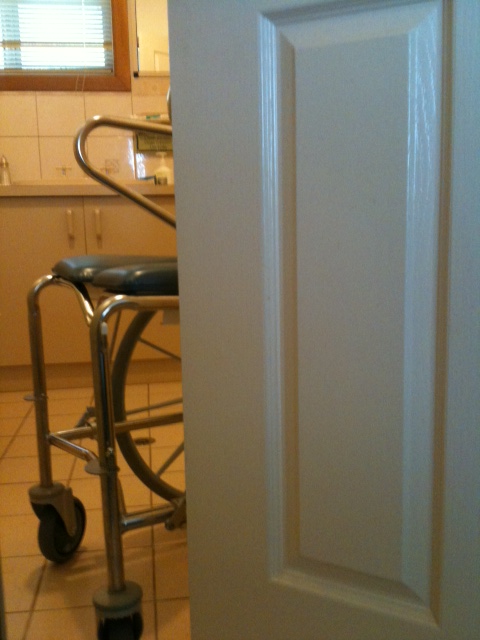
Poor B5, fifth incarnation of Good Old Bugger, is a chair like no other.  Cold and utilitarian, it is no vehicle of discovery, no machine to take pride in; in short, B5 is no B4!   Nine months ago I wrote with voyeuristic horror about a device I examined at Brooklyn’s Independent Living Centre: the Attendant Propelled Mobile Shower Commode Chair *.  Poor B5 at least has the distinction of being Self Propelled, but there its dignityends.  My favourite Wife informed me that Little One gave Poor B5 a thorough going over yesterday, paying perplexed attention to the carpet directly beneath the mysterious and highly inappropriate ‘hole’.
A rare glimpse of the coy and camera-shy Poor B5

A note on Gender. 
B4 – indeed the entire Bugger stableis of the fairer sex.  It’s immediately evident in the cut of her jib and the style of her footplate. She has the graceful lines of a skiff under sail. Poor B5, however, is another matter.  Male? Female? I honestly can’t tell!  ‘It’ has no personality at all, nothing to suggest either masculine stamina or feminine wile charm.  ‘It’ is all white plastic, shiny stainless steel, and pallid blue vinyl.  Awkward and anaemic, Poor B5 evokes a lingering sense of pity.  How terribly, terribly sad.  Who ever heard of an androgynous wheelchair? 

Why, I hear you ask, would I write about such things?  If you aren’t actually asking that question, I know I surely am!  Why would I want to exhibit this obnoxious contraption on the World Wide Web?  Well, for starters there is a certain macabre humour about a Commode that I find appealing, but difficult to justify.  Then I admit that there is hidden within me – and not at any great depth, let it be said – something of the nature of the attention seeker.  (I have long had a visceral anticipation for the moment during the flight safety demonstration when the life jacket adorned airline stewardess says “and a whistle to attract attention”.   When they wave that whistle around I so badly want to blow it!  Give me the whistle! Pleeease let me have the whistle!).  And I guess it’s part of the human condition to parade our problems now and then for everyone to see.  Especially for us blokes who make such miserable patients and thrive on sympathetic attention.  But those are not my reasons for this expose.

No, the simple explanation is that Poor B5 needs friends; people like you in fact!  Poor, reclusive B5 is a hermit; ‘it’ desperately needs to get out.  In a full week Poor B5 has not ventured out of the house once.  In fact ‘it’ rarely leaves one particular room; a dark, airless room at that.    After letting ‘it’ have a couple of days to settle into our home I was gunning for a trip to town; a coffee in the mall, or at the very least a run round park down the road. Do you think Poor B5 was interested?  Not for a second.  A firm rebuttal.  No go. 

A definition:   Occult; (adjct)
1. hidden from view.
2. secret; disclosed or communicated only to the initiated.
3. of or pertaining to secret and supernatural powers or agencies.

I am not – not for one second – suggesting that there is anything unseemly or evil about Poor B5.  But one must ask: just what is ‘it’ getting up to in there, locked away in secrecy for hours on end?

Privacy is no secret.  Privacy is a curious practice, given that we diligently hide from each other the very things that we share most fundamentally in common.  Secrecy, in contrast, involves hiding what others do not know.   Privacy is a false blind, and provides a tangible bond amongst members of the ‘normal’ world.  We are united by the unspoken knowledge of our private commonality.  And that, I think, actually explains my strange desire to tell the world about Poor B5, the Self Propelled Mobile Shower Commode Chair.  If everyone had one, then concealing ‘it’ from view (as we hurriedly did yesterday when visitors came by!) would simply be a matter of privacy.  But because a Commode is not part of the ‘normal’ person’s world, privacy quickly becomes secrecy. 

Secrecy I cannot abide.  If I tell the world it is a bid to belong to the world.  You know my secrets, therefore we aren’t all that different, and therefore I am not alone. 

KBO!

______________________________________________________________

*Attendant Propelled Mobile Shower Commode Chair (item 11:45:037), available in fetching surgical stainless steel and white plastic. This accessory makes a robust attack on most readings of the word ‘Independent’, and like so many of the devices on display, its design has a wordless power to chill the core of a man.  (Guiding Star, July 2010).

The King in Federation Square

Autumn 2011 #6

Bleak perhaps, but last week’s post was fact.  ‘Bums and belts’, however, was only one facet of our Melbourne weekend.  This, then, is the flip side, the head to last Sunday’s tail; the uppermost half of the brim-full glass:

A tiny Little Blue Man, barely two inches across, caught my attention amongst the flagstones of Federation Square where we were meeting my Godmother for lunch.  It’s worth stopping for a moment to note that this beloved friend and I have a long history of remarkable, coincidental adventure; Dumbstruck’ being the most astonishing.  The Little Blue Man held my puzzled gaze until eventually it dawned on me that there was another about two feet away, and another, and another; all marking a wandering trail up through the centre of the Square.  With my Favourite Wife and Godmother in tow, the hunt was on.  How could anyone resist a trail marked by such reliable friends as Little Blue Men?  Icons of access, harbingers of the privileged path*.

A two inch Little Blue Man

The terminus of our trail was a wheelchair lift; but more attractive to us was the restaurant next door.  Perfect!  We were shown to one table, but there was another, further in, against a dramatic glass wall.   We settled in, Bugger and all, we ordered, the food was superb, and the view utterly absorbing.  In the near distance the Yarra River; beneath us through the glass wall the timber-lined elegance of the Edge Auditorium; at its heart a grand piano, and at its keys a piano tuner engrossed in his trade.  Perfect indeed!  We sat enthralled in a sensory feast of good company, fine food and the intriguing drama unfolding below.  Seats were being set and a growing number of black-clad minions with the insignia ‘VO’ were scurrying to and fro.

As we ordered dessert, and then coffee, and then more coffee, just to keep a stake on our table, the excitement was building downstairs. Through the glass wall we saw a well known face, that of Richard Gill, conductor of the Victorian Opera!  Then through the glass wall we saw another well known face, that of my cousin!  Crikey!  A flurry of excited hand waving and urgent SMSing conveyed an invitation to come downstairs.  And that is how we came to join in a rehearsal, and later that night to sing in a massed choir with soloists from the Victorian Opera.  Crikey indeed!

"Sing Your Own Opera", BMW Edge Auditorium.

Well, advocates of the Chaos Theory propound something called the ‘sensitive dependence on initial conditions’.  Hence the Butterfly Effect, where the tiny beat of a butterfly’s wing in Brazil creates – or cancels – a tornado in Texas.  And when life seems to turn for better or worse on a moment of chance, one can wonder if chaos is king.  But there was nothing chaotic in our day!  It was perfect; rich with unexpected adventure, exhilarating friendship, good food, music, laughter and life!  I much prefer the Congruence Theory, believing that even a Little Blue Man points to destiny.

 As for the King in Federation Square … well, who could have organised all that?  You be the judge.  

Rejoice!

___________________________________________________________

*More on the wonders of Little Blue Men.

The Queen of Flinders Street Station

Autumn 2011 #5

It’s late, very late.  Our train is clattering north again, and soon we will be back once more in Paradise, our home in the hills.  Soon Little One will be with us again; and we will celebrate a “Welcome Home” in our traditional style to end her respite days. 

I had hoped to write an eloquent tale tonight.  I hoped to paint a picture of a rose-red face, round as a dinner plate, startling me out of the hypnotic concentration of weaving Bugger through Melbourne’s crowded streets.  “Would you like a nice hot cup of Milo love? Or tea? It’s free!” 

I’ve tried tonight to write about the vacant, distant stare of a thousand faces on a city street. Those lifeless eyes, unable or unwilling to engage with just one soul amongst the countless of hoard.  And I wanted to show you what I see these days: not vacant eyes, but bums and belt buckles: a sight far worse!  I hoped to find a way to capture our Friday night wander along the banks of the Yarra, when a miasma of self-pity took hold; when the stigma of difference, the awkward isolation of a wheelchair, bit more keenly than ever.  (Wouldn’t you have thought that I’d be over that by now?)  I was hoping, too, to find words to describe a quite irrational fear of meeting with family and our closest friends without a voice, or at least not much of one.  How strange that crowds of utter strangers should be the cause of such unsettling thoughts. 

“Well deary, will you have one? It’s free!”  For a moment we were eye to eye, I was shocked to see a human face at last.  Perched on a wheelie-walker, the red-round visage belonged to a Queen – of sorts.  The matriarch of Flinders Street Station, enthroned with aplomb, hailing her passing public with authority and verve that her pedestrian subjects could not match.  She alone dared to challenge the indifference of the masses, inviting them to her table: a curbside food van that was most likely nothing to do with her at all.  But the moment passed and I rolled on.  I had no voice to say to her, “Thanks, but not this time”.  I could have held her hand perhaps, and looked her in the eye.  We could have met at least, but we did not.   

I wanted to tell you how she changed my frame of mind, the Queen of Flinders Street Station, how I saw in her once more the simple fact that I am not alone.  That nothing really cuts us off from one another, that people, all of us, are mostly much the same. 

This is the story I wanted to tell, but it’s just so late, and it won’t quite write!

So this will have to do.